






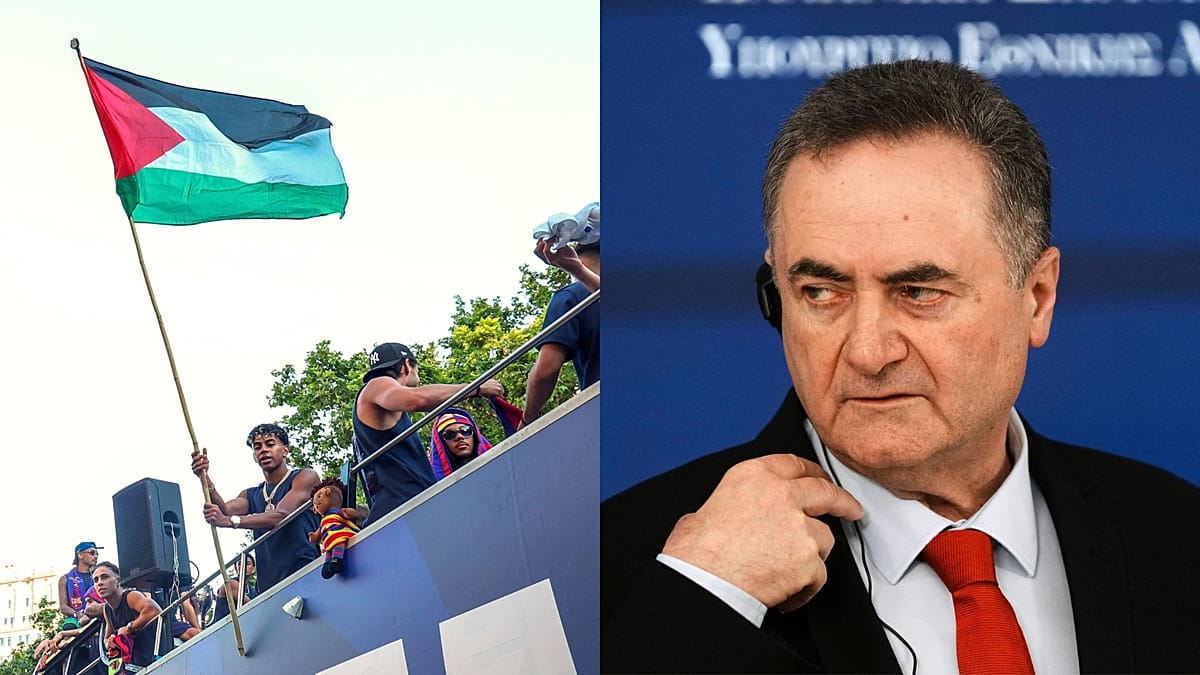
Spanish football club FC Barcelona have declined to provide comment on accusations made by the Israeli defence minister towards its star player Lamine Yamal of “inciting hatred” against the country after he waved a Palestinian flag at a victory parade.
ADVERTISEMENT


ADVERTISEMENT
Katz said the player’s gesture, made during Barcelona’s recent La Liga title celebrations, amounted to “inciting hatred towards Israel and the Jewish people”, adding that anyone who supports actions like Yamal’s should “ask themselves: is this humanitarian? Is this moral?”
Israel’s defence minister also said that Yamal chose to do it “while Israeli soldiers were fighting the terrorist organisation Hamas, which massacred, raped, burned and murdered children, women and Jewish elders on 7 October.”
Katz went on to call on Barcelona — Yamal’s club since the age of seven — to “make it clear that there is no place for incitement or support for terrorism.”
Euronews also contacted former Barcelona president Joan Gaspart and the Royal Spanish Football Federation, which governs football in Spain and oversees the Spanish national team, of which Lamine Yamal is a member.
Gaspart, who led the club from 2000 to 2003 after serving as vice-president for 22 years, said the Israeli defence minister can say “whatever he wants” and that he “respects his opinion”. Asked what he made of FC Barcelona declining to comment on the attacks against Yamal, he said: “If the club has said that, there’s nothing else for me to add.”
He also suggested that the majority of the club’s 150,000 members — who effectively co-owners of the club and elect its leadership — would agree with Barcelona’s decision not to comment on the issue. “Ask them,” he said.
On Yamal waving a Palestinian flag, he argued that “Barcelona must focus on football”, but that everyone can “defend their ideas on a personal level”. However, he added that “when you are at Barcelona, you need to try to keep your personal views to yourself. I never expressed my personal opinion when I was president.”
On the reaction of Spanish Prime Minister Pedro Sánchez to Katz’s comments about Yamal, in which Sánchez defended the player, Gaspart said he did not want to comment: “He is not a Barcelona supporter, so I am not going to assess what he said.”
Spain’s football governing body also declined to comment on the matter, arguing that Lamine Yamal is only considered a player of the Spanish national team while participating in its own camp rather than Barcelona’s.
Yamal, who is considered one of the Spanish national team’s best players, was included this week in the preliminary squad for the 2026 FIFA World Cup. He is also expected to be named in the final squad, despite an injury that has kept him out of Barcelona’s team in recent weeks.
Praise and backlash
The 18-year-old Yamal, a son of a Guinean-Ecuadorian mother and a Moroccan father, has previously been vocal about social issues.
A Muslim himself, he previously condemned Spanish fans who chanted hateful songs against Muslims during a friendly match with Egypt as “ignorant” and “racist”. He has not publicly expressed support for Hamas or the 7 October terrorist attacks.
His recent move to wave a Palestinian flag has drawn both praise and criticism. In Gaza, a mural depicting the Barcelona star waving the Palestinian flag has been painted on a wall by local artists.
In Spain, prominent politicians such as Catalan nationalist Gabriel Rufián have publicly shown support. “Maybe some people have moved from indifference to condemning the genocide in Gaza simply because he waved that flag,” he argued.
Others, such as Elías Bendodo from Spain’s main opposition party Partido Popular, said that “sport must not be mixed with other issues”.
Yamal’s coach at Barcelona struck a similar tone when asked. “I usually don’t like these things,” Hansi Flick said during a press conference on Tuesday. “But he’s old enough, so he should make his own decisions.”
Speaking to Euronews, Joan Gaspart praised Flick: “I fully agree with him. Lamine is young and a great player and should listen to him.”
Some Catalan media have criticised Flick’s comments, however. On Catalunya Radio, commentators said the German coach should not make Yamal’s freedom of expression conditional. And online, many fans spoke out against Hansi Flick, arguing that his views on Yamal’s actions are influenced by his agent, Pini Zahavi, an Israeli citizen. There is currently no evidence to support that claim.
The row has revived debate over the role of political expression in sport, particularly with the World Cup — jointly hosted by the United States, Canada and Mexico — less than a month away.
For Barcelona, this is not the first time football and politics have intersected. In 2017, days before the Catalan independence referendum, which had been deemed illegal, the club published an official statement saying it had “always defended the country’s (Catalonia), democracy, freedom of expression, and the right to self-determination”.
Will politics feature in the FIFA World Cup (again)?
Amid growing geopolitical tensions and the war on Iran launched by the US and Israel, politics has already played a role in discussions surrounding the upcoming 2026 FIFA World Cup. For example, with the US set to co-host the tournament alongside Canada and Mexico, Iran at one point claimed it would not take part before later retracting the statement.
At one point, a US government official even suggested FIFA should allow Italy to play in the World Cup instead of Iran. Italy had failed to qualify after losing a play-off against Bosnia and Herzegovina. The last time its national team played at a World Cup was in 2014.
FIFA rules do give the world football’s governing body “sole discretion” to decide what happens if a team is withdrawn or excluded from a FIFA competition. Article 6 of its World Cup rulebook also allows the organisation to replace one team with another.
However, shortly after reports emerged that Trump’s Special Envoy Paolo Zampolli had requested FIFA replace Iran with Italy, it was reported that no such plan had been put forward.
The current situation is reminiscent of the 2022 World Cup in Qatar, where politics also featured prominently. That year, FIFA prohibited several team captains from wearing armbands supporting LGBTQ+ inclusion as part of the “OneLove” campaign launched by the Royal Dutch Football Association.
FIFA warned that players wearing the armband risked receiving a yellow card, and the initiative was ultimately abandoned during the tournament.
FIFA regulations state that team equipment must not contain “political, religious, or personal slogans”. The tournament stadium code also prohibited banners, flags and flyers of a “political, offensive and/or discriminatory nature”.
The enforcement of these rules during the tournament in Qatar prompted heated debate over consistency, with some arguing that different forms of political expression were treated unevenly.
Read the full article here