









Over the past week, Ukraine has received a stark reminder of its growing dependence on uninterrupted access to Elon Musk’s Starlink and Starshield networks in its drone-heavy war against Russia, now in its fifth year.
Ukraine has a fraction of Russia’s resources, but its aggressive development of drone warfare on defensive and offensive fronts has helped it endure an onslaught from its much bigger adversary, which invaded Ukraine in early 2022. That was true until last week, when Ukraine reported a throttling of the Starshield network that was causing its drones to stop midflight and fall out of the sky.
The two SpaceX networks operate on a constellation of thousands of low-Earth satellites — Starlink is the commercial version, while Starshield is a military product licensed to the U.S. government and its partners, among them Ukraine.
Kyiv’s reliance on drones has made Starlink and Starshield nearly indispensable to its arsenal. When Ukraine experienced a disruption to those networks, it lost the shield of interceptors and drones that offered some protection against Russian drone and missile strikes.
Ukrainian President Volodymyr Zelenskyy believes Musk throttled Starshield at the request of U.S. officials, though the world’s richest man has denied any role and said it’s the U.S. government that controls the military-grade network. President Trump has also denied he’s responsible for slowing the network. However, CBS News reported Tuesday that Musk was behind the disruption, though a number of questions remain unanswered.
There has also been conflicting information about whether full access to the networks has been restored. As of Wednesday afternoon, Starlink remained throttled, Zelenskyy’s office confirmed.
Here’s what’s known about Starshield and Starlink — and their role in the Ukraine war.
What happened in Ukraine?
On Oct. 13, Ukraine’s military began experiencing sudden difficulties with Starshield equipment, making it more difficult to carry out missions with fast-moving drones, officials and soldiers told CBS News.
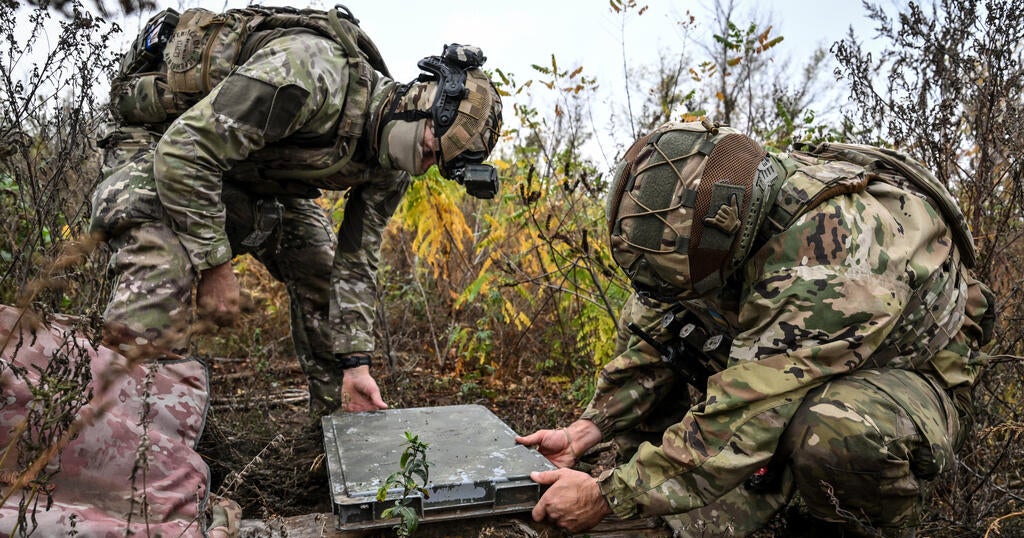
Ukrainian soldiers said they noticed “speed limits” had been imposed on their use of SpaceX’s Starshield internet dishes, the military-grade Starlink dishes that Ukrainians strap onto their drones so remote pilots can maintain their connection with the unmanned aircraft as they fly toward Russian targets.
Access was restricted by turning off dishes on Ukrainian drones flying above a certain speed, causing them to fall out of the sky. Ukraine’s Ministry of Defense sources said SpaceX had unilaterally imposed the Starshield restrictions without informing them beforehand.
Zelenskyy said Saturday the speed limits had prevented Ukraine from using Starshield to shoot down Russian Shahed attack drones.
What are Starshield and Starlink?
Starshield, the military-grade satellite network, runs on the same constellation of satellites as its civilian sister, Starlink, but has fewer technical limitations and more advanced security features. Both are operated by Musk’s company SpaceX.
The U.S. government pays SpaceX to license the use of Starshield and controls who can access the technology. Its use has been limited to Ukraine and occupied territories. It is not available in Russia.
There is no working alternative to Starlink, as no direct competitor approaches Starlink’s coverage of 11,150 satellites. Amazon Leo aims to compete, but at this point, it has under 400 satellites in low Earth orbit and has been hampered by the launchpad explosion of a Blue Origin rocket in May.
Regular Starlink terminals have a 70 km/hr (43.5 mph) speed cap, which is the speed at which internet can be used in a vehicle in motion. At rates exceeding the cap, the internet degrades and is no longer usable.
Starshield has no artificial speed cap and is known to work at speeds of at least 160 km/hr (99.4 mph). Starshield-equipped strike drones cruise at 160 km/h or more, and they’re the backbone of Ukrainian mid-range strikes.
During the throttling over the last week, Ukrainian units reported link drops at speeds as low as 90 km/hr (55.9 mph), making those drones inoperable. The degradation of Starshield is estimated to have cost Ukraine tens of millions of dollars in losses, according to an analysis by Dimko Zhluktenko, a drone pilot and analyst in the Armed Forces of Ukraine.
On Oct. 15, some Ukrainian officials said that the Starshield restrictions had been lifted. But Zelenskyy told NBC News on Sunday the maximum speed was still 161 km/hr.
Zelenskyy told Fox News on Wednesday that the service was “still limited,” but he added that Secretary of State Marco Rubio told him he would “work with his team on this to unblock” it.
Is Ukraine using Starshield or Starlink?
It uses both. Starlink has been providing internet service to Ukrainian civilians and military forces since 2022, when Russia invaded Ukraine, according to Reuters.
Initially funded by private donors and a U.S. foreign aid contract, SpaceX won a Pentagon contract to pay for Starlink for Ukraine in 2023, along with a contract for 500 Starshield terminals.
In August 2024, SpaceX signed another Defense Department contract to expand Starshield usage to 3,000 terminals for the front lines, Bloomberg reported.
Beyond communicating with and guiding drones over long distances, Starshield also serves another function: It connects every sensor and weapon system on the battlefield. Disruptions to the service have an impact that can be compared to an office having to function without being able to connect to Wi-Fi.
Ukraine’s military uses Starlink for general battlefield communications, and Ukrainian civilians rely on it for communications needs, too.
On the Russian side, the Kremlin had also been using Starlink until February, when SpaceX cut off its access. As a result, Ukraine gained more than 150 square miles of territory.
Musk and throttling Ukraine’s access to Starshield
CBS News reported Tuesday that a decision by Musk led to restrictions on Ukraine’s use of SpaceX’s satellite communications network, though it remains unclear how Musk’s order to curtail service was executed.
Musk had spoken with administration officials multiple times, seeking clarity on the president’s thinking on the matter. He has in the past expressed distaste for the perception that his company could be seen as profiting from the Ukraine war.
The temporary restrictions came as a surprise to some Trump administration officials, who said neither Mr. Trump nor the Pentagon had specifically ordered any limits meant to deliberately disrupt drone operations and battlefield communications.
The president said Monday he was seeking information about who had ordered the slowdown. Defense Secretary Pete Hegseth on Tuesday denied the Pentagon had manipulated the service, saying, “We haven’t made any directives or anything like that.”
Can Elon Musk stop the use of Starlink and Starshield?
Musk has not admitted to imposing restrictions on Ukraine’s use of Starshield.
“Any limits on speed or usage are decided by the US military and ultimately POTUS,” the world’s richest person wrote on X.
He added that Starlink is a “commercial service,” writing that it is “limited to civilian or defensive activities and cannot be used for offensive military action.”
Rubio, however, seemed to attribute the network constraints to Musk.
“The president has nothing to do with the decisions that are made by Starlink and Starshield and by Mr. Musk,” Rubio told reporters in Mumbai on Wednesday.
Within a few minutes, though, he seemed to concede that Starshield was different: “We don’t control what a private company — how they decide their product can be used. Now, if they’re in a contract with the United States military, like Starshield, that’s a different matter, because that’s something we are purchasing and using for our use.”
Intelligence-sharing
At around the same time as the Starlink and Starshield disruptions, Ukraine also did not receive warnings from U.S. intelligence about major Russian strikes.
Ukraine relies on a mixture of American sensors, aircraft, surveillance and human intelligence to map Russian positions and launch sites.
The early warning system, which is distinct from the SpaceX products, notifies Ukraine when Russia has launched a ballistic missile in its direction. It failed in at least two instances, on Oct. 13 and Oct. 18.
On Oct. 13, Zelenskyy said Ukraine “received no advance warning” when Russia launched a ballistic missile barrage. That overnight attack targeted energy and critical infrastructure in Kyiv and Kharkiv, killing six people and leaving some 600,000 without power.
Ukrainian sources said U.S. officials said the warning system had failed due to “bad weather.” Ukrainian officials expressed doubt about that explanation and accused the U.S. of “playing” with the system. By 3 a.m., that system seemed to have been restored.
Then on Monday, Zelenskyy said Ukraine had been hit by another wave of Russian missile and drone strikes, “and again, there was no warning from partners.”
A senior Pentagon official told CBS News Monday there had been “no change to Department of War policy regarding intelligence sharing or any capabilities we are enabling Europeans to provide to Ukraine.”
By Wednesday, however, the warning system appeared to have been restored: “Now intelligence works. Thank you so much. That was crucial for us,” Zelenskyy said on Fox News.
Rising pressure to end the war
Deliveries of key Patriot interceptor missiles to Ukraine have also slowed, Ukraine has said.
Rubio on Tuesday called interceptors the “most in-demand product right now in the defense field,” and said that “when a country doesn’t get interceptors from the United States, it’s not because we’re denying. We have our own needs, too.”
“There’s nothing being deliberately denied to Ukraine,” he said. “It’s simply a balance between our obligations.”
Mr. Trump has grown impatient with the more than four-year-long war. He has sought to portray the ongoing Ukraine war as the reason for high energy prices and has vented his frustration with Zelenskyy more frequently in recent weeks, accusing him of not doing enough to end it.
He waived restrictions on buying Russian diesel earlier this month in an effort to ease pressure on the price of the commodity, a move Zelenskyy argued could embolden Russian President Vladimir Putin. And Mr. Trump also waived sanctions on Russia last week.
Mr. Trump said earlier this month that Ukraine and Russia had agreed to stop striking each other’s energy infrastructure — announcing an “energy ceasefire.” Zelenskyy initially said Ukraine was willing to abide by such an agreement, but that Russia’s strikes never ceased, and several days later he told the Financial Times his country would no longer hold off on striking Russian refineries because Russia was still attacking Ukrainian energy infrastructure.
The Russian government never confirmed that it had agreed to a ceasefire.
Mr. Trump told reporters Tuesday that Russia keeps “grinding away” and is more capable of sustaining casualties than Ukraine, arguing “it’s time” for Zelenskyy to make a deal.