
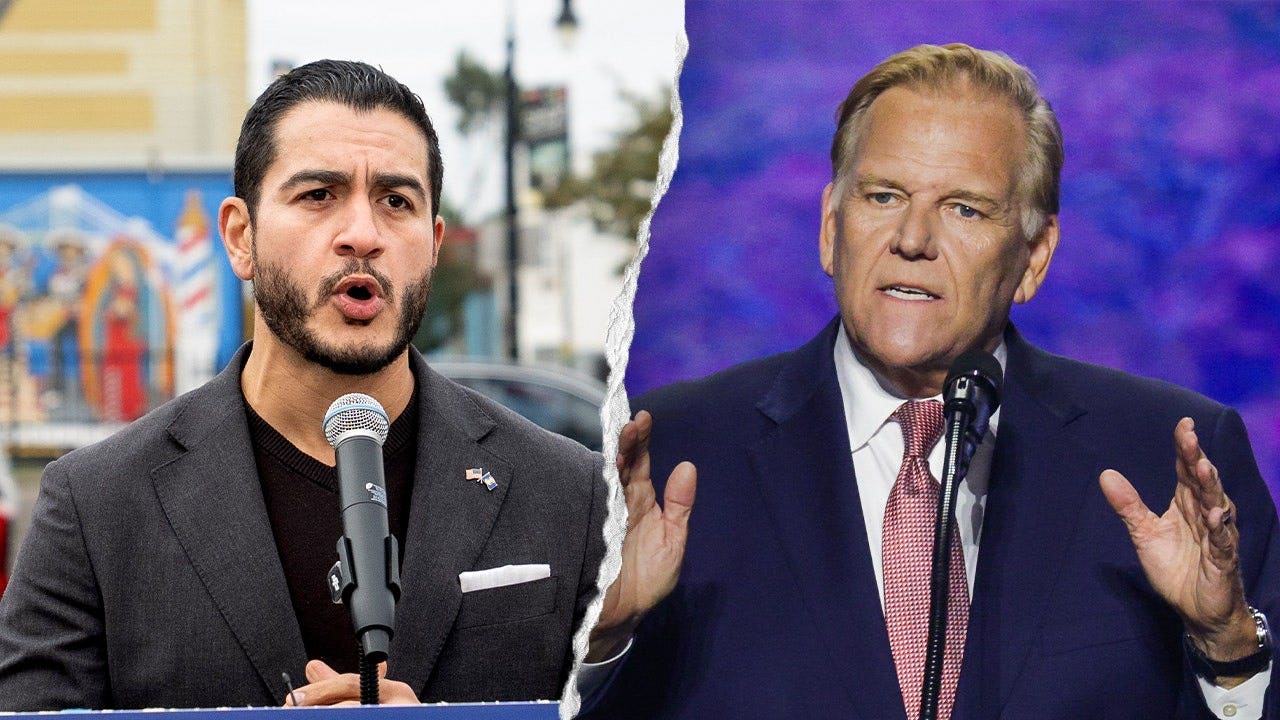








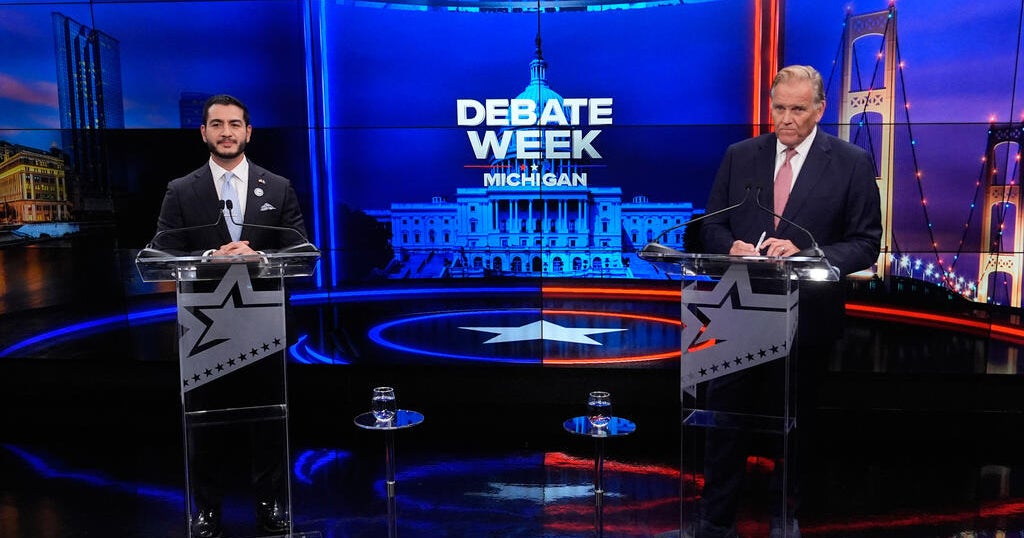
In Thursday’s Michigan Senate debate, Democrat Abdul El-Sayed called his opponent “weak,” “cowardly” and a “sock puppet for the Trump administration.” Republican Mike Rogers called his opponent a “glitchy AI chatbot” who is running a “con” and will “say anything to win.”
The two candidates in one of the country’s most closely watched midterm contests spent the hourlong debate sparring over the Iran war, the trade war with Canada, immigration, healthcare policy and cost-of-living issues. They also tossed insults across the stage in nearly every exchange, accusing each other of flip-flopping and financial entanglements.
After the only commercial break, debate moderator Rick Albin of WOOD-TV in Grand Rapids said the two men were arguing even when they were off-air. At various points, Albin pleaded with the candidates to “work with me” and said: “I appreciate your passion, but please, let’s try to keep this orderly.”
El-Sayed secured the Democratic nomination after a bitter primary in which the former health official clashed with the party’s moderate wing over his support for single-payer healthcare and his opposition to U.S. military aid for Israel. A former congressman, Rogers won the GOP nomination with little competition after an endorsement from President Trump, whose rocky approval ratings have posed a vulnerability for his party’s midterm candidates.
Most polls show a razor-thin race between the two candidates, who are competing to replace retiring Democratic Sen. Gary Peters. The race could be pivotal in determining which party wins control of the Senate.
During the debate, both candidates called for pausing the gas tax as the conflict in the Middle East keeps energy prices high, and questioned the tit-for-tat tariff war with Canada.
On the Iran war, Rogers said “this would be the time to wrap it up.” He also argued “we need to end” the trade dispute with Canada by striking a deal with the U.S.’ northern neighbor, saying he spoke with Commerce Secretary Howard Lutnick “about getting the deal done.”
But El-Sayed pushed Rogers on the Trump administration’s trade and Iran policies, accusing him of running at the president’s behest and being unwilling to stand up to Mr. Trump.
“He’s got a direct line to the president who’s making sure the war does not end, and he’s not using it,” El-Sayed said of the Iran conflict, which he called a “stupid war.”
Asked if the Trump administration’s crackdown on illegal immigration has gone too far, Rogers said the intense operations in Minnesota earlier this year were “probably not appropriate.”
“They made that correction. They made an adjustment,” Rogers said, before arguing agents are “targeting murderers and rapists who were here illegally doing bad things.”
El-Sayed — who has called for Immigration and Customs Enforcement to be abolished — was asked whether an undocumented immigrant who committed a violent crime should be deported. He answered: “Yes, but you don’t have to do that by violating the whole Constitution.”
Meanwhile, Rogers attacked El-Sayed over his support for Medicare For All, calling his views on healthcare “dangerous” and arguing it would involve “taking over your private health insurance and giving it to the government.” When El-Sayed said that “if families want to keep their private health insurance, that’s fine by me,” Rogers interjected: “That is absolutely news to me.”
Foreign policy animated much of the debate. El-Sayed frequently criticized the Iran war and cast Rogers as a hawk who “thinks there’s a war for everything.” El-Sayed said he supports a diplomatic solution on Iran, pointing to the Obama-era deal that limited Iran’s uranium enrichment, an agreement that Mr. Trump ended during his first term.
Rogers said he believes the war can end now because Iran’s nuclear program and conventional military have been severely degraded.
El-Sayed is a vehement critic of the Israeli government over its conduct during its war against Hamas in the Gaza Strip, and opposes U.S. military assistance to Israel. Asked by the moderator whether he views Iran or Israel as a bigger threat, El-Sayed called it a “ridiculous hypothetical,” arguing Israel spurred the U.S. to enter the war with Iran and saying “both of them have proven dangerous in their own way.”
Rogers described himself as a staunch backer of Israel. Asked if there is anything Israel could do to cause him to lose support, he said: “If they were talking about using nuclear weapons, they would definitely lose my support. I’ve never heard them say that, though.”
Rogers pressed El-Sayed for not putting out a statement marking three years since Hamas’ deadly Oct. 7, 2023, terror attack on Israel, alleging that his opponent “could not bring himself to even acknowledge the pain, the terrorism, the rape, the murders.” El-Sayed said he has condemned the attack but “didn’t turn it into political theater like you just did.” He later told reporters after the debate that he felt whatever he had said about the terror attack would be scrutinized and politicized.
Both candidates pressed each other on campaign donations and questioned each other’s finances, with El-Sayed dinging Rogers over a waterfront home that he owns in Florida and Rogers bringing up El-Sayed’s wife’s rental property in the United Arab Emirates.
“At least Florida is in the United States,” Rogers said at one point, prompting El-Sayed to respond, “It’s not in Michigan, my guy.”