









Republicans undertook a historic effort to redraw several states’ Congressional districts mid-decade in an attempt to maintain control of the House. That effort was rebuffed on Tuesday night as the GOP was on track to lose all of the districts it tried to gerrymander.
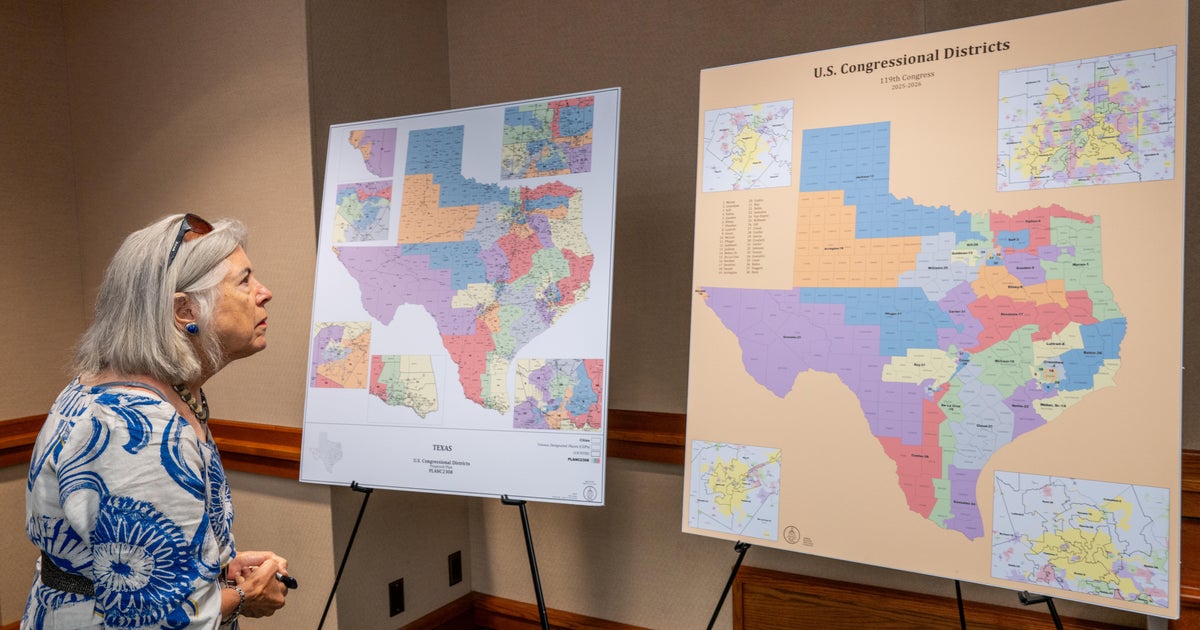
There were several reasons that states undertook what had previously been a rare practice of mid-decade redistricting. Republican efforts started when President Trump ordered Texas lawmakers to redraw their map to net up to five seats for the GOP.
But despite the all-out effort, Democrats won control of the House on Tuesday, with CBS News estimating Democrats could end up with 251 to 268 House seats.
With the House decisively swinging toward Democrats and Democrats undertaking measures in a few states to counter the GOP’s efforts, Republicans are faced with the possibility of having created a so-called “dummymander,” a situation in which a party tries to gerrymander, but ends up benefiting the other party.
Here’s a state-by-state breakdown of how the redistricting efforts panned out:
Texas
Texas Republicans went into Election Day controlling 24 seats, while Democrats controlled 13 seats and there was one seat in a GOP-leaning district that was vacant. In redrawing the map, Republicans sought to emphasize Mr. Trump’s gains in South Texas to win five more seats.
As of Wednesday, Republicans had won 24 seats and Democrats had won 14 seats, making Texas a dummymander.
Ohio
A commission comprised mainly of Republicans hand-picked by GOP lawmakers redrew Ohio’s map to net two more seats for their party. Republicans heavily targeted longtime Democratic Rep. Marcy Kaptur’s district in the northern part of the state and Rep. Greg Landsman’s Cincinnati-area district.
Heading into Tuesday night, Ohio Republicans controlled 10 seats and Democrats controlled five. Seven Democrats, including Kaptur and Landsman, won Tuesday night, and CBS News estimates another district is likely Democratic. Republicans have only won seven districts, making Ohio a dummymander.
North Carolina
Although North Carolina has a Democratic governor, Republican lawmakers have a veto-proof majority in the statehouse and pushed through a new map that attempted to oust Democratic Rep. Don Davis.
North Carolina Republicans controlled 10 House seats going into Election Day, while Democrats controlled four, including Davis’ district. As of Wednesday, four Democrats had won and CBS News estimated that another five were likely Democratic. Republicans had not yet won any races, with CBS News estimating one race was likely Republican and another four were toss-ups.
If Democrats ultimately win any of the undecided races, North Carolina will be a dummymander.
Louisiana
Louisiana lawmakers redrew their districts after the Supreme Court ruled in June that compliance with Section 2 of the Voting Rights Act could not justify the state’s use of race in redrawing its House district lines.
Louisiana went into Election Day with four House seats controlled by Republicans and two controlled by Democrats. The new map aimed to eliminate one of the majority Black districts that currently have Democratic representatives.
As of Wednesday, Republicans had won three districts, while Democrats had won one. CBS News estimates one district is a toss-up and the state’s 5th District will be going to a runoff. If Democrats win either of those districts, Louisiana will be a dummymander.
Alabama
After the same Supreme Court decision, Alabama Republicans sought to eliminate the state’s two majority Black districts, both of which are represented by Democrats. Both incumbents won reelection on Tuesday, so Republicans did not net any more than the five they already controlled, making Alabama a dummymander.
Tennessee
Tennessee lawmakers also redrew their map after that Supreme Court decision to target the lone Democratic district in Nashville.
Going into Election Day, Republicans had eight seats and Democrats had one. As of Wednesday, Republicans had won six seats and two races were set to go to a runoff, including the newly drawn 9th District in Nashville. If Democrats win one or both districts, Tennessee will be a dummymander.
Florida
Led by Florida’s Republican Gov. Ron DeSantis, GOP lawmakers redrew their map to net up to four more seats for their party.
Heading into Election Day, Republicans controlled 20 seats and Democrats controlled eight. As of Wednesday, Republicans had won 16 seats, Democrats had won seven and there were five districts that CBS News estimated were toss-ups. If Democrats win any of the toss-up races, Florida will be a dummymander.
Missouri
Missouri’s GOP-led legislature last year redrew their map to make one of the state’s two Democratic-held districts more friendly to Republicans. But the map’s legality was challenged, and a state court ruled the map could not be used unless it was approved by voters. The Supreme Court three times blocked Missouri from using the new map, leaving the 2022 congressional districts in place for Tuesday’s election.
Heading into Election Day, Republicans controlled six districts while Democrats held two. Democrats flipped another district, giving them three seats to the Republicans’ five.
Indiana
Mr. Trump had also pushed lawmakers in Indiana to pass a map that would edge out the state’s two Democratic lawmakers and make it a 9-0 Republican delegation. Despite pressure from Mr. Trump, the GOP-led state Senate rejected the new map.
Using the same boundaries as the last two cycles, Democrats held onto their two seats and flipped a third, making the state’s representation 6-3.
South Carolina
South Carolina Republicans also sought to redraw their map after the Supreme Court decision in an effort to edge out powerful Democratic Rep. Jim Clyburn and make the state’s representation 7-0 for Republicans. But the measure failed in the state Senate, and Clyburn won reelection on Tuesday. Two other races are considered toss-ups.
California
In response to Texas’ redistricting efforts, California’s Democratic Gov. Gavin Newsom put forth a ballot measure to redraw the map to gain five seats for Democrats, which was decisively approved by voters.
Heading into Election Day, Democrats held 43 districts and Republicans held nine. As of Wednesday, Democrats won in 42 districts, while CBS News estimates another six are likely Democratic. Republicans have won two districts and another two are likely Republican.
Since Democrats picked up seats in California, it is a successful gerrymander for Democrats.
Utah
A judge in 2025 rejected Utah’s congressional map that favored Republicans in all four districts, and then a district court rejected the redistricting map selected by the GOP-controlled legislature and instead selected a map that would create a Democratic-leaning congressional district in Salt Lake City.
Under the new map, Democrat Ben McAdams won the 1st District in Salt Lake City by 47 points.
Virginia
Virginia voters decisively approved a ballot measure in April to redraw the congressional map to favor Democrats in 10 districts and Republicans in one. But the map was thrown out by the Virginia Supreme Court, putting back in place the map drawn in 2021.
Heading into Tuesday, Democrats held six seats while Republicans held five. Using the same boundaries as the past two cycles, Democrats won seven seats, Republicans won two and two are considered toss-ups.
Maryland
Maryland’s state constitution requires that congressional districts be compact and connected, and Democratic Gov. Wes Moore and other Democratic lawmakers championed a ballot initiative to remove those restraints on redistricting.
The ballot initiative, known as Question 3, passed by 20 points on Tuesday, so Democrats are likely to redraw their map now to edge out their sole GOP representative.