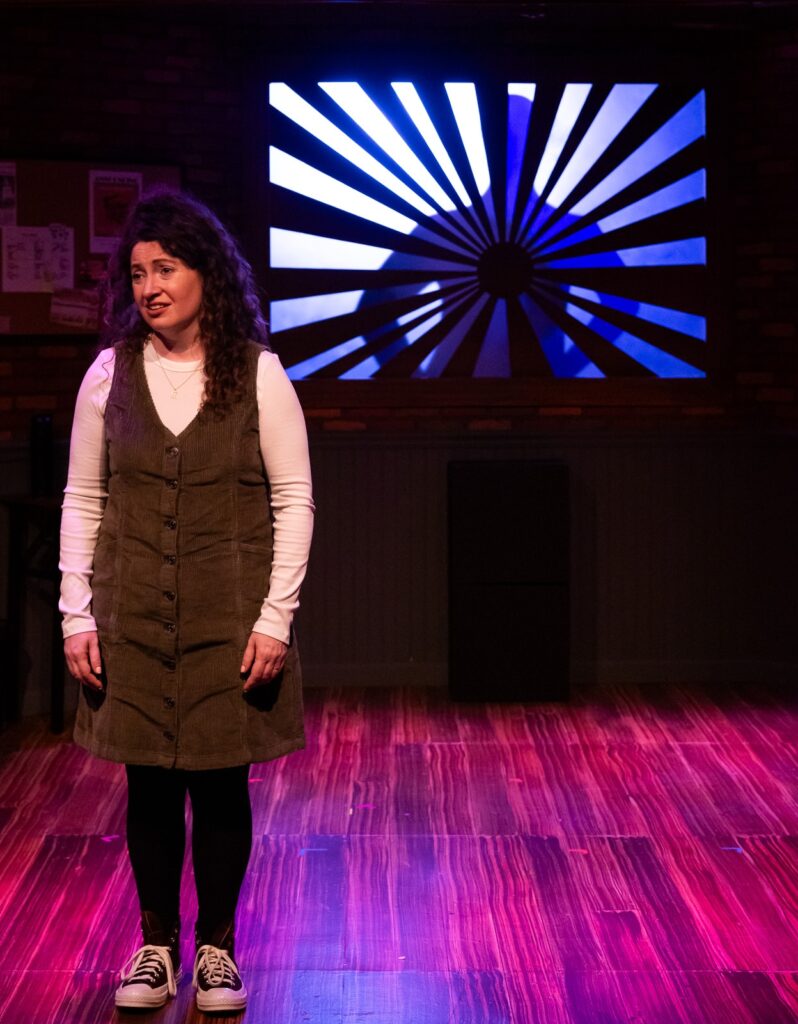









Playwright and actress Joanna Castle Miller in last season’s Inferna
By Bill Hirschman
Several playwrights have written trilogies featuring the same characters, such as Richard Nelson whose We’ll See about the Apple family is on Broadway right now.
Few have seen them all produced at the same theater over a month—let alone playing all at once on one Sunday.
But Theatre Lab will produce all three of Joanna Castle Miller’s semi-autobiographical plays next month in her Bad Faith Trilogy—Inferna, Conversa and the newly-completed “part one” of the series, Virginia.
The first two bowed at the Boca Raton company last season, although Inferno has been rewritten.
All will have separate performances on separate days over those three weeks, but all three will be performed in a marathon on Dec. 20, with breaks between for the audience and the artists.
Castle Miller will again be the primary performer on the stage helmed by producing artistic director Matt Stabile, both involved in the complicated logistics of the undertaking.
The plays merge plentiful comedy with a dozen issues. One of the most intriguing is how Castle Miller’s mother wanted to become a rabbi in the Deep South. But through Jews for Jesus, she raised the girl in a Messianic Christian home—where her mother hosts Passover dinners for Christians. But as an adult, she discovered an evangelical Baptist upbringing failed to prepare her for dealing with the issues of sexual coercion and sexual abuse, especially of youngsters and young women.
At its core, the three plays have the same central narrator described as a healed playwright reflecting back on her journey.
As a whole now, Castle Miller said, “The ultimate question that I’m asking is about change and about what it takes for a person to change, what it takes for us to change our own minds, and what we owe each other in the process as we’re all sort of having to reckon with things from our pasts and things that we believe as we ask for a sort of grace and forgiveness for ourselves as we go through those changes.”
Stabile expanded: “There’s this really beautiful theme that moves through Virginia about black and white thinking versus the gray …That’s not talking politics at dinner. It’s just the stuff that we don’t talk about because it makes us uncomfortable… the most dangerous area and a place that our country is kind of in right now… In Conversa I keep calling it the coming home. Joanna said it’s a place where ‘Now we have taken the brave steps, we have gotten messy, now we know how to have these conversations in a way that is no longer threatening and feels more like I can be safe and have these conversations and I can feel at home and in place.’ ”
The arc may echo Castle Miller’s own life but, she said, “It’s a real priority///that the conversation be much broader than my specific experiences. My specific experiences are there just as a conversation starter. And ultimately, the point is to have a bigger conversation about other things.”
Staging all three virtually at the same time posed a score of challenges such as what you actually see with different costumes, lighting projections as well as tone, so that “people who come see all three are going to definitely be able to feel the sense of the journey, not only in just the storytelling but in the design,” Stabile said.
The evolution of the overall project was unexpected even by the artists.
Two days into penning Inferna, she was being dogged by two other ideas that she assumed were for other future works. But the ideas kept intruding as she wrote Inferna, although she said to herself, “You do not have to tell all three of these stories. I should probably talk about this thing that’s related to my dad, or I should talk about this thing that’s related to my mom.”
She realized they could be three related plays, even though at the time Inferna was a standalone piece.
Two years later, she began writing Conversa with the Jewish Plays Project.
“But I had always sort of assumed that it would take a pretty long time to get all of these plays produced simply because they are each standalone pieces on their own. I sort of saw the trajectory as being a few years of sort of work on each production separately.”
But while Theatre Lab was producing Conversa, Stabile suggested “What if we sped that up and performing them in rep which somehow had not ever crossed my mind,” she said.
For what Stabile has nicknamed a theatrical marathon race, the all-day starts with a pre-show at 11 a.m. with breakfast, then a noon curtain for Virginia, then a 90-minute refuel session to talk among the crowd with snacks, then back in for Inferno, then a dinner on your own break, then back at 6 p.m. for a reception, then on to Conversa, and then a finish line party.
While each play stands on its own, Stabile said, “Tracking them across all three is a vastly different experience because there (are) …callbacks to the other plays. There’s stuff that if you’ve seen Virginia by the time you see Inferno, there’s certain references when she starts talking about God that like you experience those references in a very different way.”
Read our previous reviews of the first two productions:
https://www.floridatheateronstage.com/reviews/theater-labs-inferna-traditional-indoctrination-doesnt-deal-with-sexual-abuse/
https://www.floridatheateronstage.com/reviews/religion-immigration-humor-intersect-in-conversa/
The Bad Faith Trilogy opens in previews Nov. 28, formally opening Dec. 5 and running through Dec. 20 at Theatre Lab, on Florida Atlantic University’s Boca Raton campus at 777 Glades Road. The company has been moved on campus to the Marleen Forkas Studio One Theatre which is downstairs and adjoining the main college auditorium up on the hill. Parking remains where it has been, but a regular parade of trams will take you to the theater if you do not want to walk. The times and dates and ticket prices are varied; check with https://www.fau.edu/artsandletters/departments/theatrelab/