
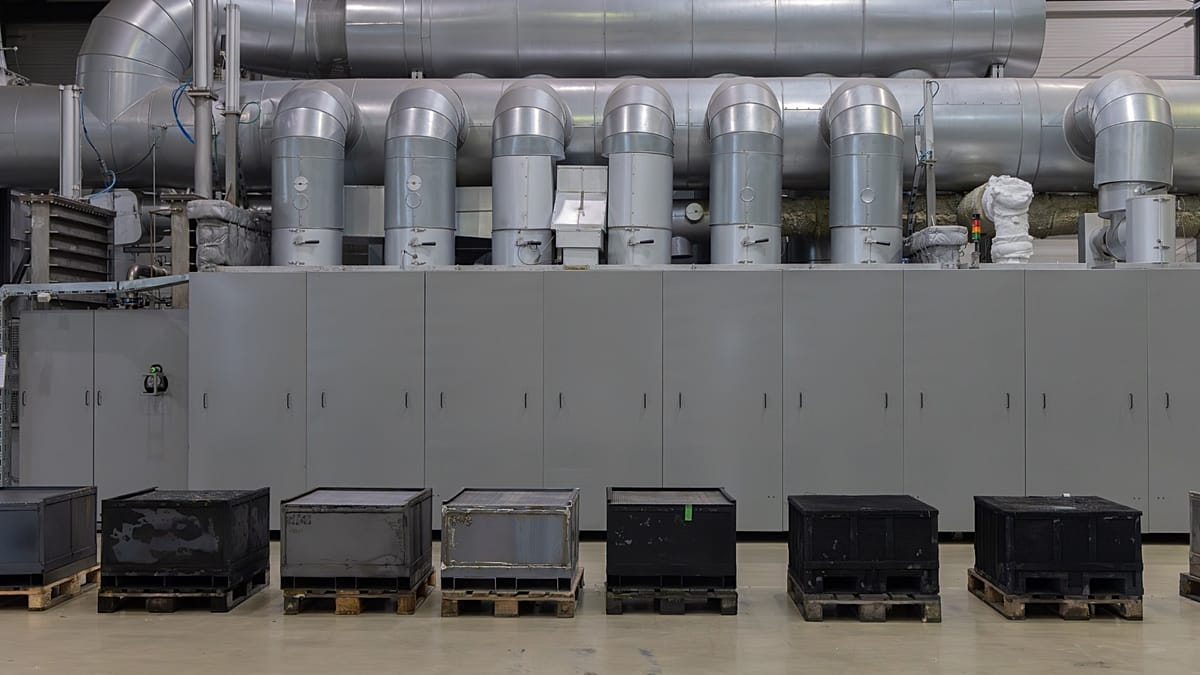









Inside a production facility in Krefeld, Germany, a family-owned recycling company is recovering lithium from used batteries without relying on aggressive chemicals.
ADVERTISEMENT


ADVERTISEMENT
The process was developed by Accurec Recycling GmbH, which has specialised in battery recycling for more than three decades.
Speaking to Euronews, the company’s head of development, Simon Bremer, explains how the technology works, why Europe has fallen behind in battery recycling and what needs to change in its critical raw materials policy.
From power-tool batteries to electric vehicles
Founded in 1995, Accurec has focused on battery recycling from the outset. Initially, the company specialised in nickel-cadmium and nickel-metal hydride batteries, older rechargeable technologies that have largely been superseded by lithium-ion batteries.
Over the past 15 years, lithium-ion technology has become increasingly widespread, powering everything from smartphones and cordless power tools to electric vehicles.
Accurec has spent around a decade developing its lithium-ion battery recycling operations at its Krefeld facility, where it currently processes approximately 5,000 tonnes of batteries annually.
The company employs around 85 people and operates a second recycling plant in Mülheim an der Ruhr.
According to Bremer, the new facility, which began operating in December 2025, can initially recover 50% of the lithium contained in the batteries it processes, meeting the recovery target set by EU legislation for 2027.
But the company is already aiming higher.
“We have been working on expanding the plant for about a month now. That means ramping up both capacity and yield so that in the first quarter of 2027 we will be able to recover 80 percent or more,” Bremer said.
The expansion is already underway. Accurec is investing €5.5 million to double the operating area of its Krefeld facility, with the aim of increasing annual processing capacity to as much as 20,000 tonnes of used batteries, four times its current volume.
Europe’s reliance on China for lithium
Lithium is a crucial component of rechargeable batteries, making it essential to the energy transition. It is used in electric vehicles and many energy storage systems that support wind and solar power.
However, Europe remains heavily dependent on China for processed lithium. According to Bremer, around 65% to 70% of battery-grade lithium chemicals currently come from Chinese production.
China has previously demonstrated its ability to restrict supplies of strategically important materials, including rare earths and germanium, highlighting the potential risks for European manufacturers.
Accurec hopes its new facility can help reduce that dependence. While the company does not claim its technology can solve Europe’s raw materials challenges on its own, it sees domestic battery recycling as an important step towards diversifying supply and keeping valuable materials within Europe rather than exporting them.
The science behind water-based lithium recovery
At the heart of Accurec’s recycling process, known internally as “CLIMA”, is a thermal pre-treatment that makes lithium soluble in water.
First, batteries are sorted and, in the case of larger units such as electric vehicle battery packs, dismantled. They then undergo pyrolysis, a process that uses high temperatures to break down organic components.
Crucially, this treatment also changes the chemical form of the lithium, allowing it to be extracted using water rather than aggressive chemicals.
“We convert the lithium into a water-soluble form. In other words, the entire rest of the battery is insoluble in water, except for the lithium,” Bremer explains.
He compares the process to making filter coffee.
“You can imagine it like making filter coffee. When you pour water over the coffee, the flavour compounds are washed out and only the grounds left in the filter remain.”
The process is also designed to minimise energy consumption. According to Bremer, heat generated during pyrolysis is recovered and subsequently used to recrystallise the lithium salt.
“That allows us to avoid using additional energy and thus reduce overall process costs,” Bremer says.
Accurec claims its technology reduces energy consumption by almost 50% and cuts CO₂ emissions per tonne of lithium carbonate by more than 59%.
China’s dominance in battery recycling
Bremer identifies a structural weakness in Europe’s battery recycling industry: the lack of facilities capable of processing recovered materials into individual raw materials.
Most European recycling plants currently produce what is known as “black mass”, an intermediate product containing lithium, nickel and cobalt that have yet to be separated.
With few facilities in Europe equipped to extract these materials, much of the black mass is exported to Asia for further processing.
“The actual recovery of raw materials then takes place predominantly in China, and partly in Korea,” Bremer explains.
As a result, valuable materials recovered from used batteries leave Europe’s recycling supply chain rather than being processed and reused within the region.
Another challenge, according to Bremer, is the pricing strategy of Asian buyers. He argues that they offer such high prices for European black mass that local companies struggle to establish commercially viable processing operations.
Bremer believes Asian battery manufacturers can afford to pay a premium because they generate revenue further down the supply chain, particularly from finished battery cells.
In his view, paying more for European black mass remains commercially worthwhile for these companies, while also making it harder for a competing processing industry to emerge in Europe.
Closing the battery recycling loop in Europe
Accurec’s options for processing its recovered lithium within Europe remain limited. According to Bremer, one of the few significant potential customers is AMG Lithium in Bitterfeld, Germany, which refines lithium for battery production.
The two companies have already signed a memorandum of understanding, although technical details still need to be resolved before deliveries can begin.
“Right now it is still about ironing out the final interface issues in order to enable feed-in to that plant,” Bremer says.
Until the partnership is fully operational, some of Accurec’s recovered lithium is being used in other applications or marketed in Asia through partners.
The company’s long-term ambition is to establish a closed European battery recycling loop, allowing lithium recovered from used batteries to be processed and reused in new batteries manufactured in Europe.
What needs to change in EU policy?
Bremer welcomes the EU’s decision to classify black mass as hazardous waste from December 2025, a measure intended to tighten controls on exports.
“That is an important step and, from our point of view, absolutely the right one to say: the material has to stay in Europe,” he says.
However, Bremer argues that the regulation will only be effective if customs and supervisory authorities have sufficient resources to enforce it.
He also points to the EU’s mandatory recycled-content requirements for new batteries, which are due to apply from 2031.
While these rules establish minimum shares of recycled materials in battery production, they do not require manufacturers to source those materials from within Europe.
Bremer wants the EU to go a step further by introducing requirements for the use of European-sourced recycled materials.
“Alongside the recycled content, we can also talk about a European share,” he says.
He points to similar requirements in other sectors, such as public procurement, where contracts can include conditions requiring a certain proportion of production to take place in Europe.
More broadly, Bremer criticises what he sees as the absence of a coordinated European strategy covering the entire battery value chain.
He cites the insolvency of battery manufacturer Northvolt as an example of the risks associated with supporting major industrial projects without developing the wider network of suppliers and customers they depend on.
In his view, Europe needs a comprehensive strategy that supports every stage of the battery supply chain rather than focusing on individual flagship projects.
Read the full article here