








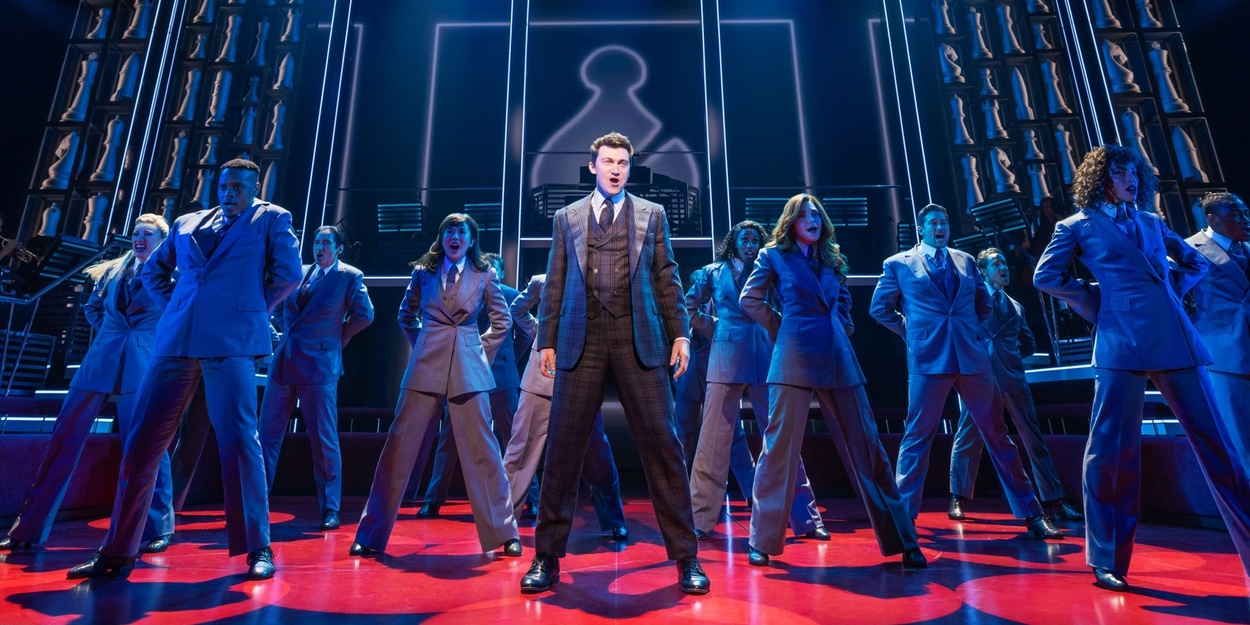
Some performances feel polished. Others feel possessed. Bryce Pinkham’s Tony-nominated turn as the Arbiter in Broadway’s Chess revival somehow manages to be both. Part ringmaster, part historian, part provocateur, Pinkham’s Arbiter doesn’t merely guide audiences through the sleekly reimagined revival currently electrifying the Imperial Theatre. He seems to conjure it into existence in real time, snapping characters into motion like a theatrical hypnotist while balancing impish wit with mounting geopolitical dread.
For Pinkham, the performance represents the culmination of a relationship with Chess that stretches back nearly a decade, beginning with the 2018 Kennedy Center production and continuing through subsequent workshops and concert iterations before arriving on Broadway.
“I think the music is the heart of the show, and I think if you love the show, you love the music,” Pinkham says of Chess. “The first time I did it at the Kennedy Center, I didn’t know much about the show.”
What began as a job has evolved into something much more personal. Because this version significantly reimagined the Arbiter, Pinkham found himself deeply involved in shaping the role alongside book writer Danny Strong. “I really felt like I had made it with Danny,” he explains. “I felt like the part was partially mine, and the success of the part and the show felt tied to it. And, I was excited to continue that journey. So, [accepting the offer to reprise the Arbiter on Broadway] was an easy yes.”
That ownership is palpable in performance. In fact, Pinkham’s Arbiter feels omnipresent. He’s a knowing figure who exists both inside and outside the story, orchestrating events while maintaining a direct relationship with the audience. The concept, he says, began with a single insight from director Lauren Lataro. “On our first day on our feet in the rehearsal room, she said, ‘I think the entire set is at your disposal,’ and, ‘I think you’re the puppet master of all this.’”
Pinkham ran with it. “I wanted it to feel similar to the Emcee in CABARET. Like someone who’s both a part of the show and is also telling us this story for a reason,” he states. That framing ultimately shaped one of the production’s most compelling theatrical devices. “I think of him as somewhat like a hypnotist, which is where the snaps came from,” he explains. “And I thought, ‘What if he’s needing to tell this story and he’s arranged these performers to help tell it.’”
Beyond that, some of the Arbiter’s delicious mischief comes quite naturally. “Well, that’s kind of like me,” Pinkham laughs. “In first grade, my parents were called into a parent-teacher conference where the teacher basically told them, ‘You need to find your child an outlet other than my classroom for his’—the words she used were—‘for his reckless creativity.’” That outlet, naturally, became theater.
“In the rehearsal room,” he adds, “I’m trying to make my friends laugh.” That spirit informs his Arbiter, who offers audiences permission to embrace both the grandeur and occasional absurdity of Chess. “We really like when he’s cheeky,” Pinkham says of discoveries made early in the show’s development. “We like when he is a little bit outside of the story so that we, the audience, can laugh at the story when it’s a little ludicrous.”
Still, beneath the wit lies extraordinary precision. The score for Chess remains one of musical theater’s most demanding, packed with intricate orchestrations and emotionally charged material beloved by generations of theater fans. “The challenge feels like it’s living up to people’s expectations for something that’s so beloved by the people who love it,” Pinkham reveals. So, he approaches the complex score with “diligence and a little bit of grace.”
That grace includes allowing himself humanity, even amid Broadway’s relentless demands. “Sometimes there’s been nights where the allergies have been really bad this season,” he points out, recalling one performance where he jokingly altered a one ad-libbed line that now exists in the book from “Yes, I’m going to sing, and, yes, I’m going to crush it” to “Yes, I’m going to sing, and, yes, I’m going to do the best I can.” Adding, “That’s what you’re doing on any, any given night.”
Yet, part of what makes this revival so thrilling is how clearly the creative team understood what earlier Broadway versions struggled to solve. “I think they made it a love story,” Pinkham posits. “I think they let the metaphor live without staging the metaphor.”
He also points to the streamlined storytelling, visible musicians, and the decision to let the music dominate. “They simplified it, clarified it, and allowed the music to sort of take center stage,” Pinkham explains. They also packed the company with powerhouse talent. “With the performers we have singing those songs, how could you not like them? It’s hit after hit,” he gushes.
Chess’ power in 2026 extends beyond nostalgia though. Pinkham is acutely aware of how the musical’s Cold War tensions resonate in today’s global climate. “I think the political environment is tense,” he states. “The global geopolitical environment is tense in ways that have echoes of the Cold War.” This contextualization is highlighted in the Arbiter’s profound final monologue, which advocates diplomacy over war.
That very moment has evolved in emotional weight throughout the Broadway run. “Doing that speech over the nine months we’ve been running Chess has been very interesting because it’s changed in its relevance,” Pinkham reveals. “It’s not a relevance that we’re happy about, but it certainly feels like it’s palpable.”
For Pinkham, one moment especially resonates as both an artist and a parent. “There’s a spoiler here, but [Walter de Courcey] sort of makes up this reason that he cares about the Cold War,” Pinkham explains, referencing Walter’s story about a nightmare where his young daughter tries to survive a nuclear winter. “As a parent, of a six and seven-year-old, that those adults, who are adversaries, are trying to work it out for the sake of the children whose futures they’re playing with is always very moving to me.”
That emotional grounding makes his current Tony nomination especially meaningful. Pinkham previously earned a Tony nomination a little over a decade ago, but this recognition feels profoundly different. “This has been a very different experience than my first nomination,” he says. “I feel more grounded, and I feel more accomplished and certain of my place here.”
Since his 2014 nomination his life has changed. “I have a whole family life that I didn’t have back then that is the center of my universe now,” he beams. So this time around the nomination, he says, is “icing on a cake that I already really love.”
Still, Pinkham doesn’t shy away from acknowledging the work behind it. “I’ve spent time away from my family to make it happen,” he acknowledges. “And I go out there and give the show everything I can every night that I do it.” He also adds, “I love having an audience of 1,600 people laugh at a joke that I made in the rehearsal room to try and make my friends laugh. There are few feelings better than that.”
As for the revival itself, Pinkham is understandably proud. “For my money, it’s a pretty good revival of a show that, in the same theater, closed after 17 previews and 68 performances. And, this time, in the same theater, the show has broken box office records.”
“I want you to leave feeling like you saw some of the best performers in the world in this genre do a really hard thing, and you were blown away by it,” Pinkham says of what he wants audiences to take away from this revival. Luckily, that ambition is already being realized nightly. There’s a reason the clip of Nicholas Christopher belting out a note for nearly 20 seconds, something he does eight times a week, has gone viral and nightly receives mid-song applause.

In Pinkham’s capable hands, Chess’ Arbiter offers audiences a performance that feels deeply crafted yet alive with spontaneity, charm, and heart. In a Broadway season filled with remarkable work, that kind of alchemy is hard to ignore. Ultimately, Pinkham’s performance doesn’t just guide Chess. It helps make the case for why this revival matters.
Chess runs through September 13, 2026 at the Imperial Theatre.
2026 Theater Fans’ Choice Awards – Live Stats
Best Sound Design – Top 3
1.
Adam Fisher – The Lost Boys
29.6% of votes
2.
John Shivers – Chess
15.8% of votes
3.
Tony Gayle – Two Strangers (Carry a Cake Across New York)
8.9% of votes