









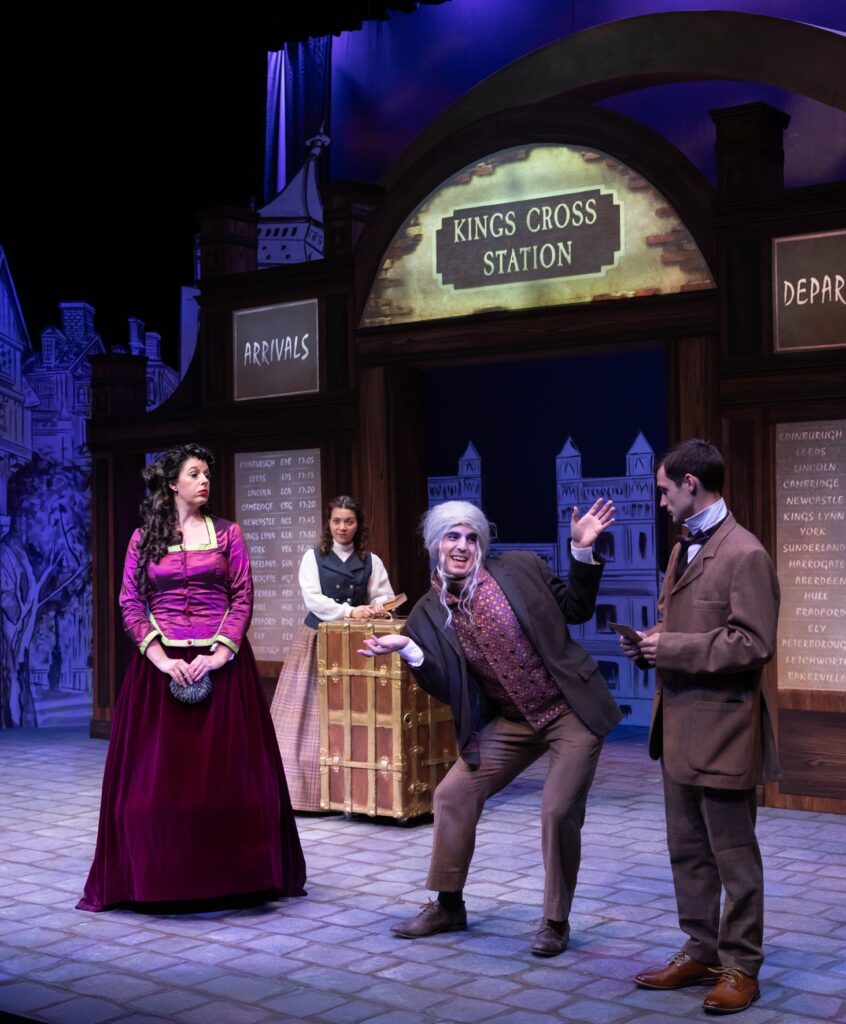
Paige Rogers, Clare Bawaski, Daniel Llaca and Jonathan White detect mayhem in Theatre Lab’s family-oriented play Baker Street Beginnings about the origin of Sherlock Holmes stories.
By Britin Haller
Before Sherlock Holmes ever picked up a magnifying glass, there was Arthur Conan Doyle. And before Doyle created the world’s most famous consulting detective, there was Dr. Joseph Bell, the real-life physician whose remarkable powers of observation and deduction helped inspire Doyle’s writings.
That bit of history becomes the springboard for Baker Street Beginnings, Gina Montét’s wonderful new play directed by Matt Stabile and receiving its world premiere at Theatre Lab’s new larger space, the Marleen Forkas Studio One Theatre at FAU.
Commissioned specifically for their eighth annual Heckscher Theatre for Families production, this is a smart, hilarious, and thoroughly charming piece of family entertainment that gives children plenty to laugh at while quietly slipping both literary and Victorian-era history past them.
Baker Street Beginnings is Montét’s third full production there, following Overactive Letdown, and last season’s clever and spooky Heebie Jeebies: Tales from the Midnight Campfire.
In her playwright’s note, Montét explains she became intrigued by the fact that Dr. Bell inspired Sherlock Holmes. That historical fact is not merely window dressing; it’s the engine driving the entire play.
It’s the 1870s, and we meet young Arthur Conan Doyle (Jonathan White) while he is studying under Bell (Daniel Llaca), and the joke is immediately apparent to anyone with even passing familiarity with Holmes because Bell looks and behaves suspiciously like the detective who does not yet exist, right down to his pipe and uncanny ability to observe details other people miss.
When a desperately ill and hallucinating woman named Violet (Paige Rogers) arrives clutching nothing but a pawn shop ticket, Bell suspects poison. The things she mutters in her delirium provide clues, and the doctor sends Arthur to London to follow the trail before it’s too late to identify the poison and save her.
On the train, Arthur meets Emmeline (Clare Bawarski), an intelligent, determined young woman traveling to London to take an examination that could gain her admission to an all-male academy. Violet, it turns out, works at Emmeline’s school, giving Emmeline a personal stake in solving the mystery. Arthur’s old friend Bram (Doriyan Caty) soon joins them, and the three race around London following clues through a pawnshop, an apothecary, a séance, and, to Bram’s almost indecent delight, a graveyard.
White, Bawarski, and Caty make a terrific trio, playing off one another with an easy comic rhythm that makes Arthur, Emmeline, and Bram’s budding friendship as entertaining as the dilemma they’re trying to solve. Their contrasting personalities fit together beautifully: Arthur’s earnest curiosity, Emmeline’s spirited determination, and Bram’s gleeful fascination with all things macabre turn them into an unlikely, but thoroughly enjoyable, little detective team.
The identity of the culprit is best left for audiences to discover, but that reveal is only half the fun because Montét has filled her fictional adventure with real people standing at the beginnings of extraordinary futures.
Jonathan White makes Arthur Conan Doyle an appealing center for all this controlled lunacy. He is enthusiastic, inquisitive, and still developing the observational skills that Bell is teaching him. White also gives Arthur an easy chemistry with Bawarski’s Emmeline, whose intelligence quickly establishes her as his equal rather than his sidekick.
Conan Doyle is trying to find his place in medicine, and ultimately literature, while Emmeline is trying to force her way into an educational world that literally doesn’t want women in it. Bawarski comes across not just the obligatory girl in this trio, but a tough and spunky street fighter on her own personal quest.
Emmeline is not simply a fictional nod to Victorian women struggling for educational opportunities. Montét’s note identifies her as Emmeline Pankhurst, the future leader of the British suffragette movement. Bawarski captures that beautifully, making her character spirited, stubborn, and wholly believable as a young woman already impatient with a world determined to tell her where she belongs.
Then there is Bram. Doriyan Caty’s Bram is a lovable, silly oddball obsessed with death, cemeteries, and anything remotely creepy. He skips and sweeps around in a long black cape with a red lining, deploying it for maximum comedic effect, and spends much of the play waiting hopefully for the investigation to become sufficiently morbid. When the trio finally reaches a graveyard, Bram’s ecstasy knows no bounds.
Minor spoiler here: the joke becomes even better once you realize that Bram is Bram Stoker, future author of Dracula. At some point, Stoker and Doyle really did become friends, and Doyle would later write warmly to Stoker after reading his vampire novel. Montét moves their friendship backward in time and turns Bram’s obsession with death, his theatrical cape, and even the appearance of a character named Renfield into a trail of delicious literary breadcrumbs.
Children need not understand any of that to adore Caty’s performance. The adults who catch the references get an entirely different layer of comedy.
As “Actor 4,” Daniel Llaca is a very physical actor who has the formidable assignment of playing Dr. Bell, a constable, a pawnbroker, and Renfield, the assistant to a psychic medium. Llaca makes his transformations clear, beginning with a Bell who is practically a proto-Holmes right down to the pipe and mannerisms that instantly establish the play’s central joke. As Renfield, and the pawnshop owner, Llaca entertains wildly with his elaborate entrances and exits, and the kids eat it up.
Paige Rogers likewise handles multiple roles as “Actor 5,” including the deathly-ill Violet, the spectacularly over-the-top psychic Madame Cook, and the headmistress of Emmeline’s school who has exactly the old-fashioned severity needed to make Emmeline’s rebellion feel consequential. Rogers also gives Violet enough vulnerability that the race to solve the mystery has genuine stakes.
Gustavo Garcia, as “Actor 6,” nearly steals the spotlight every time he appears, particularly as Mycroft, a patient of Dr. Bell who hates needles and a big teddy bear of a guy who is fiercely protective of Arthur. Mycroft’s return at a crucial moment to help Arthur save the day is unexpectedly sweet. Fans of Sherlock Holmes will recognize the name Mycroft as the famous detective’s older brother, although that is where the comparison stops.
Garcia also handles the role of the boys’ academy principal with the same overall sincerity.
Matt Stabile directs the six-member ensemble with a light touch and an understanding of precisely what kind of theater this is, the kind that allows children to participate emotionally rather than asking them to sit reverently through Victorian literary history. As a result, there are elements of old-fashioned melodrama in the audience’s responses, the descendant of a time when spectators happily booed and hissed villains who tied fair maidens to train tracks, and clapped and cheered for their favorite heroes.
Llaca, Garcia, and Caty emerged as clear audience favorites drawing enormous reactions from children and adults alike.
A well-placed fart joke lands exactly as intended, especially with the younger contingent, because who doesn’t love a well-placed fart joke, while a surprising sight gag near the end, with another very famous literary character, resulted in tremendous audience applause.
The technical work gives the actors a playful sandbox to run around in. Michael McClain’s scenic design creates a versatile London that becomes a train station, pawnshop, apothecary, vibrating spiritual sanctuary, a graveyard and more without bogging down the pace. Manny Zaldivar’s projections expand that world and help whisk the audience from location to location, while Eric Nelson’s lighting supplies atmosphere, including the foggy, mysterious look such a story demands.
Dawn C. Shamburger’s costumes are terrific, particularly Bram’s gloriously dramatic cape and the period pieces that immediately establish character. Casey Sacco’s hair and makeup design completes the picture, while Aubrey Rodriguez’s properties give the mystery its tactile details, from the magnifying glass, to the cryptogram puzzle, to the other objects and clues the young detectives encounter along the way. Matt Corey’s sound design, assisted by Joel Rodriguez, who also serves as accent coach, keeps the production moving through train travel and plenty of eerie encounters, including a delightful séance complete with a floating ghost.
Rodriguez’s accent work is especially important in a play so dependent on rapid Victorian dialogue, and the cast remains clear and understandable throughout.
Stage Manager Gianella Yañez Camino keeps the complicated procession of entrances, exits, and costume and character changes running smoothly.
One of the smartest things about Baker Street Beginnings is that none of its historical knowledge is required homework. A child can watch three friends solve a poisoning mystery, laugh at Bram yearning for a cemetery, cheer for the endearing big lug Mycroft, and marvel at the puzzle-solving. Adults can recognize the pieces of Sherlock Holmes and Dracula gradually assembling before their very eyes.
Dialogue clues like “controls the minds of wolves,” “surely locked,” and from the man who is calling for his missing kitten, “Watson! Watson!” add to the amusement.
There is something blissfully appropriate about a Sherlock Holmes origin story that turns its own audience into detectives, leaving us clues to follow and discoveries to make long after we leave the theater, so much so that it’s not difficult to wish for a sequel. If Montét is looking for her next challenge, we have one: reunite Arthur, Emmeline, and Bram for another adventure, because this trio is far too much fun to send their separate ways.
Baker Street Beginnings is what family theater should do. It does not talk down to children, and it does not sentence adults to an hour plus of dutiful endurance. By the time Arthur leaves us with the first sparks of the stories that will eventually become Sherlock Holmes, Baker Street Beginnings has accomplished its own neat bit of deduction: the best way to introduce young audiences to history and literature is to make them laugh, give them something worth solving, and let them discover the rest for themselves.
Tip for Families: Before the curtain rises, Theatre Lab is offering free “Detective Science” activities beginning an hour prior to the performance, with interactive stations where kids can decode messages, solve puzzles, take fingerprints, and try other hands-on activities meant to extend the mystery beyond the stage.
Baker Street Beginnings runs through September 20 at Theatre Lab on the campus of Florida Atlantic University, Marleen Forkas Studio One Theatre, 777 Glades Road, Boca Raton, FL; Sat at 7pm and Sun at 3pm; Running time approx. 75 minutes with no intermission. Tickets are $25 with each adult ticket including one free child’s ticket. Additional children’s tickets are $5 each. Call 561-297-6124 or visit https://fauevents.universitytickets.com.
Britin Haller is a journalist, editor, and author who serves on the board of directors for the Mystery Writers of America Florida Chapter. As a celebrity wrangler, Brit regularly rubbed elbows with movie, sports, and rock stars, and as a media escort, she toured with NY Times bestselling authors. After appearing in local musicals and all-state choir, Britin studied theater at Indiana University (a Big 10 college) and the University of Evansville (Rami Malek’s alma mater).

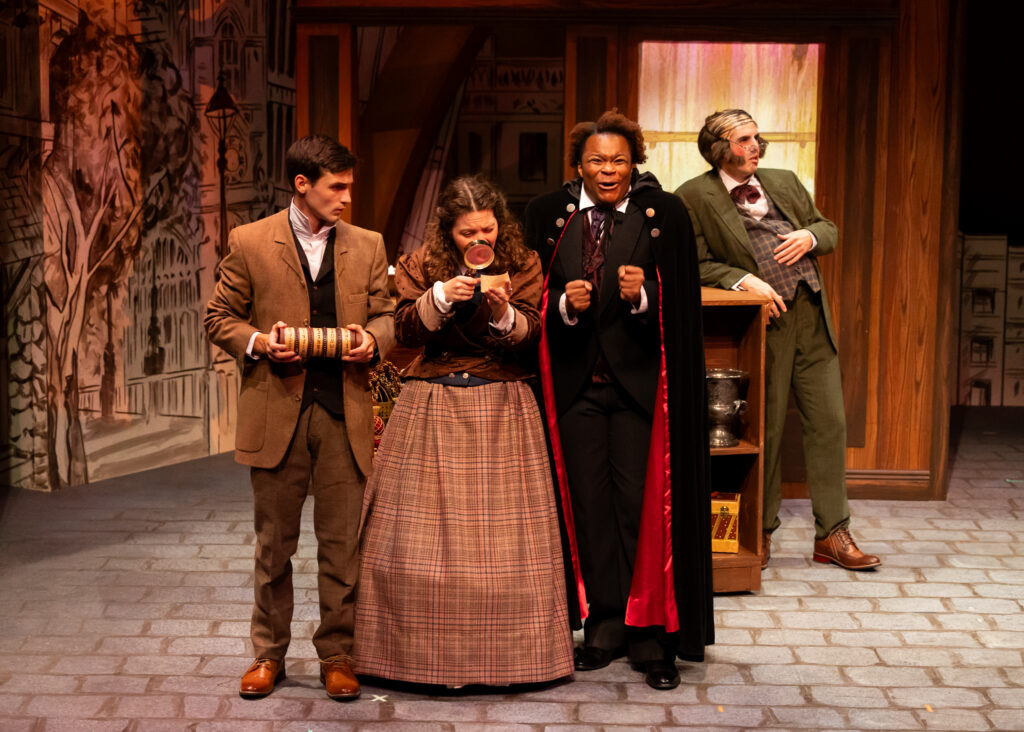
Jonathan White, Clare Bawarski, Doriyan Caty, Daniel Llaca