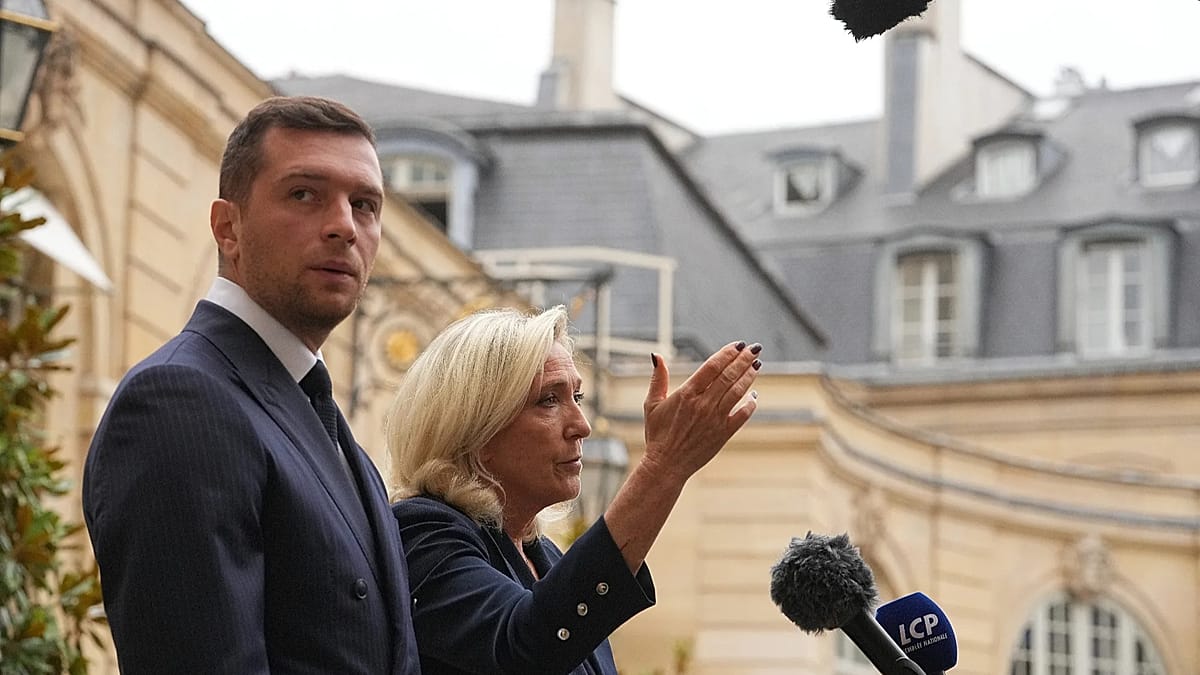








Marine Le Pen has broken her silence to publicly renew her support for Jordan Bardella, who is now in turmoil after fresh revelations about antisemitic and conspiracist messages attributed to him.
ADVERTISEMENT


ADVERTISEMENT
Three days after investigative website Mediapart published a second article on the affair, the presidential hopeful told La Tribune Dimanche she has “total confidence” in the man tipped to become her prime minister if she wins the 2027 presidential election.
Le Pen had already defended Bardella when Mediapart first published the allegations on Monday. “You won’t get anyone to believe that,” she told reporters during a walkabout at a trade fair, cutting the exchange short. “It’s not that it’s not an issue (…) it’s just madness,” she added.
What are the allegations?
Mediapart, which says it preserved the grammatical and spelling mistakes of the original messages, reports that Bardella, then 17 or 18, railed in one conversation against the supposed desire of “the Jew” to “dominate” other peoples, to “crush” and “rob” them, adding that “a Zionist is necessarily Jewish, deep down”.
He is also said to have accused several ministers from François Hollande’s presidency of putting Israel and banking interests ahead of French interests.
The article also highlights the alleged influence of Alain Soral on Bardella’s political thinking. Soral is a far-right ideologue repeatedly convicted of inciting racial hatred, antisemitic insults, homophobia and Holocaust denial.
Bardella dismisses the messages as “crude fakes” and says they mark “the beginnings of a total war” meant to derail the National Rally’s presidential campaign. He has announced two legal complaints, one for defamation and one for forgery and use of forgeries.
Mediapart presents its second article as a response to what it calls a “violent challenge” to its work. It accuses Bardella of having “lied to the whole of France” by refusing to acknowledge authorship of his own texts.
It publishes screenshots that sources described as coming from Bardella’s entourage are said to have supplied and says Meta authenticated the messages, which date from 2013, through a Facebook archive extraction.
A row with no impact on voting intentions
According to an investigation by Le Parisien, Marine Le Pen “is not necessarily convinced of her protégé’s good faith”.
The French newspaper says it has interviewed a member of the RN candidate’s campaign team, who told it that “in her view, it is quite likely that the exchanges are real. They are the words of a 17-year-old kid intoxicated by Soral, who is no longer the same person today.”
A version that stands in stark contrast to the brief comment made by Marine Le Pen in La Tribune Dimanche.
The weekly also points out that, according to a source within the campaign team, “these controversies do not in any way dent the 30% to 35% of voting intentions in favour of Marine Le Pen”. “If our electorate paid attention to what the press says about us, we’d be on 2%,” she dismisses.
These accusations against Jordan Bardella come as Marine Le Pen is currently credited with 31% to 36% of first-round voting intentions in the presidential election, according to opinion polls, ahead of former prime minister Édouard Philippe and Jean-Luc Mélenchon, the France Unbowed candidate, who are vying for second place.
According to several media reports, Marine Le Pen and Jordan Bardella are due to appear together on Tuesday at a joint press conference to present an alternative budget put forward by the RN candidate, just as the government unveiled its budget plans on Thursday.
Le Journal du Dimanche (JDD) wonders, quoting an RN MP, whether the controversy could lead the party not to seek to censure the government if it pushes its bill through using article 49.3, which allows a text to be adopted without a vote unless a motion of censure secures a majority. Resorting to this constitutional tool is deemed likely by an expert interviewed by Euronews.
“Even if we consider that Jordan is innocent of the acts of which he is accused, the controversy is there, whether we like it or not. Perhaps we should avoid adding further disorder to the bad press,” the JDD writes.
Read the full article here