






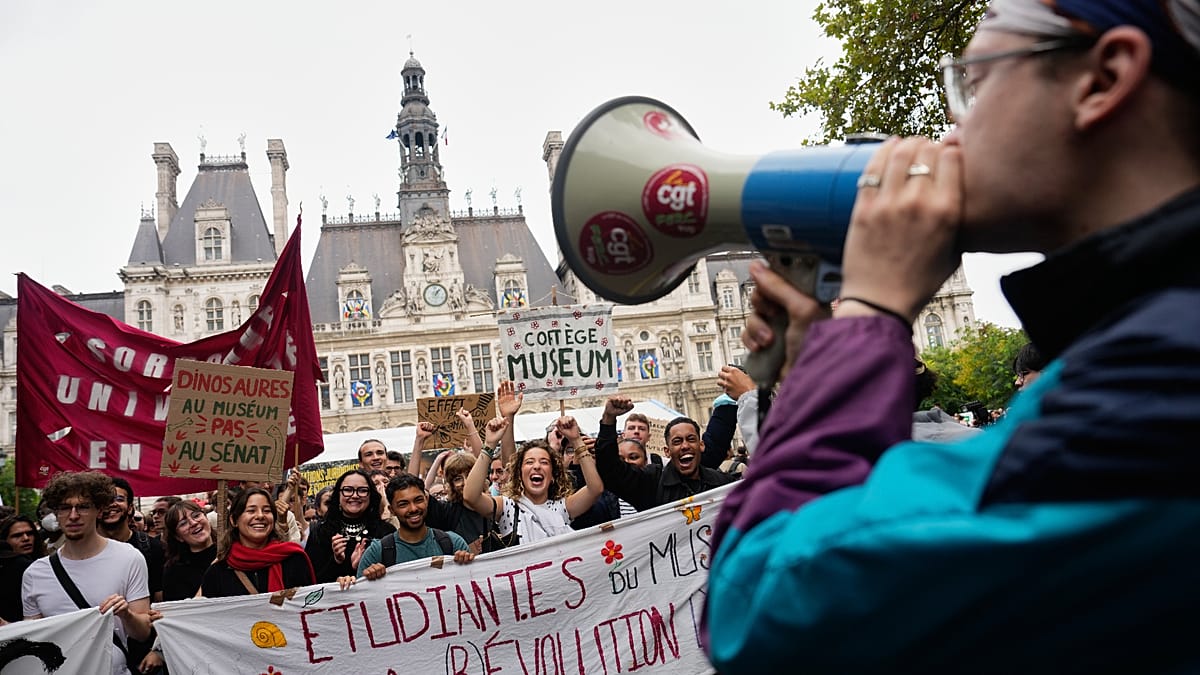
Another major day of demonstrations got underway in France on Tuesday, with students and trade unions taking to the streets to protest education conditions and funding as the National Assembly began its debate on the government’s budget proposals for 2027.
ADVERTISEMENT


ADVERTISEMENT
Teaching unions told Euronews that they were dissatisfied with the government’s response to concerns over long school days, overcrowded classrooms, run down facilities, and teacher absences.
“It is clear that the responses that have been provided are inadequate and do not meet the needs set out,” Elisabeth Allain-Moreno, secretary-general of SE UNSA, a teachers’ union, said.
France’s Education Minister Édouard Geffray announced on 8 October that 3,000 available supply teachers would be deployed across more than 500 priority schools by Tuesday in a bid to solve teacher absences.
On Tuesday, he announced that just 35% of the target had been achieved.
“We have a generation that is articulating demands that we identified years ago, which we have been advocating for and were never heard,” Morgane Verviers, secretary-general of UNSA Education, told Euronews.
“It’s clear that the responses provided are inadequate and don’t meet the needs set out,” Moreno added.
Budget proposal under fire
The government’s budget proposal includes a €1.2 billion increase in funding for the National Education Ministry, as France grapples with one of the highest public deficits in the eurozone.
However, critics say this measure is insufficient, arguing that a 1.6% increase in funding falls short of inflation, which is forecast at 1.8%.
Sabrine Kharbach, a spokesperson for l’Union Etudiante, France’s biggest student union, said she felt the government had underestimated students’ ability to understand budget matters.
“They believe that students and young people are not aware of the economy and don’t understand what’s happening. But we truly understand, when we see that there’s an additional $400 billion being allocated to the military,” Kharbach told Euronews. France’s government has allocated a total budget of €413.3 billion to its armed forces for 2024 to 2030 under its Military Programming Law (LPM).
“We have to ask ourselves if they want to invest in death or in the future,” she added.
One secondary school student said she felt her generation was not being taken seriously, despite being the “future of France.”
“We can’t turn a blind eye to issues, especially in secondary schools in the suburbs, which really lack funding,” she said.
Swedish activist Greta Thunberg also joined Tuesday’s protests, telling the AFP news agency that “young people are not being included in the conversation.”
“Our future is being robbed away from us,” she added.
Thunberg’s visit to France comes after French students’ grievance struck a chord with young people across Europe, leading students in Belgium and Italy to stage their own demonstrations over the past week.
Jean-Luc Mélenchon, the leader of the hard-left France Unbowed party, was also among those who joined the protests.
Taking to X on 8 October, he declared that the Bastille had been “retaken” after a mass protest on Paris’ Place de la Bastille captured audiences worldwide.
Police violence sparks outrage
France’s protests and school blockades began in Paris’s suburbs in mid-September, before rapidly spreading nationwide.
While many demonstrations have been peaceful, others have been marred by sideline riots and clashes with police.
Rights groups have accused officers of exercising disproportionate force whilst dealing with protesters following a wave of injuries to students.
According to figures shared by France’s Ministry of Justice on Friday, there have been 6,877 arrests since the beginning of the movement, mostly involving minors.
More than 215 students and nearly 800 police officers have also been injured.
Read the full article here