










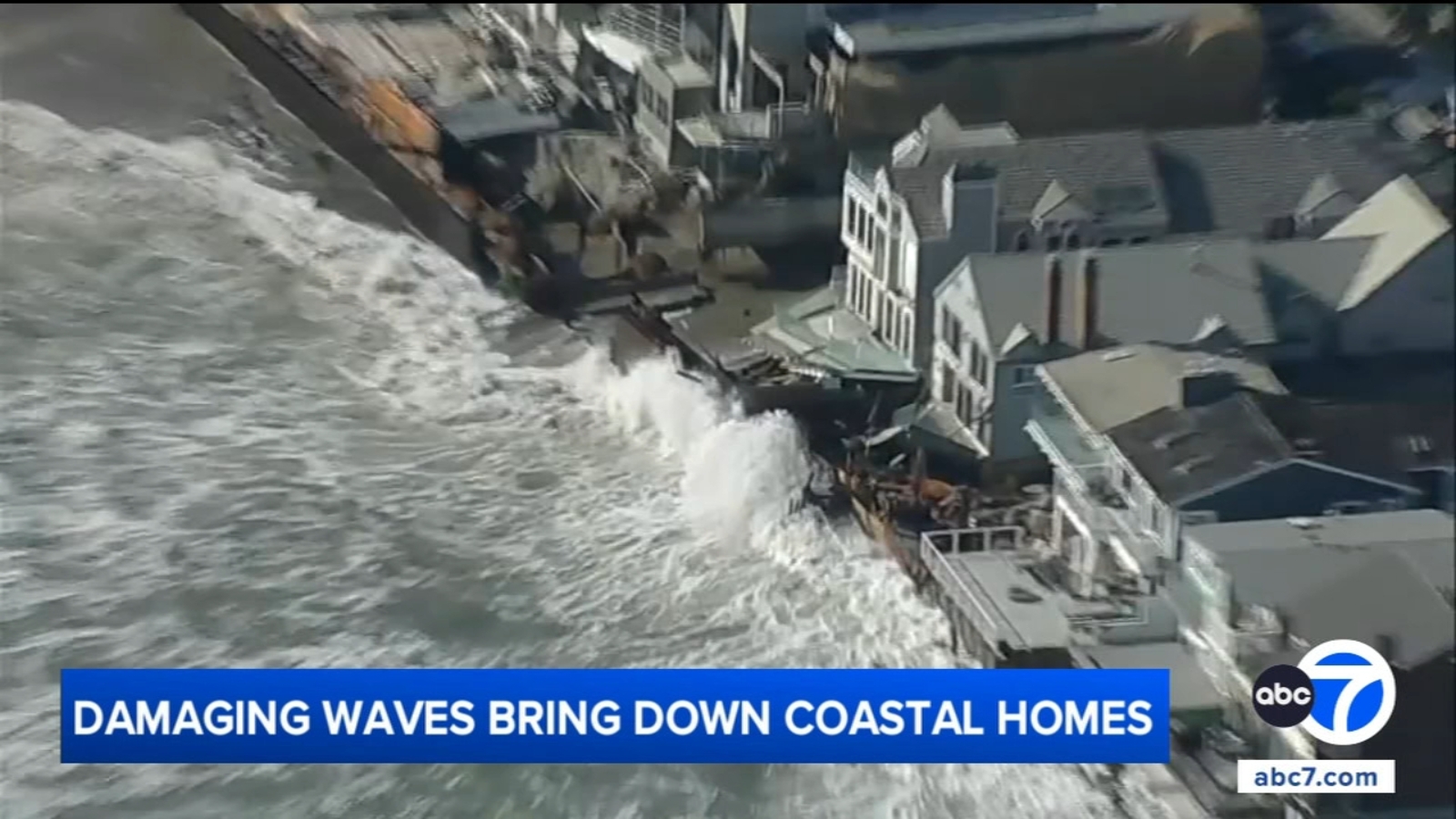
DANA POINT, Calif. () — More than a dozen homes were damaged in Dana Point after hurricane-force swells battered the coastline, prompting emergency efforts to protect vulnerable beachfront properties and leading city officials to proclaim a local emergency.
Nine homes were red-tagged, and seven others were yellow-tagged as a result of the damage from high tides and swells, according to a statement from the city.
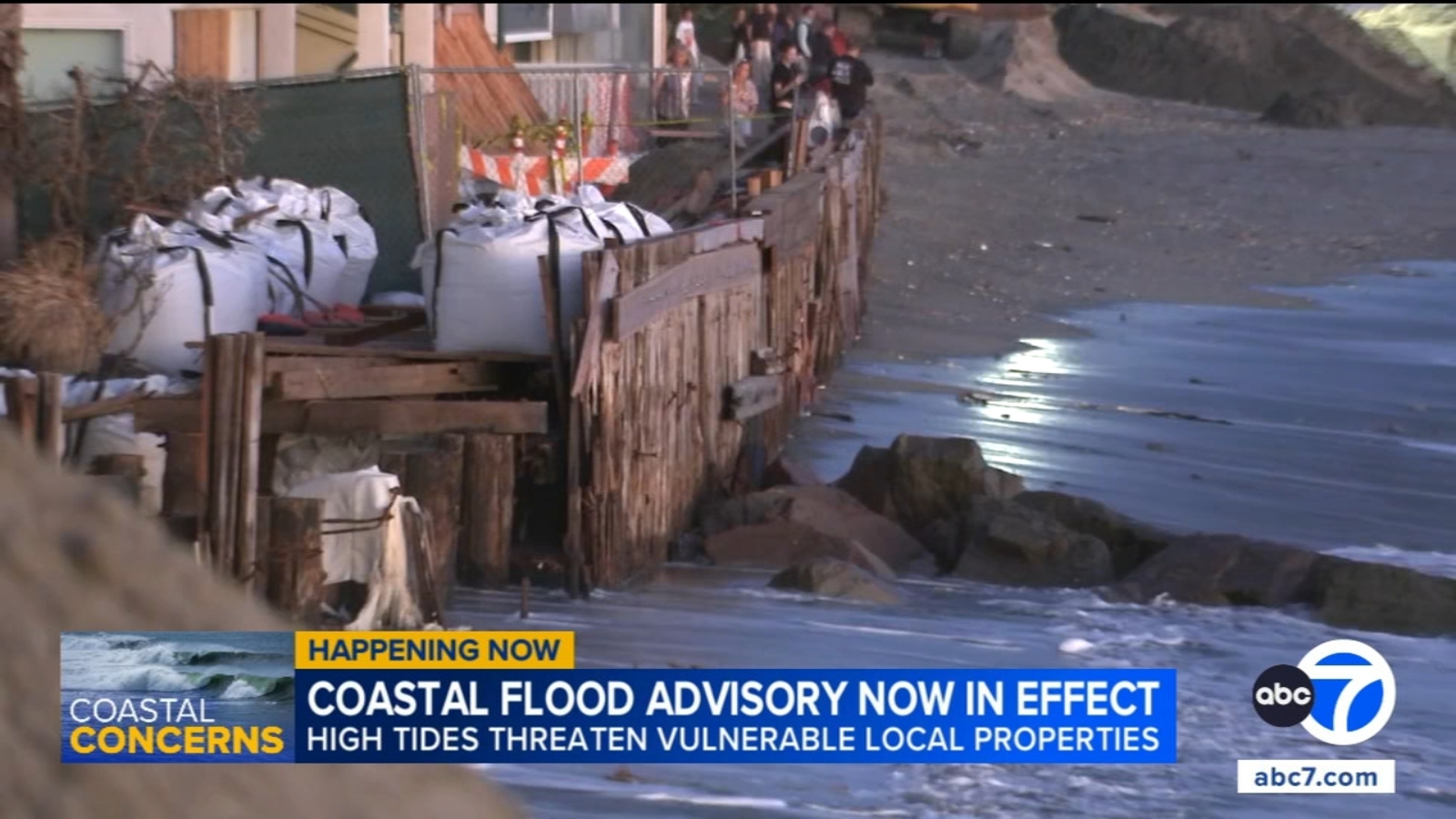
Cleanup continued Wednesday as crews raced to rebuild a shoreline barrier damaged by powerful waves. Truckloads of boulders were placed along a stretch of beach in an effort to protect properties from pounding surf and tidal erosion. An excavator was seen putting the boulders, some weighing as much as 700 pounds, in place.
One of the red-tagged homes was demolished by crews after waves broke through the seawall. The district’s general manager told Eyewitness News two more homes are at extreme risk.
Rafael Heredia, a homeowner who lives nearby, described the situation as “devastating.”
“I just was looking at a house that I guess it was red-tagged and the city knocked it down,” Heredia told 7. “I was told the residents were on vacation in Hawaii. So I can’t even imagine coming home and seeing this, where there’s no home,” he said, gesturing toward the crashing waves.
Despite the offshore hurricane churning hundreds of miles from Southern California beaches, the surf it generated hammered homes in the Capistrano Bay District community on Beach Road.
“City staff have been and will remain on site to inspect damage and, when appropriate, place tags and advise residents to vacate homes that exhibit structural damage that make them unsafe,” the city said in a Tuesday news release.
Among those watching the damage on Tuesday was Hall of Famer and former Los Angeles Dodger Adrian Beltré and his family, as the deck of a home they had been remodeling collapsed into the waves.
Residents, officials debate coastal protection measures
Residents along Beach Road are at odds with the California Coastal Commission following the damage, which they say could have been reduced through greater use of coastal armoring.
“We have our emergency permits that we did from Coastal that we paid $1,600 for,” said Natalie Driessen, a Capistrano Beach resident.
Driessen argued that additional protective measures could have helped shield homes from the ocean’s force.
“If we all had rocks, the ocean would have been protected better, our houses would have protected better,” she said. “I’m out of pocket right now almost $400,000 just trying to save my home.”
Residents and the Capistrano Bay District general manager say they have sought permanent coastal armoring for years, including more boulders along the shoreline to absorb ocean energy. The Coastal Commission has argued that the approach accelerates coastal erosion.
“There’s too much red tape,” said Rich Holt of Holt Rock, who has worked in the Capistrano Beach community for years. “Instead of proper prevention, now it’s an emergency. And this is the aftermath of what happens when people aren’t allowed to protect their property.”
Holt said boulder placement is typically approved only after residents obtain emergency permits, as at least a dozen residents did in the two weeks before the swell from Hurricane Marie approached.
Recently filed emergency permits have been granted. For many, residents said, the approvals came too late because tides were too high to place the boulders.
“It’s like getting an emergency approval to do weed abatement after the fire’s already lit right? It’s a day late and a boulder short,” Holt said.
During a Coastal Commission meeting Wednesday, a representative from the Surfrider Foundation spoke in opposition to the use of emergency permits for seawalls.
“Every seawall approved sacrifices the beach in front of it. Those beaches belong to all of us,” said Mitch Silverstein of the Surfrider Foundation.
The California Coastal Commission said it had teams working throughout the weekend to help process emergency requests. The agency discussed damage from pounding surf across the coast, from Tamarack Beach in Carlsbad to the sinkhole in Malibu, during a discussion about the impacts of El Niño.
“This is happening now and it will only become more challenging. This is our new normal and we have to meet it with urgency planning and action. One way we can do that is to prioritize sea level rise adaptation planning and implementation for all coastal communities,” said Dr. Kate Huckelbridge of the California Coastal Commission.
“This work needs funding and it needs focus and it is the best path to protect our coastal communities and ensure that there will still be beaches left to pass on to children.”
Huckelbridge noted that emergency permits require a follow-up coastal development permit review, during which the Coastal Commission conducts a full analysis of what is allowable under the Coastal Act.
Jonathan Warrick, a research geologist with the U.S. Geological Survey, said erosion has increased as local beaches have lost sand at a rapid pace.
“Erosion has been much larger than in the past,” Warrick said.
Local and state leaders have identified sand nourishment as a long-term solution for communities facing coastal erosion. Warrick pointed to regular beach nourishment projects near Huntington Beach, saying the added sand eventually moves down the coast and helps protect other shoreline areas.
“They nourish the beach at Surfside Sunset regularly every couple years or so and the sand is added because the Surfside Sunset area, that beach gets quite narrow. Well that sand moves down the coast to Huntington Beach and you’re not reporting from Huntington Beach right now because it’s not severely eroding,” Warrick said.
Orange County Supervisor Katrina Foley’s office said it is pursuing funding for a sand replenishment project between Capistrano Beach and Doheny. She said the Capistrano Beach area has received about 100,000 cubic yards of sand over the last three years but needs roughly 1 million cubic yards.
“Why are we not getting more sand out here? It’s really about the permitting. We can’t get the permitting done fast enough. The bureaucracy is actually causing us to not be prepared for this kind of damage. This was predictable,” Foley said.
Meanwhile, farther north along the coast, a massive sinkhole opened Tuesday in the driveway of an oceanfront Malibu home reportedly owned by actor Nicolas Cage, prompting city officials to declare a local emergency and order evacuations.
Just after 6:20 p.m., the city announced that a local emergency was declared and ordered evacuations for affected properties along Sea Level Drive as the sinkhole continued to expand and restrict access for residents and emergency services.
Evacuation orders were issued for residents of five neighboring homes along the private road, and the properties were red-tagged.
A sinkhole opened in the driveway of an oceanfront Malibu home reportedly owned by Nicolas Cage, prompting evacuation orders.
© 2026 Television,