









Hey, Old Friends: Joline Mujica, Alex Jorth and John Reed in Zoetic Stage’s Merrily We Roll Along (Photos by Justin Namon.)
By Bill Hirschman
There is both joy and fear when you’re enroute to a performance of a cherished piece of work whether its Beethoven’s Fifth, La bohème or Beatles songs you know so well you have to force yourself not to sing along.
In theater especially, there is anxious anticipation when a beloved work can be radically reinterpreted like endlessly reenvisioned Hamlets.
Or rescued, as is the case for a lifelong Sondhead like this critic.
Stephen Sondheim’s oft-revamped Merrily We Roll Along prevails in Zoetic Stage’s glorious production at the Arsht Center through April 5.
With Zoetic’s penchant for reinvention (e.g. last season’s Fiddler on the Roof), this company delivers a fresh vision of the musical, visually and passionately different than the acclaimed 2022-23 revival on Broadway.
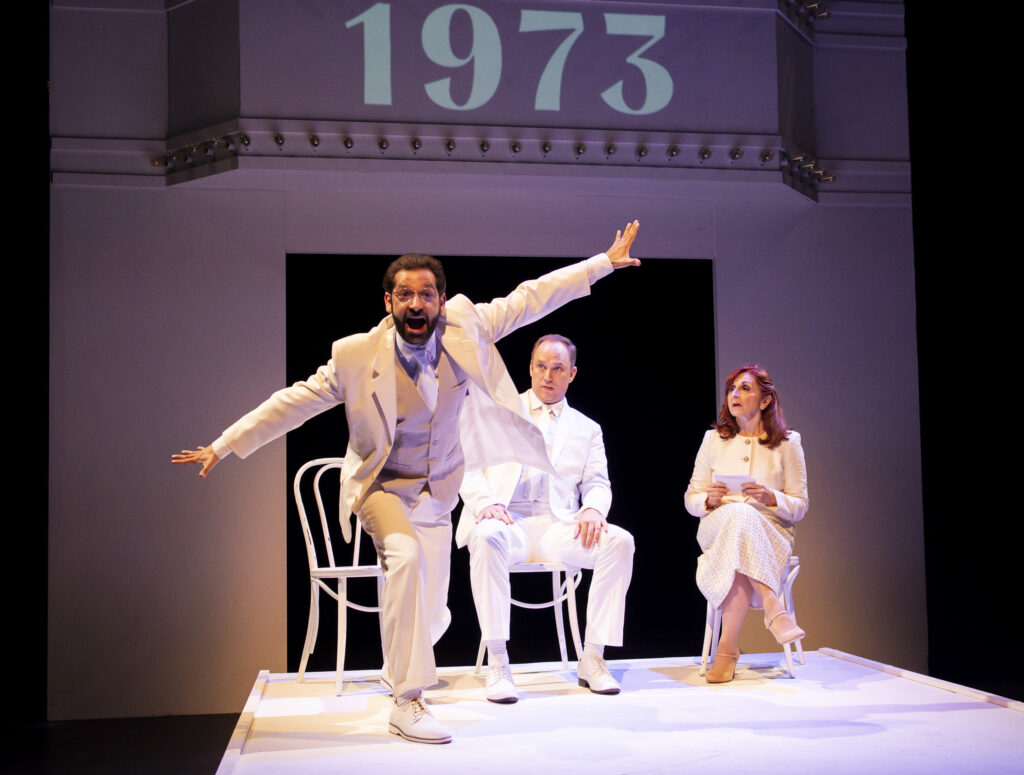
For instance – and this is stunning in the opening moments — the entire cast portraying the hero’s memories spends the first act in stylish immaculately white clothing similarly to that of the hero. And the entire show is mounted (as Zoetic has done before) on a runway surrounded on both sides by the audience whose every member is not more than five rows from the stage.
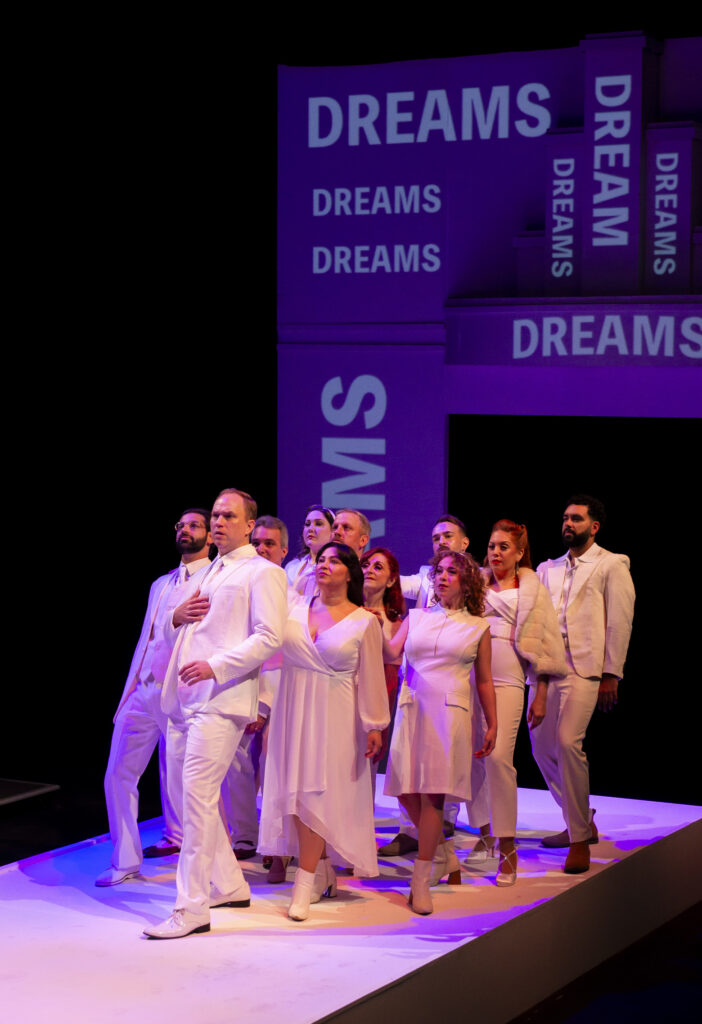

But remaining true to the Sondheim/George Furth/Hal Prince original, the artists take us on a dramaturgical journey backwards scene by scene over 20 years as three gifted souls struggle with creative-stifling ambition that destroys their devoted bond. This ain’t Mamma Mia.
The plot, based on the 1934 play by George S. Kaufman and Moss Hart, follows Franklin Shepard, an inspired composer abandoning his Broadway music to produce films (Alex Jorth) and his pals, lyricist-playwright Charlie Kringas (John Reed) and sharp-wit novelist-drama critic Mary Flynn (Joline Mujica).
At first, we have to care and connect about our lead Franklin who has succumbed to now ingrained character flaws. But by the evening’s end, we see the trio’s initial bonding in their early 20s abounding with optimism and idealism.
Indeed, this work hosts one of the most daringly ambivalent finales in musical theater because it fuses our sadness at the deterioration we now know is coming and our shared elation at the boundless celebration of possibilities. Which is its point. Only in the last three seconds of this production is there an easily missed moment of a rue-filled Franklin who has learned something from looking back.
Sondheim’s immeasurable genius is inescapable with this wide variety of musical styles and moods changing for each period and his brilliant interior-revealing lyrics. The late Furth’s book that he rewrote a few productions ago is a sharp observation of human frailty seasoned with arch humor that avoids jokes but elicit grins and chuckles.
If there is asterisk, Furth’s book never drags but seems to go on a bit long – no fault of this company’s pacing. But know that the running time is three hours over two acts including the intermission.
The list of artists who deserve laurels is simply the entire assemblage in the playbill. Top of the list is artistic director Stuart Meltzer, musical director Jeff Gess and musical stager (a sort of choreographer) Lauren Danielle Horgan. They and every last member of the cast gift an evening powered by a vibrant enthusiasm that barely disguises how much joy the artists are immersed within.
Meltzer and Horgan have successfully countered the limited staging space with steady movement, considerable gesturing, square dance chain steps, Irish jigs and physical interaction between players. More crucially, they have molded the entire production into a thematic and tonal whole with an emphasis of having actors imbue the roles with more passion than some other productions.
All the actors convincingly evolve or devolve over the decades, so we watch as the toxic scabs of alcoholism, unfaithfulness and cynicism convincingly fall away piece by piece, revealing the underlying character and virtue of our trio.
As Frank, Alex Jorth simply becomes the complex center of the saga. Jorth has been a mainstay choreographer and performer for well over a decade locally and across the state. But his creation here eclipses every performance we have ever seen him do, making Frank someone you want to root for. He and Meltzer believably chart every step of Frank’s descent. You believe his sold out troubled soul in the early scenes and his untrammeled optimism in the end – and each step along the way.
Mujica (who was fine in Zoetic’s The Comeuppance) deeply invests herself into the issuing of melodic notes in a powerful affecting voice. Similarly to Jorth, she arcs as an acidic crushed observer of the shallow, glitz-dominated scene that Frank has succumbed to, yet believably ends up as the most eager to embrace the future. Her heart-breaking reprise of “Not A Day Goes By” is imbedded with the imminent loss of her unrequited love for Frank.
Reed is new to Florida stages, but his kinetic frenetic Charlie memorably captures manic drive with both physical animation and precision delivery of such challenges as “Franklin Shepard Inc.” The growing tirade recounting in a TV interview how the pals’ creative bond disintegrated requires Reed to alternately mime typing in precise sync with fiendishly difficult percussion – all while mastering Sondheim’s intricate words and music.

Zoetic was fortunate to have two other pros inhabiting key characters who change over time. Lindsey Corey, fresh from Island City’s Ruthless and acclaimed for Sally in Cabaret, creates Beth, Frank’s first wife who met when they performed together in a Greenwich Village revue. Her golden voice meshed with profound expressive depth in the earlier version of “Not A Day Goes By.”
Leah Sessa, memorable in the same Ruthless and Heathers, has an infectiously delightful time portraying the star of the duo’s first Broadway success and Frank’s second wife. She disappears inside this witchy, nasty, self-idolizing, imperious vamp.
The supporting cast playing a commenting chorus and multiple characters is composed of veterans Irene Adjan, Sara Grant and Wayne LeGette, plus Kalen Edean, Spencer Hanan, Justin Packard and Joel Rodriguez. Every last one is at the top of their game.
The creative and tech teams are first rank. Applause is due (among a dozen others) lighting designer Tony Galaska, scenic designer Jacob Brown, stage managers Vanessa Santiago and Amanda Hernandez, and projection designer Steve Covey. Special attention is due Joel Rodriguez’s crystal sound for both the voices and the band, and Dawn C. Shamburger’s costumes.
Hess leads a dead on band nailing Sondheim’s intricate then soaring score: Jyllian Bown, keyboard, Kate Arkins (trumpet), Orin Jacobs (reeds), David Winograd (bass), Casandra Del Valle (drums/percussion).
Merrily debuted on Broadway 1981 to a doleful public and critical reaction to its backwards chronology and a totally teenage cast playing middle-aged characters while garbed in name-labeled sweatshirts. But that was memorialized in a cast album treasured by Sondheads. Since then, the script and score have been rewritten and produced and rewritten and produced and rewritten and produced.
Finally, miraculously, British director Maria Friedman found a way to vitalize it in 2022, along with lead actors Jonathan Groff, Lindsey Mendez and Daniel Radcliffe. We saw the commercial video of its live performances and it was indeed a treat, although people we know who saw it live were downright transfixed.
But as a whole, Zoetic Stage has granted us a Merrily that gently reproaches to us to value the moments and intimates in our lives.
Note: The film of the Broadway version is available on CD, DVD and buyable/rentable on Amazon Prime. Even more ambitious, reportedly, Richard Linklater is photographing each scene over the next decade to show the effect of time on the actors Paul Mescal, Ben Platt, and Beanie Feldstein.
Merrily We Roll Along, produced by Zoetic Stage and the Arsht Center runs through April 5 at the Carnival Studio Theatre at the Arsht Center, 1300 Biscayne Blvd., Miami. Times 7:30 Wednesday-Saturday, 2:30 p.m. Sunday. Running time three hours including one intermission. Tickets $78.39 at Arshtcenter.org or 305.949.6722 or tickets@arshtcenter.org.


