









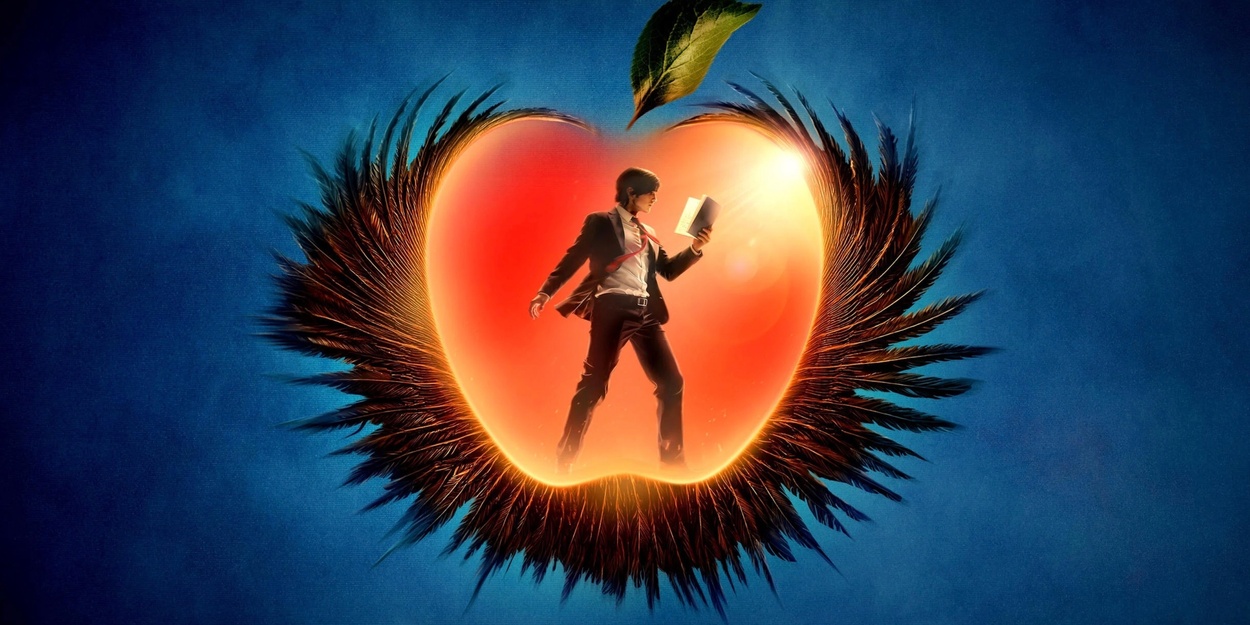
As Broadwayworld reported earlier this month, a new world premiere production of Death Note: The Musical will play London’s Barbican Theatre this summer. If you are new to Death Note, there is a lot to catch up on. It has inspired multiple adaptations across television, film, novels, video games, and even stage productions, becoming one of the most influential franchises in contemporary Japanese pop culture.
When brilliant student Light Yagami discovers a notebook with the power over life and death, his quest to reshape the world sparks a relentless battle of wits with the elusive detective L, where every name carries consequences. Write a name. Change the world.
Death Note: The Musical is based on the Japanese manga series of the same name by Tsugumi Ohba and Takeshi Obata. It has sold over 30 million copies worldwide. The series was published in installments in Weekly Shōnen Jump from December 2003 through May 2006. Its chapters were later compiled and released across 12 collected tankōbon volumes.
A 37-episode anime adaptation of the manga was produced by Madhouse and directed by Tetsurō Araki, airing on Nippon Television from October 2006 through June 2007. In the same year, a light novel inspired by the series and written by Nisio Isin was published. Konami also released several Death Note video games for the Nintendo DS.
The story was later adapted into three live-action films in Japan, released in June and November 2006 and February 2008, followed by a television drama in 2015. In 2016, the miniseries Death Note: New Generation and a fourth film debuted. An American film version premiered exclusively on Netflix in August 2017.
Two manga follow-ups, C-Kira and a-Kira, were published in 2008 and 2020, respectively. These were later compiled with additional standalone stories in the 2021 collection Death Note: Short Stories.
![Death Note | Official Trailer [HD] | Netflix](https://i.ytimg.com/vi/gvxNaSIB_WI/hqdefault.jpg)
Why does Death Note remain so influential?
What sets Death Note apart from many other manga and anime series is its intense focus on moral philosophy and psychological conflict. The story asks complex questions about justice, power, and the dangers of absolute authority.
More than two decades after its debut, the franchise continues to inspire new adaptations and discussions among fans worldwide. Whether experienced through the original manga, the anime, or one of its many adaptations, Death Note remains one of the most iconic and thought-provoking stories in modern pop culture.
Who wrote Death Note: The Musical?
The musical features a score by Tony, Grammy and Emmy nominee Frank Wildhorn, lyrics by Jack Murphy and a book by Ivan Menchell. Wildhorn and Murphy’s past collaborations include The Civil War, Swing, Wonderland, Carmen, and Count of Monte Cristo. Wildhorn is perhaps best known for Jekyll & Hyde, Bonnie & Clyde, The Scarlet Pimpernel, and Dracula.
Wildhorn’s work on Death Note led to more manga adaptations, including Fist of the North Star in 2021 and Your Lie In April in 2022. I see Death Note as this total international, breaking the glass ceiling of what manga can be musically, around the world,” Wildhorn recently told BroadwayWorld.

The musical had its world premiere on April 6, 2015, at the Nissay Theatre in Tokyo, Japan, with a Korean production opening the following July, running through August, at the Opera House of Seongnam Arts Center in Seoul.
In 2023, a concert staging took place at the London Palladium that ran from August 21 to the 22nd, becoming the first English production of the musical. The cast featured Joaquin Pedro Valdes, Dean John-Wilson, and Frances Mayli McCann as Light, L, and Misa, respectively, as well as Adam Pascal as Ryuk and Aimie Atkinson as Rem. After its run at the London Palladium, the production transferred to the Lyric Theatre where it had a limited run from September 7 to the 10th. Notable cast changes for the Lyric Theatre production included George Maguire replacing Pascal as Ryuk and Jessica Lee taking over for Mayli McCann as Misa.
The new version of Death Note: The Musical will run for for 50 performances only, Thursday 30 July – Saturday 12 September 2026.