








For decades, 60 Minutes has explored some of the most remote and extraordinary places on Earth, places viewers have never been and likely will never go. But even by those standards, correspondent Scott Pelley’s latest assignment stands apart.
“This was completely unique,” Pelley said.
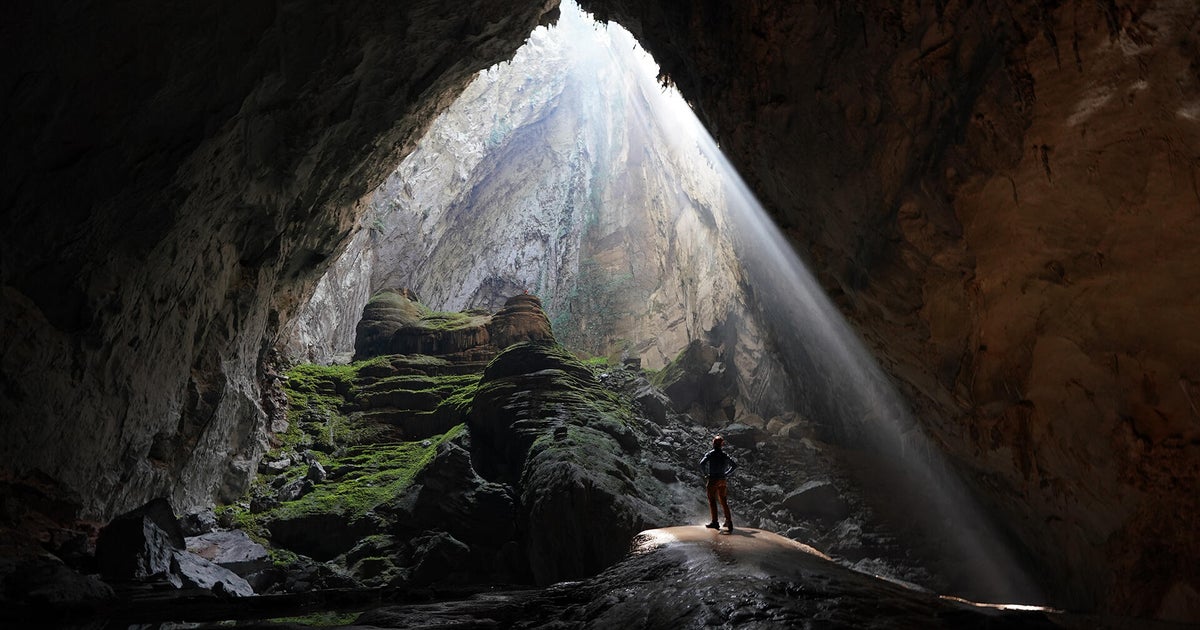
This week’s journey takes viewers deep into the largest known cave passage in the world: Son Doong Cave in central Vietnam. Its caverns reach higher than 65 stories and stretch as wide as one and a half football fields — large enough to contain the Great Pyramid of Giza.
Traversing the cave required an arduous effort by Pelley and the 60 Minutes team. But getting there almost never happened.
A reluctant start and a grueling journey
Son Doong was first discovered in 1990 by Ho Khanh, a Vietnamese villager who found the entrance while sheltering from a storm. Inside, he was greeted by darkness and an immediate 300-foot drop, so he never explored the immense cavern.
In 2000, British cavers asked Ho Khanh to show them the cave he had found, but it took another eight years for Ho Khanh to relocate the narrow entrance. He’d lost it in the trackless jungle. As a result, Son Doong was not explored until 2009.
60 Minutes’ trip there began when veteran producer Nicole Young pitched the idea of filming inside Son Doong. Pelley initially declined.
He told Young his doubts: “It’s a hole in the ground. What are we going to take pictures of?”
But after persistent encouragement, he agreed, setting off on what would become one of the most physically demanding and visually stunning assignments of his career.
Reaching Son Doong is no simple task. The cave lies deep within a remote national park, accessible only by trekking through dense jungle for a day and a half. There are no roads, only rivers to cross, mud to navigate, and wildlife to avoid.
The team endured roughly 20 river crossings, constant wet conditions, and even leeches that demanded frequent stops to clean out their boots. The terrain was so punishing that Young noted the jungle itself proved to be one of the toughest parts of the expedition.
“You think, how can the largest cave in the world not be found?” she said. “Until you go to the jungle in Vietnam.”
Entering another world
Once inside, the challenges only intensified. The crew relied on an expert climbing team to rappel down steep walls, scale rocks, and navigate treacherous terrain. The cave is classified at level six, the highest level of difficulty in caving — despite none of the journalists having significant prior caving experience.
At one point, Pelley climbed atop a massive stalagmite tower more than 100 feet high. With water constantly dripping from above, the surface was slick and unstable.
“Regret is probably not too strong a word,” he said. “I thought, ‘This is the last dumb thing I get to do.'”
He made it down safely with the help of the climbing team.
Inside Son Doong, a subterranean river continues to carve the cave, producing a constant roar that echoes through its chambers. In areas without collapsed ceilings where no natural light enters, the darkness is absolute. Visibility is limited to the narrow beam of a headlamp, forcing each step to be taken with caution.
“It’s utterly dark,” Pelley said. “The only thing you can see is what’s at the end of the light on your helmet.”
A protected wonder
Son Doong remains carefully protected by Vietnamese authorities. Access is highly restricted — only about 1,000 visitors are permitted each year — and film crews must agree to strict environmental protections.
Young said the cave has also become an important driver for nearby communities, creating opportunities through sustainable tourism.
The 60 Minutes team secured last-minute access to film after another trip was canceled, underscoring just how rare access to the cave truly is.
For both Pelley and Young, the journey proved transformative.
“You just realize that you were in some place that was just so special and so undiscovered,” Young said.
After initially rejecting the idea, Pelley later questioned why he had hesitated at all.
In a career that has spanned from the Arctic to Antarctica, he said nothing compares.
“I’ve never seen anything approaching this before,” Pelley said. “I’m so glad I had a chance to see it in my lifetime.”
The video above was produced by Nicole Young, Kristin Steve, and Brit McCandless Farmer. It was edited by Scott Rosann.