








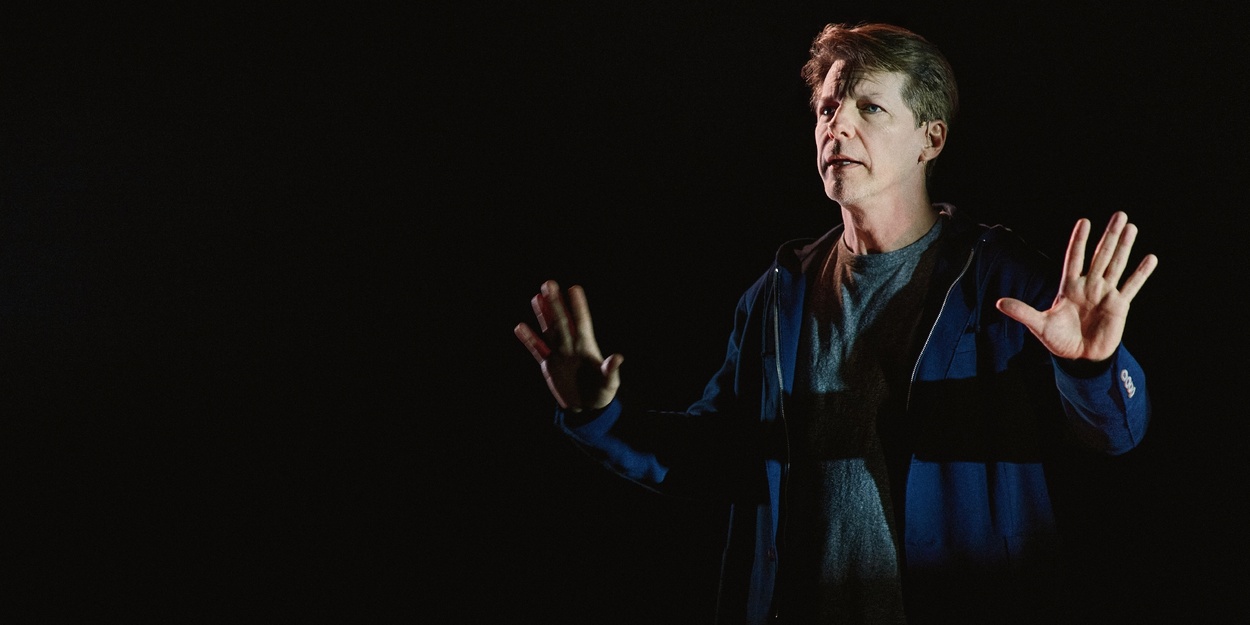
See what the critics are saying about The Unknown, a new solo show starring Tony, Emmy and SAG Award winning actor Sean Hayes. The new one-man play is written by acclaimed and award-winning playwright David Cale and directed by Tony Award nominee Leigh Silverman.
The Unknown is a gripping new play about a writer on the edge. Desperate to cure his writer’s block, Elliott retreats to a remote cabin—only to discover he may not be alone. As the boundaries between his work and his life collapse, Elliott begins to question everything he knows. Is he writing a thriller? Living one? Both? The Unknown is a provocative thriller that explores the fine line between fascination and obsession.
Helen Shaw, The New York Times: The director Leigh Silverman treats the set (designed by Studio Bent) like a noir soundstage, filling it with hard-edge shadows (Cha See designed the lights) and banks of fog-like smoke. The primary quality, though, is sound. “The Unknown” is hypnotic, which is another way of saying that its pleasures are very quiet ones. I felt like I was listening to radio drama on a rainy night, or as if someone were reading me a familiar story, but I’d forgotten the ending. Waller-Bridge’s dreamy music sounds as though it’s coming from another room, and it’s only when Cale deploys certain haptic details — Hayes describes the spare keys to Elliott’s apartment, stuck with a magnet to his fridge — that the evening takes on momentary weight.

Jackson McHenry, Vulture: The Unknown could use more of that menace. Throughout the production, and especially once Elliott’s circumstances start to get weird, director Leigh Silverman hits the audience with sudden, silent horror-film punctuation marks. The lights (by Cha See) will drop out and isolate Hayes in a beam of dread as he arrives at some further unsteadying discovery about his stalker. But those swerves into ominousness don’t linger, and Silverman and Hayes don’t keep us submerged for long.


Adam Feldman, Time Out New York: How well do you know Sean Hayes? You probably think of him as a master of broad comedy, as he demonstrated in 11 seasons as Jack on Will & Grace (and as Jerry in Martin and Lewis and Larry in The Three Stooges). Maybe you enjoy his good-natured enthusiasm on the podcast Smartless. Maybe you saw him quip, scowl and play classical piano in his Tony-winning portrayal of Oscar Levant in Broadway’s Good Night, Oscar. Even so, you might still be surprised by how well he plays a basically regular guy in The Unknown: Elliott, a somewhat isolated, somewhat depressed, mostly sober middle-aged writer who has been having a hard time devising a screenplay, perhaps because his own life has so little drama.
Charles Isherwood, The Wall Street Journal: “The Unknown” is primarily a potent entertainment, but Mr. Cale also slyly raises intriguing questions about the relationship between a writer’s life and his work—familiar territory, true, and fodder for innumerable discussions of literary biographies, but depicted here in a fresh dramatic guise. As Larry says to Elliott at one point: “So let me get this straight, you’re living your life and you’re also spying on it at the same time. Is that what all writers do?” Elliott brushes off the question, but I would guess that many fiction writers would find it just as uncomfortable to answer.
Jonathan Mandell, New York Theater: Would “The Unknown” interest Jude Law? Only, it seems to me, if he’s willing to perform it on stage. This is a trickster’s play, in a production with almost no set, but Cha See’s oblique lighting and Caroline Eng’s sound enhancing the tension and the teasing; scarier, or at least creepier, because it is live.
Frank Scheck, New York Stage Review: That’s thankfully not the case with The Unknown, receiving its world premiere at Off-Broadway’s Studio Seaview. Starring Sean Hayes, this endlessly tricky solo drama by David Cale is less a confessional monologue than a scarily gothic tale of shifting identities. It’s the rare one-person play that you can imagine as a fully fleshed-out film, perhaps directed by Brian De Palma.
Joe Dziemianowicz, New York Theatre Guide: Thematically, however, the play is too diffuse for its own good. Over its 75 minutes, it skims over juicy ideas about identity, creativity, desire (“I Wish You’d Wanted Me,” a fictional song from a show Elliott wrote, is a recurring motif), rejection, isolation, and friendship without diving deep.

Average Rating:
68.8%
.