









For better or for worse, 2026 is a hell of a time to find myself tasked with reviewing The Crucible.
To start with, I can easily say that I was thoroughly impressed by the precision, ambition, and artistry of Palm Beach Dramaworks’ take on the piece, which is something that I don’t want to lose sight of.
In attempting to assess the play itself, though, I have to admit that my reaction was somewhat more multi-faceted— which is how I now find myself torn between a desire to interrogate the script’s outdated conventions and an appreciation for the chilling prescience of its themes.
Written by Arthur Miller and first performed in 1953, this canonical work theatrically retells the true story—the infamous Salem Witch Trials. And on some level, saying that it wasn’t a particularly easy play to watch is simply a testament to how well it reflects the tragic injustice of its historical subject matter.
Originally intended to serve as an allegory for McCarthyism, the play now seems to hold up a nightmarish mirror to today’s political landscape. Literal truth is eclipsed by alarmist misinformation; religious ideology is weaponized for control; and innocent people become pawns in a performative power struggle.
The Crucible’s best moments make the stakes of that struggle visceral, with the work of the expansive ensemble cast grounding the play’s broader themes in human cost.
At plenty of other points during the show’s three hours, I felt as if those stakes were being obscured by unfocused storytelling, with the dialogue sprawling into dense procedural exchanges that slowed the narrative momentum.
In incorporating so many characters, Miller creates a thorough portrait of a community in crisis—but in doing so also makes the action more difficult to follow and diffuses our ability to connect with individuals. And unlike similarly heavy plays that leave room for moments of levity or release, The Crucible is relatively humorless, which made the weight of its runtime that much more burdensome.
Still, as a well-crafted cautionary tale, it makes a vital moral argument—even if I at times found myself wishing it could have done so more economically or entertainingly.
Interestingly, many of the moments that I did find most engaging were those where Miller ceded the floor to his female characters—who mostly felt more distinct, interesting, and theatrically alive than their male counterparts.
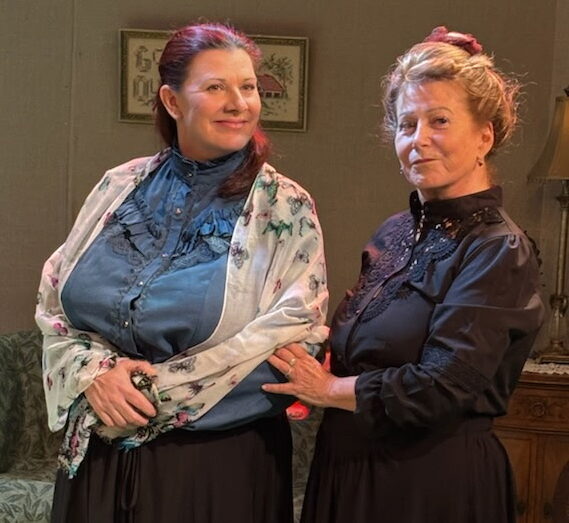
Margery Lowe is an engaging presence as Ann Putnam, and even more compelling when she reemerges as unhinged prisoner Sarah Good. Karen Stephens is equally fearless and fierce as the betrayed Tituba, and an Act 2 scene that finds the two imprisoned together is an unexpectedly electric highlight.
Julie Kleiner’s grounded portrayal of Elizabeth Proctor is powerfully affecting, as is Barbara B. Bradshaw’s as the wizened Rebecca Nurse.
And, most obviously, Abigail Williams makes for a deliciously complex antagonist, especially in the hands of actress Elizabeth Yancey. Though the character’s motivations are initially understandable, her actions become increasingly unforgivable— and I enjoyed the thrill of seeing how far her machinations escalated.
She seems to hold an almost primal sway over the other girls she recruits to bolster her accusations, something that director William Hayes’ staging physicalizes brilliantly.
Throughout, Hayes’ blocking choices keep crowded scenes coherent and the show visually dynamic. And Jessica Chen’s choreography of impressionistic transition sequences infuses welcome theatrical spark.
His vision is well-served by an equally talented design team. Costume designer Brian O’Keefe makes the most of period constraints, José Santiago’s lighting adds intensity to key moments, and Doug Wilkinson’s scenic design immediately sets an appropriately eerie mood. Projection design by Adam J. Thompson allows the show to end on a note that brings attention to its real-life roots.
Rather than try to comprehensively assess every individual actor in the show’s 20-strong cast I haven’t already mentioned, I’ll make one more note of their across-the-board excellence. But I would be remiss not to single out Tom Patterson’s exquisite handling of his role as John Proctor, whose arc is essential to the play’s emotional payoff.
All nitpicking aside, The Crucible has clearly stood the test of time for a reason, and it’s hard to imagine a more effective version than Dramaworks’ current incarnation. If you think you can handle the heat of this witch hunt, catch it only until this April 19th!
The post ‘The Crucible’ Is A Chilling Look Into History appeared on South Florida Theater.