







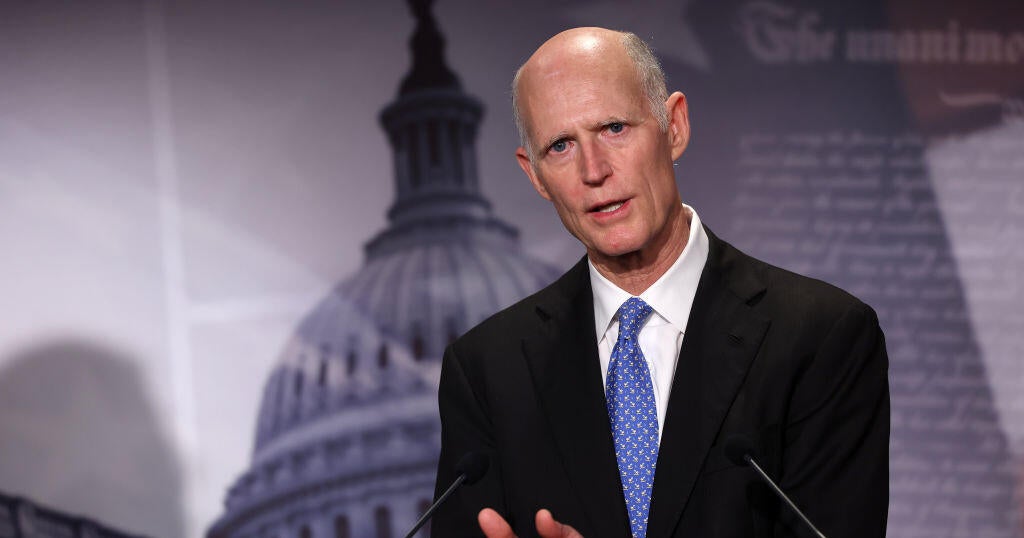
A trio of Republican senators asked the Trump administration to end a visa waiver program in far-flung U.S. territories in the Pacific that they say encourages “birth tourism” from Chinese nationals and allows them “to obtain fast-track American citizenship.”
The Guam-CNMI Visa Waiver Program allows Chinese nationals to visit the U.S. territories of Guam and the Northern Mariana Islands visa-free for up to 14 days.
In a letter to Homeland Security Secretary Kristi Noem and Interior Secretary Doug Burgum dated Jan. 15, the three GOP senators — Rick Scott of Florida, Jim Banks of Indiana and Markwayne Mullin of Oklahoma — urged the Trump administration to end the program, saying it “has opened the United States to significant security threats by creating a veritable cottage industry of Chinese nationals giving birth in the [Mariana Islands] and gaining access to U.S. citizenship.”
The senators’ letter comes as Scott pushes for a bill he introduced in November that would ban the use of surrogacy in the U.S. by people from certain foreign countries, including China. Scott’s bill highlights a Chinese-born couple in California who had nearly two dozen babies born to surrogates removed from their care last year amid a child abuse investigation.
President Trump raised the issue of Chinese “birth tourism” during a press briefing on Tuesday, speaking on a wide range of topics — including birthright citizenship — while marking the first year of his second term.
“China is making a big business out of that,” said Mr. Trump. “They come to the country. They have a child. They’re an American citizen. They get all the benefits.”
The Guam-CNMI Visa Waiver Program was created in 2009. It allows holders of Hong Kong passports to travel to the islands for up to 45 days without obtaining a visa.
In the years after its creation, Saipan, the capital of the Northern Marianas, became a hotspot for birth tourism.
But by 2024, births to tourists on the island dropped significantly. There were only 58 live births to tourists at the islands’ hospital, down from a high of 581 in 2018 during the first Trump administration, according to data provided to CBS News by the office of Kimberlyn King-Hinds, who represents the Northern Mariana Islands as a non-voting delegate in the House.
In its final weeks, the Biden administration expanded the program, allowing citizens of mainland China to travel to the islands without a visa for up to 14 days.
The GOP senators worry the Guam and Northern Mariana visa waiver policies create a long-term security risk, saying that people born through the program could eventually “apply for high positions within the U.S. federal government and likely receive priority consideration due to fluency in Mandarin.”
“This is an ongoing security vulnerability that Xi Jinping and his successors in the [Chinese Communist Party] will be more than happy to exploit,” they wrote, later adding that “birth tourism” has “overwhelmed” the Northern Marianas’ only public hospital.
But King-Hinds, a fellow Republican, disagrees.
“Congresswoman King-Hinds does not support changes to the CNMI-Guam Visa Waiver Program based on claims that ‘birth tourism’ is overwhelming the Commonwealth Health Center,” said her spokesperson, Christopher Concepcion. “Birth tourism in the CNMI is not a major issue when viewed in the context of total foreign births in the United States today, particularly given that millions of Chinese nationals travel to the mainland United States each year.”
Simon Hankinson, a research fellow at the Heritage Foundation, a conservative think tank, said the visa waiver program should be reserved for countries that share criminal record information and whose travelers rarely overstay visas. “None of that applies with China,” Hankinson said.
“We should not have any visa waiver program involving China,” Hankinson said. “China is a competitor at best, a threat at worst, and their people should be screened for visas, just like people from most of the rest of the world.”
In 2017, the Justice Department scored marquee victories in its fight against “birth tourism” schemes in Saipan. Chinese national Sen Sun was sentenced to a year in federal prison for an illegal business that catered to pregnant foreigners. In a separate case, Richard Peng, who had dual citizenship in the U.S. and Taiwan, received a six-month sentence for running a business “harboring” birth tourists, housing them on a farm on the island.
In their letter, Scott and the other senators pointed to a more recent pair of cases that they say point to continued vulnerabilities with the visa program. Last year, a Chinese national named Kangle Jiang was sentenced to 30 days in prison for transporting eight other Chinese nationals from Saipan to Guam. “Most of the passengers were later encountered in or near sensitive military installations,” according to the Justice Department.
In November, four other men received sentences ranging from 37 days to 30 months for smuggling 21 people to Guam, all of whom were Chinese nationals who the Justice Department said were attempting to avoid airport immigration checks.
The senators said the cases refute the idea that the visa waiver program benefits the islands, saying the schemes “hardly offered a reliable source of economic development for U.S. citizens and residents residing in the Marianas.”
Benjamin Jensen, a senior fellow at the bipartisan Center for Strategic and International Studies, emphasized national security concerns. He said the program could allow China “to take advantage of that loophole, to then get operatives in place to monitor U.S. military facilities, which are all increasingly being expanded and upgraded in that area.”
“We’re expanding out all sorts of runways and facilities across the entire region as part of creating mobility to get back and forth between the U.S. mainland and even Japan and the first island chain. So there’s tons of refurbishment all throughout the area of old, even World War II fields,” Jensen said. “So it’s key for military options, which is why anything that might compromise it is a real issue.”
Customs and Border Protection abruptly halted processing of applications under the program in April 2025, before resuming in July. The absence of tourists under the program during those months led to a 30% drop in visitors and a spike in hotel vacancies, the Marianas Visitors Authority said in July, calling the “pipeline” to “non-visa holders from Hong Kong and China, something we desperately need to revive our tourism economy.”
Concepcion said King-Hinds credits President Trump for work during his first and second terms that has allowed the islands’ depleted tourism industry to remain “on life support.”
“Hastening the collapse of the CNMI’s only industry by further restricting customers entering the Commonwealth and hindering the government’s dire need for revenue would do far greater harm to the fragile healthcare system on the islands,” Concepcion said.
The senators asked for a response from Noem by Jan. 28. A spokesperson for the Department of the Interior referred CBS News to the Department of Homeland Security, which said it replies to correspondence from senators through official channels.
“We would strongly urge that you require a standard tourist visa for Chinese nationals visiting the CNMI, which is a unilateral decision that can be made by the Secretary of the Department of Homeland Security,” the senators wrote.