







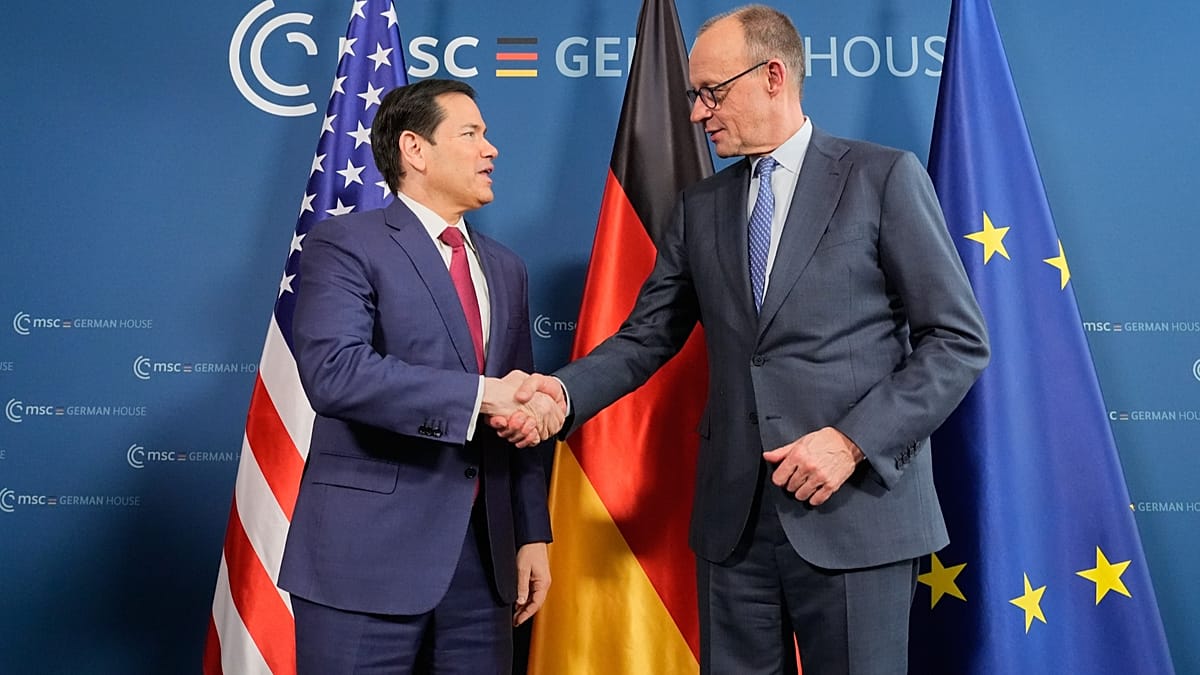
The annual gathering brought together American, Ukrainian and European top diplomatic delegations, with the transatlantic relation in focus. The three days of talks underscored two competing visions of the West, what it represents and its values.
ADVERTISEMENT


ADVERTISEMENT
US Secretary of State Marco Rubio called on Europe to help save the West as a common civilisation, while chief European diplomat Kaja Kallas pushed back saying the EU does not need saving. Meanwhile, President Volodymyr Zelenskyy urged Europeans to agree to a date so that Ukraine is “technically ready” to join the bloc in 2027.
Euronews listened to the speeches from the many world leaders and ministers that took to the stage to bring you the six quotes you must take away from this year’s edition.
US has ‘no interest in being polite and orderly caretakers’: Rubio
“We do not want allies to rationalize the broken status quo rather than reckon with what is necessary to fix it, for we in America have no interest in being polite and orderly caretakers of the West’s managed decline,” US Secretary of State Marco Rubio said on Saturday.
Context: European leaders were holding their breath before Rubio’s speech, hoping it would not be a repeat of last year’s blistering attack against the continent delivered in the same spot by Vice-President JD Vance, and as tensions remain high following the US President’s recent threats to forcefully take control of Greenland.
While Rubio adopted a softer tone compared to Vance, his message ran along the same lines: the West is facing a civilisational decline by choice due ill-designed policies stemming from a climate “cult” and mass migration. And it needs saving.
What was different though was Rubio’s call for Europeans to join in with the US, describing Washington as a “child of Europe”, and affirming that its destiny “is – and always will be – intertwined” with Europe.
Ursula von der Leyen, the president of the European Commission, said that she was “very much reassured” about ties with the US after hearing Rubio’s address.
High Representative Kallas rejected a narrative of a Europe Union that needs rescuing.
“Contrary to what some may say, a woke, decadent Europe is not facing civilisational erasure” in a reference to a controversial US national security strategy document published last year calling on report to reverse course of key policies from climate to migration.
Europe’s absence from peace talks is ‘big mistake’: Zelenskyy
“Europe is practically not present at the table. It’s a big mistake to my mind. And it is we, I think, we Ukrainians who are trying to bring Europe fully into the process so that Europe’s interests and voice are taken into account. This is very important,” Ukrainian President Volodymyr Zelenskyy said on Saturday.
Context: Europe has been sidelined from the peace talks that were started last year after Trump renewed Washington’s contact with Moscow. Bilateral talks between Ukraine and Russia are brokered by the US in locations away from the Europe.
This is despite the fact European countries are now the largest donor of military and financial assistance to Ukraine and that they’re expected to shoulder the brunt of the security guarantees following a ceasefire – although they’re asking for a US backstop.
Talks in Europe to appoint a special envoy for the talks have been ongoing for nearly a year but there appears to be no clear favourite. French President Emmanuel Macron has recently tried to renew contact with Moscow dispatching his top diplomat to Russia.
The meeting yielded few results.
Yet, as Lithuanian President Gitanas Nausėda said on Saturday during a panel in Munich, these efforts hardly matter because “Putin is not willing to talk with us and Washington is willing to let that happen”.
Zelenskyy told journalists the same, suggesting Putin would try to divide and rule a “very coordinated” Europe, although he commended Macron for being transparent about the talks and the nature of it. The French President told the Munich Security Conference that Europe will have to fully redesign its security framework facing an aggressive Russia.
World order as we know it ‘no longer exists’: Merz
“But I’m afraid we have to put it in even harsher terms: This order, as flawed as it has been even in its heyday, no longer exists,” German Chancellor Friedrich Merz said on Friday.
Context: Russia’s ongoing full-scale invasion of Ukraine, China’s unfair trade practices and bullying behaviour and the US’s increasingly dismissive behaviour towards long-standing allies and multinational institutions are completely reshuffling the geopolitics stakes.
For Merz, the rules-based international order that emerged after WWII in which the West spoke with one voice under the leadership of the US is over and “big power politics”, with its “harsh, and often unpredictable rules”, has now returned.
He warned that in this new era, Europe’s “freedom is no longer a given” and that it will “need to show firmness and determination to assert this freedom.”
France in dialogue with Germany on nuclear umbrella: Macron
“We have engaged a strategic dialogue with Chancellor Merz and (other) European leaders in order to see how we can articulate our national doctrine” on nuclear deterrence, French President Emmanuel Macron said on Friday.
“This dialogue is important because it’s a way to articulate nuclear deterrence in a holistic approach of defence and security. This is a way to create convergence in our strategic approach between Germany and France,” he added.
Context: Nuclear deterrence – which the US largely provides for Europe – is among the topics increasingly being discussed as Europe rethinks its nuclear doctrine for the first time since the end of the Cold War. The overhaul is partly driven by doubts over Washington’s future commitment to European security.
Trump has accused Europe of not doing enough for its own defence, issued threats to use military force to take Greenland from NATO ally Denmark,and made clear the US wishes to partially pull its assets back from Europe to pivot towards other threatres.
While Germany seems to be looking at the offer from Paris seriously, other EU countries are not so convinced. Spanish Prime Minister Pedro Sánchez, who has positioned himself as the anti-Trump progressive voice, used his speech at the Munich Security Conference to warn against nuclear rearmament.
He said nuclear deterrence is “a far too costly and risky” way of avoiding conflict and that “a system that requires zero mistakes and constant correction to avoid total destruction is not a guarantee, it’s a gamble.”
Trump’s ‘desire’ for Greenland ‘exactly the same’: Danish PM
“No, unfortunately not. I think the desire from the US President is exactly the same,” Danish Prime Minister Mette Frederiksen said on Saturday when asked about whether tensions around Greenland had been fully de-escalated following NATO mediation.
Context: Trump said last month he was ready to forcefully take control of the sprawling Arctic island, threatening tariffs on several European nations that had sent a few dozens troops to Greenland. The row sparked a diplomatic flurry and fears that the NATO alliance was about to collapse.
An agreement for a “framework for a future deal for Greenland” struck between Trump and NATO chief Mark Rutte led to de-escalation with the US, Greenland and Denmark since engaged in trilateral talks last month. NATO allies have meanwhile agreed to launch an enhanced vigilance activity in the High North, called Arctic Sentry.
Frederiksen reiterated from Munich that she will not compromise on territorial integrity, calling it a “red line” but stressed that “there are other things” the US, Denmark and Greenland can do together, such as extending the US military footprint on the island.
Greenlandic Prime Minister Jens-Frederik Nielsen meanwhile described the pressure on his island as “unacceptable” and the current trilateral process as “the first right step”. He added that Greenland is ready to do its part and is “committed to be part of the alliance”.
EU mutual defence clause should be revised: Von der Leyen
“I believe the time has come to bring Europe’s mutual defence clause to life. Mutual defence is not optional for the EU. It is an obligation within our own Treaty – Article 42(7),” European Commission President Ursula von der Leyen said on Saturday.
Context: The EU has launched an €800 billion programme to boost its defence readiness before 2030 in the face of a possible attack from Russia and doubts over the US commitment to NATO’s collective defence under Article 5.
The bloc’s Article 42.7 states that “if an EU country is the victim of armed aggression on its territory, the other EU countries have an obligation to aid and assist it by all means in their power” but is largely seen as less powerful than its NATO equivalent.
Washington’s powerful military might serves as a powerful deterrence for the alliance.
Von der Leyen said Article 42.7 would only carry weight if it is built on trust and capability, and the terms of the clause are still seen as loosely defined.
In her defence-focused speech, she also called for faster decision-making in EU for defence-related issues and for more partnerships with third partners, especially the UK.
Read the full article here