









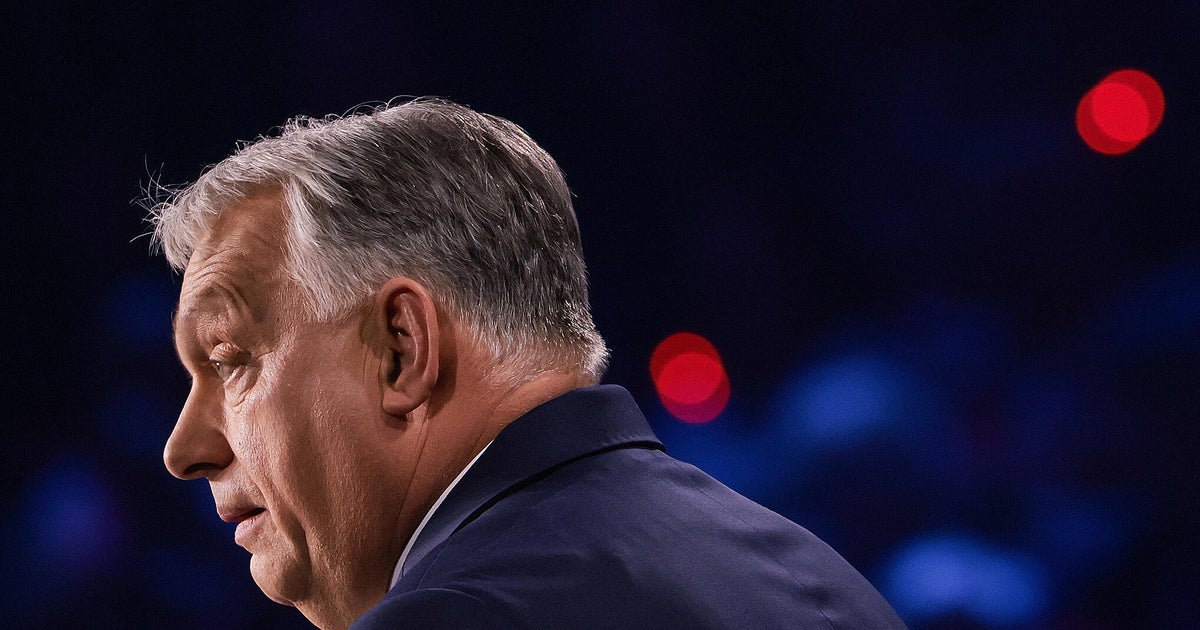
Budapest – After nearly two decades in power, Hungary’s far-right prime minister Viktor Orbán could be ousted as leader in the country’s parliamentary elections on Sunday.
The latest polls indicate that Orbán, a key international ally of President Trump, and his ruling Fidesz party are trailing the opposition center-right Tisza Party and its leader Péter Magyar in an election that will be closely watched by observers on both sides of the Atlantic.
Independent watchdogs and European Union officials have accused Orbán’s government of launching a sustained assault on the country’s democratic institutions and rule of law since he took office in 2010. In the 16 years since he took office, the country has descended to the rank of most corrupt country in the European Union, according to the U.K.-based anti-corruption group Transparency International.
Orbán has used his party’s current supermajority in Hungarian parliament to undermine the independence of the judiciary, crack down on independent media, demonize migrants and discriminate against LGBTQ people, Human Rights Watch has said. Orbán has also become known for making publicly xenophobic and racist statements, calling refugees “Muslim invaders” and saying Hungarians do not want to become a “mixed race.”
Jonathan Ernst / POOL /AFP via Getty Images
Freedom House, a democracy-oriented U.S.-based nonprofit, has designated Hungary as only “partly free,” citing issues with less-than-free-and-fair elections and a stifling of independent institutions under Orbán’s leadership.
Despite concerns over Democratic backsliding in the country, a Thursday poll conducted by the independent pro-democracy research group the IDEA Institute showed that Orbán’s Fidesz party had the support of only 37% of decided voters. The center-right Tisza party has the support of 50% of decided voters, according to the poll.
Could Trump lose a key ally?
Orbán has been one of President Trump’s closest global allies since Mr. Trump was first elected as U.S. president in 2016. He was the only European Union leader to publicly endorse Mr. Trump’s first successful bid for the presidency, and the relationship has deepened between the two men over the past decade.
On Thursday, Mr. Trump gave a full-throated endorsement of the Hungarian leader on Truth Social.
“Highly Respected Prime Minister of Hungary, Viktor Orbán, is a truly strong and powerful Leader, with a proven track record of delivering phenomenal results,” Mr. Trump wrote. “Viktor works hard to Protect Hungary, Grow the Economy, Create Jobs, Promote Trade, Stop Illegal Immigration, and Ensure LAW AND ORDER!”
The partnership between the Trump administration and Orbán was on full display Tuesday when Vice President JD Vance publicly campaigned alongside the Hungarian leader in Budapest.
Jonathan Ernst-Pool / Getty Images 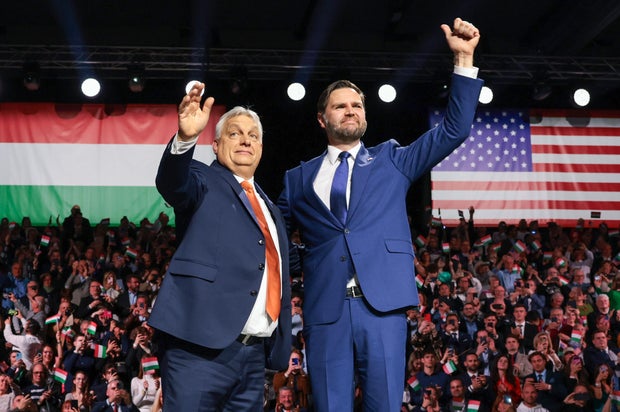

“Will you stand for sovereignty and democracy? Will you stand for Western civilization? Will you stand for freedom, for truth and for the God of our fathers?” Vance asked attendees at an Orbán campaign rally. “Then my friends, go to the polls on the weekend, stand with Viktor Orbán because he stands for you and he stands for all these things.”
The relationship goes wider than just public displays of support. Orbán’s policies have been hailed by some American conservative policy experts as a blueprint for how the U.S. should be governed. Dr. Kevin Roberts, president of the influential Heritage Foundation think tank, described Orban’s leadership as a “model for conservative governance” in 2024.
As CBS News has previously reported, pro-Orbán conservative think tank the Danube Institute also agreed to host visiting researchers from The Heritage Foundation to study Hungarian policies in various fields in 2023. Heritage and Danube signed an agreement that involved no financial transactions by either party.
“I am proud to call Viktor Orbán a friend and ally, and I am proud of the strong relationship between Heritage and The Danube Institute,” Roberts told CBS News at the time.
Fabrice Coffrini /AFP via Getty Images 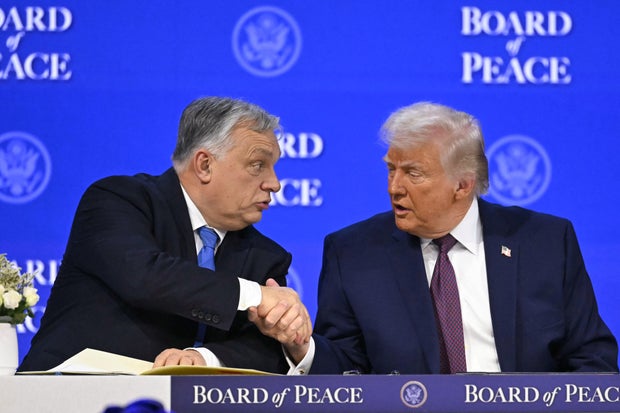

Orbán also attended the launch of Mr. Trump’s “Board of Peace” in Davos and its inaugural meeting in Washington, D.C. In February, the United States and Hungary signed a civilian nuclear cooperation agreement.
Budapest has also played host to global far-right leaders and MAGA influencers at the international version of the Conservative Political Action Conference for the past four years.
“I do think it’s good that we are collaborating with each other,” CPAC Founder Matt Schlapp, a former White House political director, told CBS News last year, regarding bringing the conference to Hungary.
“I think (Hungary’s) policies on the border and on immigration have changed the whole conversation in Europe,” Schlapp said. “It’s certainly between Orbán and Trump that have normalized this idea that you don’t just have to take an unspecific number of illegal migrants because some global institution tells you that you must.”
Ukraine and Russia also monitoring Hungary election
The election may hold significant implications for Europe’s largest conflict since World War II. Orbán has consistently dissented from European Union support for Ukraine and boasts warm relations with Russian President Vladimir Putin. While Magyar has criticized both of these positions, experts say that deeper support for Ukraine’s western integration will prove easier than untangling Hungary’s deep reliance on Russian oil.
Hungary’s dependence on Russian fossil fuels has deepened since Russia invaded Ukraine in 2022. A report from the Center for the Study of Democracy (CSD), a European public policy institute, states that in 2025, Hungary imported 93% of its oil from Russia, up from 61% in 2021.
In recent months, a spat over one specific oil pipeline has chilled relations between Budapest and Kyiv. In February, Hungarian Foreign Minister Péter Szijjártó announced that Hungary would block an EU loan worth 90 billion euros for Ukraine until Kyiv resumed oil transit through the Druzhba pipeline, which runs from Russia through Ukraine to Hungary. Orbán has threatened to break what he called Ukraine’s “oil blockade” by force, and in March, Hungary’s parliament adopted a resolution rejecting Ukraine’s accession to the European Union and opposing further financial or military aid to Kyiv
Ukrainian officials say that Hungary is using the pipeline as an excuse to carry out Russia’s interests. Ukraine’s President Volodymyr Zelenskyy has said that the pipeline was damaged in a Russian drone attack and must undergo repairs before reopening. He has also launched personal attacks against Orbán. During a cabinet meeting in March, Zelenskyy alluded to giving the Hungarian prime minister’s address “to our Armed Forces – our guys can call him and speak to him in their own language.”
This feud has made Zelenskyy a central fixture of Orbán’s so-called “anti-war” campaign. Fidesz campaign billboards feature the Ukrainian president begging for money and representing the “pro-war lobby” in Brussels.
As tensions escalate between Budapest and Kyiv, Russia has deepened cooperation with — and support for — Orbán’s government. Leaked phone calls in recent weeks between Hungary’s top diplomat Péter Szijjártó and Russian Foreign Minister Sergey Lavrov reveal the Hungarian official coordinating actions with his Kremlin counterpart. And Russia’s intelligence services have planned operations to boost Orbán’s popularity, including staging a fake assassination attempt, according to the Washington Post.
During his visit to Budapest this week, Vance said that these reports did not amount to substantial attempts to interfere in the elections — but that Ukraine’s alleged withholding of energy supplies might.
“The Ukrainians shut down pipelines, causing suffering among the Hungarian people in an effort to influence an election, that’s allegedly not foreign influence,” Vance said. “It doesn’t pass the smell test.”