








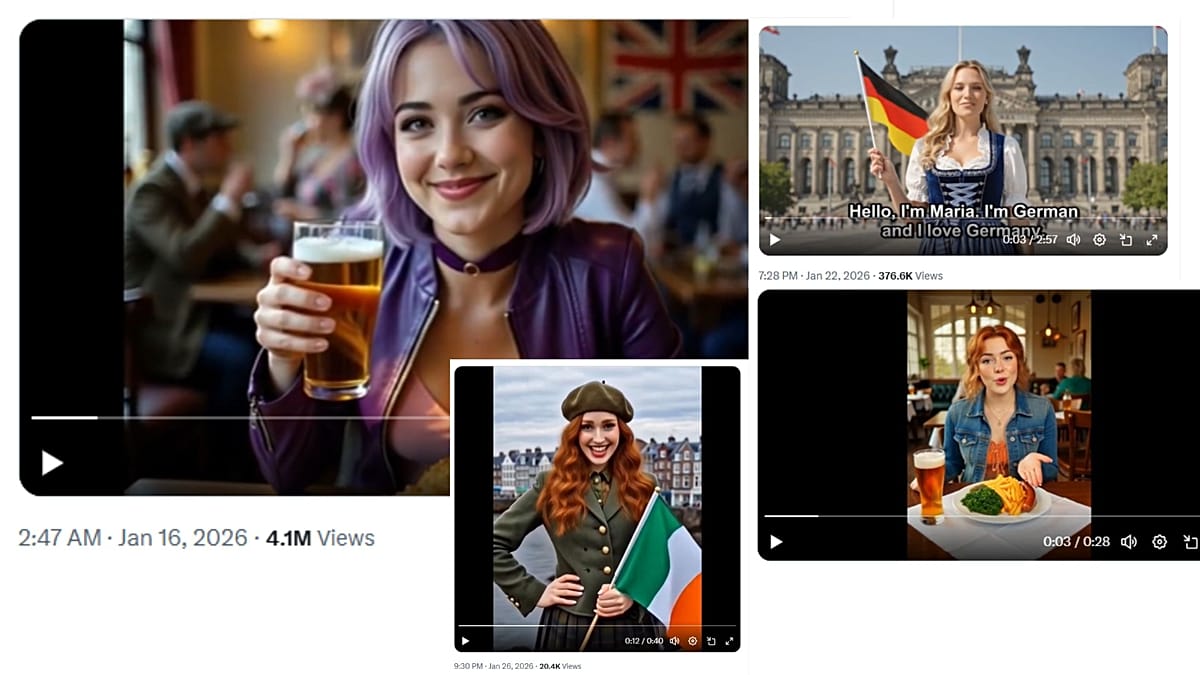
Nearly identical AI-generated characters have appeared across corners of X and Facebook all around Europe, promoting anti-immigration and anti-government messages.
Versions of the same character have been shared online, such as Dutch-speaking “Emma”, the German “Maria”, and the Irish “Amelia”.
Each character has her own national symbols and political references. In Germany, Maria wears a traditional Bavarian dirndl and expresses her love for a “cold beer in our village pub”. She claims her government is no longer protecting her and calls on “brave knights” to defend her homeland from Muslim immigrants.
In the Netherlands, an AI creation of Emma insists that Christmas should be celebrated “in the traditional way”.
In Ireland, a red-haired version of the character calls the country’s taoiseach, Micheál Martin, a “mouthpiece for Brussels”. Brussels, she insists, forces Ireland to have “open borders”, despite Ireland not being part of the Schengen area.
Individually, these videos have attracted thousands of views and interactions, particularly on X.
These copycats can be traced back to the best-known version who sprung up first in the UK. Here, Amelia, an AI-generated schoolgirl with purple hair, has gone viral, with her first viral post amassing more than 1.4 million views.
Versions of the character have spiralled on Facebook, Instagram, X and Telegram: Amelia appears in manga comics and alongside Harry Potter and the Royal Family in digitally-generated images, encouraging UK residents to “take their country back” amidst uncontrolled Muslim immigration and an incompetent government.
Amelia’s unlikely origins
The organisation that created the character the viral memes are based on says much of the online narrative surrounding Amelia is misleading.
An initial version of Amelia appeared in Pathways, an educational game developed by the UK-based social enterprise Shout Out UK in partnership with local authorities in Hull and East Riding of Yorkshire. The project was funded by the UK Home Office as part of a counter-extremism prevention programme.
The game asks students to pick a character that is then placed in various online scenarios, where they are asked to make choices about how to respond to posts, messages and various forms of peer pressure.
Matteo Bergamini, CEO of Shout Out UK, told Euronews’ fact-checking team, The Cube, that the game was developed in the background of 2023, when local authorities in Hull and Yorkshire found that radicalisation was riskiest online, especially for children between the ages of 13 and 18.
“The threat was mainly from the emerging online extreme right-wing ecosystem,” Bergamini said, adding that the game itself was targeted and limited to these areas in the UK.
The game was not meant to be played in isolation and formed part of a wider learning package designed to allow teachers to facilitate nuanced discussions about unsafe versus safe behaviours, he added.
Amelia in the game is not a protagonist or role model, but a minor character who encourages the main character to engage in risky online behaviour.
In addition, the game does not, contrary to online claims, suggest a teacher refer a child to Prevent, a UK government programme, for questioning mass migration.
It appears that the Amelia meme sprang up within far-right circles as backlash to what they saw as a caricature criticising their views against immigration and the “nanny state”.
The Cube reached out to some creators of the meme, who did not respond in time for publication.
Extreme versions and monetisation
The majority of Amelia memes, particularly on mainstream platforms such as X, are relatively harmless. They would not require removal under the rules of the Digital Services Act (DSA).
The DSA requires platforms to remove illegal content such as hate speech, terrorism and child sexual exploitation material, as well as specific types of harmful advertising.
But researchers who have been following Amelia’s rapid rise say that extreme versions of the character exist in niche online communities and on apps such as Telegram.
Siddharth Venkataramakrishnan, an analyst at the London-headquartered think tank the Institute for Strategic Dialogue (ISD), said that the meme has been taken up by a broad spectrum of online communities, from those who are using it ironically to some of the largest anti-migrant accounts.
Whilst not every version of the character contains hate speech, there are versions of it that use dehumanising and violent imagery targeted towards specific communities.
Shout Out UK says that their character has been “memefied and sexualised” online by right-wing actors, with many attaching it to racist and antisemitic language, Nazi and far-right tropes.
The campaign, the organisation says, has moved beyond internet spaces and led to threats and malicious messages being sent to its staff members.
Amelia has also become a vehicle for monetisation. The ISD has identified accounts promoting Amelia-themed meme coins, a common trend for viral social media movements.
With this in mind, Venkataramakrishnan says, it’s unclear which accounts are posting Amelia memes for the political messaging, and which are pushing it for profit-driven engagement.
“Where does the line cross from supporting something because of ideology to supporting it because you want to make money?” he said.
Emotionally charged memes are also more likely to gain traction on social media once engagement starts to build, Venkataramakrishnan explained, an effect that would have pushed Amelia memes to spread rapidly.
Read the full article here