










Mia Matthews celebrates — for the moment — in Island City Stage’s The Little Foxes (Photos by Matthew Tippins)
By Oline Cogdill
The trifecta of toxicity—greed, extreme ambition and pure hatred—combines in a sophisticated plot in Lillian Hellman’s classic drama The Little Foxes, receiving a stunning production through Feb. 8 at Island City Stage.
Michael Leeds’ assured direction—and his stellar cast—find fresh ways to explore these themes that seep through the nasty Hubbard family whose obsession with money and power override any relationships or emotions they might possess, discarding anyone in their way. Leeds makes the most of Hellman’s 1939 multi-layered, near perfect script that is as relevant today as it was at the turn of the 20th century when it takes place.
Set during 1900 in a small Alabama town, The Little Foxes revolves around the Hubbards—brothers Benjamin and Oscar, their sister Regina Hubbard Giddens and her husband Horace, a banker who has spent the last five months in a Baltimore hospital suffering from a heart condition. The brothers are obsessed with joining up with a Chicago company to build a cotton mill to “bring the machine to the cotton, and not the cotton to the machine,” says Benjamin. This deal will take the family from their solidly upper-middle class status to being truly wealthy.

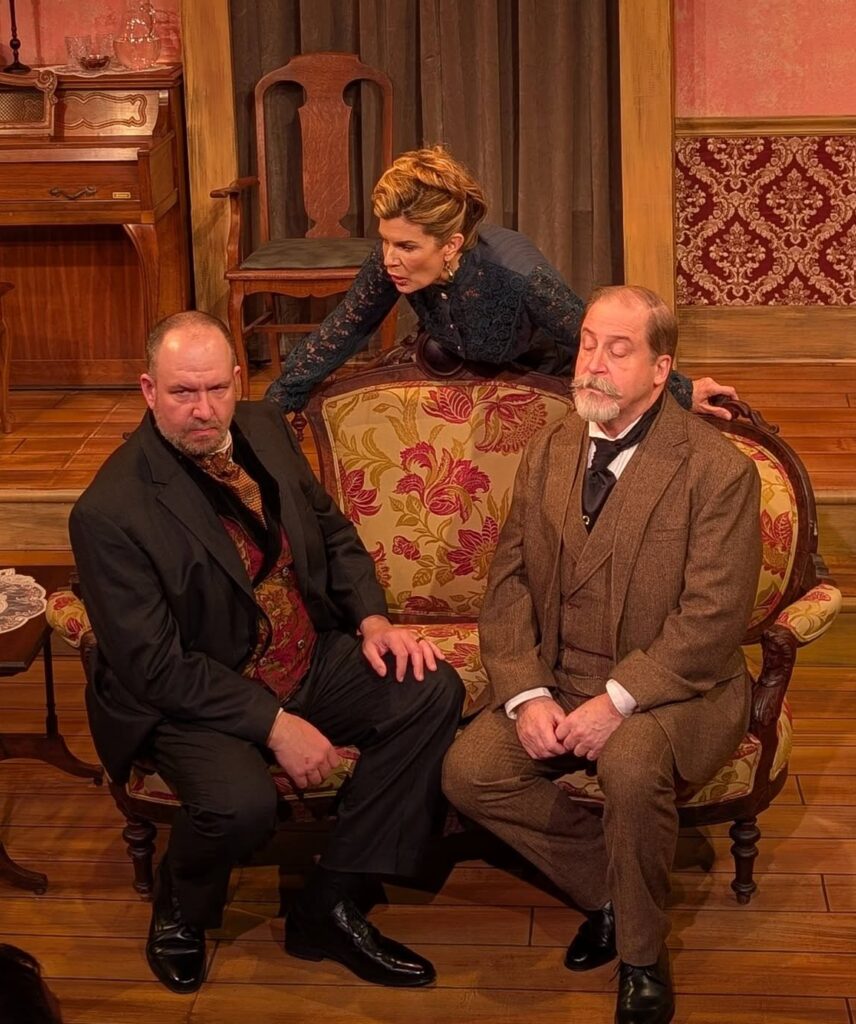
JohnBarry Green, Mia Matthews, Stephen Trovillion
Benjamin, a superb Stephen Trovillion, and Oscar, an equally superb JohnBarry Green, lust after this business plan and would love to keep it between the two of them, shutting out the Giddens. But they need $75,000 from bonds that Horace has in his safe deposit box at his bank. But so far, Horace has refused to answer any of the brothers or his wife’s letters about the proposed mill.
Regina desperately wants Horace to hand over the money. She yearns for wealth beyond what she knows so she can buy whatever she wants, escape the small town, and her loveless marriage. She dreams of being part of Chicago’s high society. “We are in-between, neither poor nor rich,” states Mia Matthews who invests Regina’s longing for money in her timbre.
The siblings are callous people who care only for themselves, fueled by a sense of entitlement. This is illustrated by Oscar’s daily shooting of wild animals whose carcasses are abandoned, left to rot. He angrily rejects the suggestion that the town’s poor residents could use the meat to feed their families. That the mill may change the area’s environmental makeup is of little concern.
Regina often is considered the villain of The Little Foxes—a manipulative, unfeeling emotionally bankrupt shrew, willing to betray her brothers, even watch someone die to get what she wants.
And she is all that, but she is no worse than her brothers. And she is much more.
Under Leeds’ vision, the luminous Matthews shows Regina’s myriad sides. Regina is a product of her era, when women had little power and were limited by the choices this small town offered. She was raised in a misogynistic family. Her brothers followed the path set by their father in their habit of underestimating her. Matthews digs deep to show that Regina has fought all her life for every shred of dignity and influence she has. The audience may not like Regina, though compared to her brothers she’s a near angel. But Matthews makes us understand her motivation.
Oscar’s wife, Birdie, (a marvelous Margery Lowe) seems to be the opposite of Regina. Birdie is physically frail, emotionally fragile, too chatty—the epitome of her name. But Lowe also shows Birdie has an inner strength though she doesn’t know what to do with it. Lowe eloquently shows how Birdie has resigned herself to a life of domestic abuse, that Oscar married her only for her land and that her sole refuge is alcohol. Birdie has only scorn for her husband and her smarmy son Leo. Birdie and Regina share the same traits, but exhibit them differently. Regina turns her disdain outwardly, planning her escape while Birde directs hers inwardly, seeing no way out. (This double-sided personality was explored in the 2017 Broadway revival in which Laura Linney and Cynthia Nixon alternated as Regina and Birdie.)
Christopher Dreeson’s second act appearance as Horace returning from the Baltimore hospital, changes the dynamics of the relationship. Horace is ill, very ill, relying on his box of medications, a cane he keeps dropping, finding a little comfort by sitting in his wheelchair as he did when he ran the bank. Dreeson shows Horace’s frailty but also lends a forcefulness to Horace, depicting him as the intelligent, in-control banker he once was, while trying to make peace with the fact he is dying. Horace is close to being the moral center among the brothers and Regina, but he has a bit of a dark past. He genuinely despises Oscar, Benjamin and Regina and knows Leo is a fool. He loves his daughter, wanting her away from Regina and he respects his servants. His reasons for wanting nothing to do with the mill have little to do with money. Dreeson depicts Horace’s contrasting personality with aplomb.
Oscar and Birdie’s oily son Leo (a perceptive Christian Cooper) seems headed in the direction of his father with his compassionless attitude toward life. He frequents prostitutes, “keeping” a woman in Mobile. Leo wants to be valued by his father but can only achieve this through theft.
But Alexandra, the daughter of Horace and Regina, shows promise that her future may be different. Mallory Flory takes Alexandra from a girl to a young woman who can stand up for herself.
The discussion of forcing a marriage between Leo and Alexandra is a cringe-worthy moment, an idea borne purely from greed. That Leo and Alexandra are first cousins doesn’t matter—after all the siblings’ grandparents were first cousins, which might explain a lot about this family dynamic. Only Birdie finds this plan repulsive, knowing this would be the ruin of her beloved niece.
Carey Brianna Hart as Addie and Randy Coleman as Cal make the most of their roles as the Giddens’ servants. Addie respects Horace, worries about Alexandra and feels sorry for Birdie. She and Cal both have no illusions about the rest. They know the kind of people for whom they are working.
Jeff Burleson makes a memorable brief appearance as Marshall, the representative of the Chicago company that sets the plot in motion.
Production values soar. Island City Stage again proves that its postage-stamp size stage is no hindrance in mounting large-scale plays as it showed last season with Edward Albee’s A Delicate Balance.
Ardean Landhuis’ scenic and lighting design is two tiered, with a functional staircase with well-appointed furnishings befitting an upper middle class house during 1900. David Hart’s sound design adds to the ambiance. W. Emil White created and sewed the beautiful dresses the women wear, fitting their personalities as their story arc changes. The men’s clothes were purchased.
Island City’s 14th season continues to be captivating with its recent hilarious staging of the dark comedy musical Ruthless!, this outstanding The Little Foxes and an intriguing upcoming schedule.
The Little Foxes presented by Island City Stage runs through Feb. 8 at 2304 N. Dixie Highway, Wilton Manors. Performances 7 p.m. Thursday, 7:30 p.m. Friday-Saturday, 1 p.m. Saturday, 5 p.m. Sunday. Tickets $43-$48, contact 954-928-9800 or islandcitystage.org.

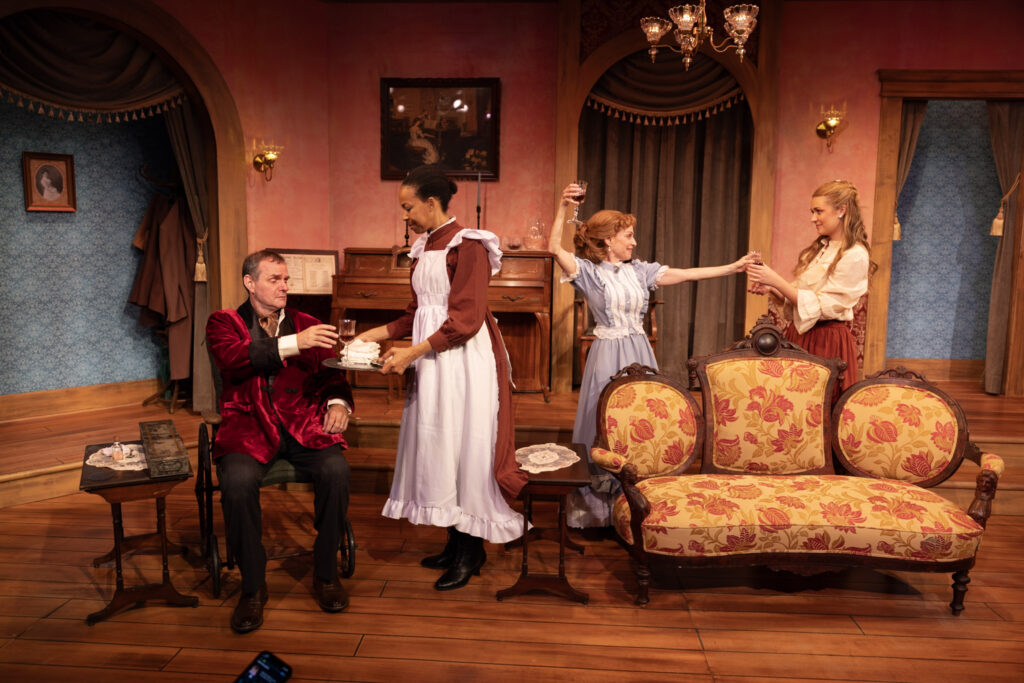
Christopher Dreeson, Carey Brianna Hart, Margery Lowe and Mallory Flory in a rare moment of peace and hilarity.