











LOS ANGELES () — March is colorectal cancer awareness month, and one in three Americans eligible for screening go unscreened.
But people under 45 aren’t eligible for colonoscopies — yet more in this age group are dying.
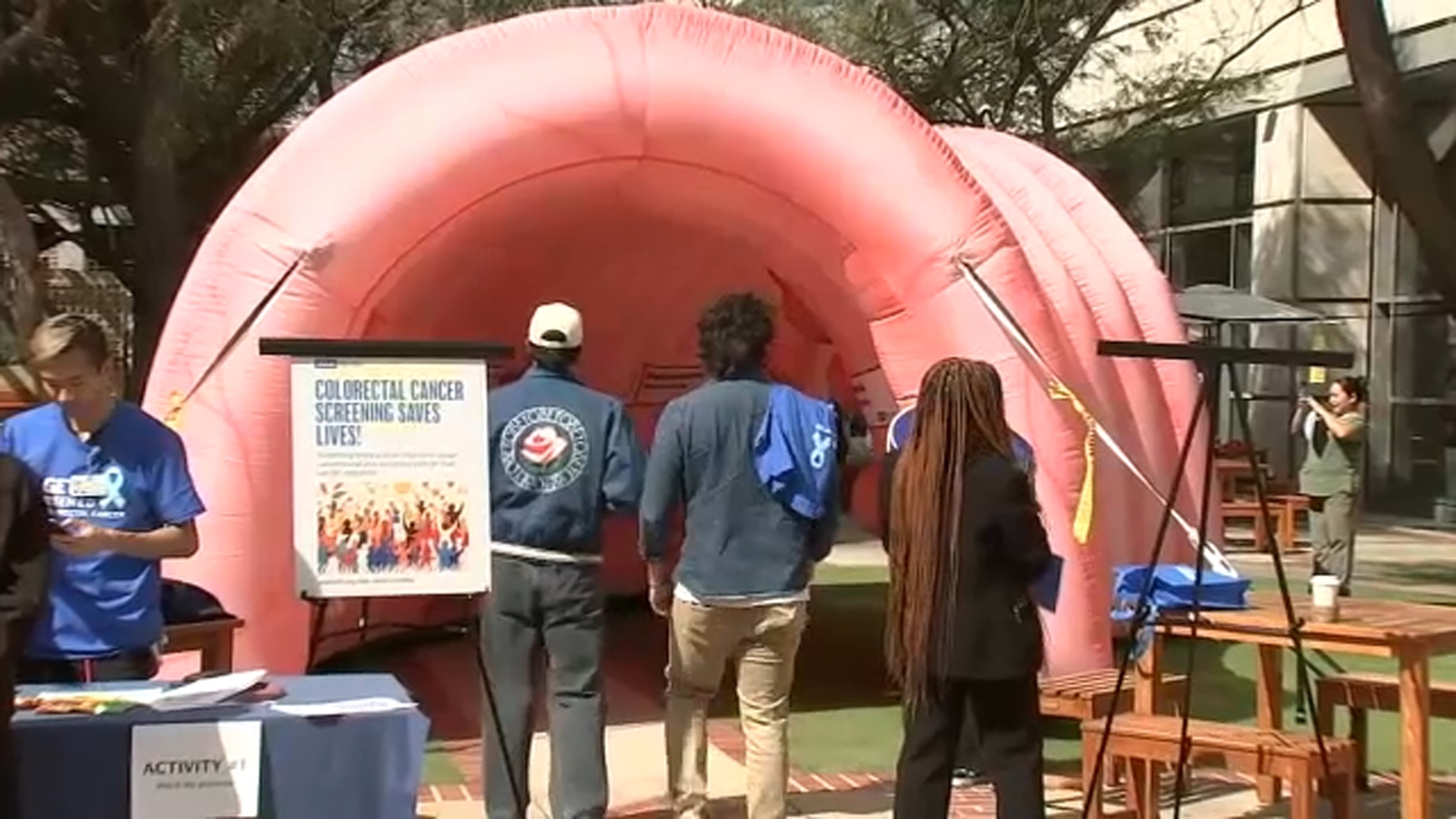
Doctors at the UCLA Ronald Reagan Medical Center are hoping a larger-than-life display will save lives.
“Just recently, we learned that it’s the number one cancer cause of death in men and women under the age of 50, and that’s a new statistic,” said UCLA Gastroenterologist Dr. Fola May.
A walk-through, inflatable colon was put on display Friday, allowing visitors to see and learn about polyps, early-stage cancers and advanced disease.
Doctors said it represents the growing crisis in colorectal cancer.
At 26, Kyle McEwen of Santa Clarita started experiencing extreme stomach pains and his doctor told him it was very unlikely he had colon cancer.
“It kind of came to a dead end at one point. She tried to comfort me by telling me I had mostly anxiety,” said McEwen.
But it wasn’t all in his head. He did more research and found a gastroenterologist who did a colonoscopy. The findings were a shock.
“We did one and he came and he said, ‘Yeah, unfortunately, we found a tumor,'” he said.
McEwen had stage 3 colorectal cancer. May said anyone born after 1950 is at increased risk.
“As we look at millennials and Gen Z and the Gen Alpha, unfortunately, those rates might be even higher in those generations,” she said.
Is it the way food is processed? Is it more screen time? Less exercise? Doctors said those are the million-dollar questions.
“There might be a role in chronic inflammation or microbiome,” said May. “It’s likely that it’s a combination of these effects in an individual and maybe plus some genetic predisposition that puts you at risk.”
If you find it early, colorectal cancer is 90% curable. Colonoscopies are recommended to start at age 45, earlier if you have a family history.
McEwen didn’t fit into any of those categories, but he knew something was wrong. He didn’t stop until he found doctors who would listen to him.
“Advocate for yourself,” he said. “I mean, there’s nothing more important. You know your body more than anybody else.”
Five years after his diagnosis, McEwen is cancer free.
He said sometimes it takes a huge reminder for people to take action.
“If it means that we have to have an inflatable colon in the courtyard for people to pay attention, I think it’s good.”
© 2026 Television,