










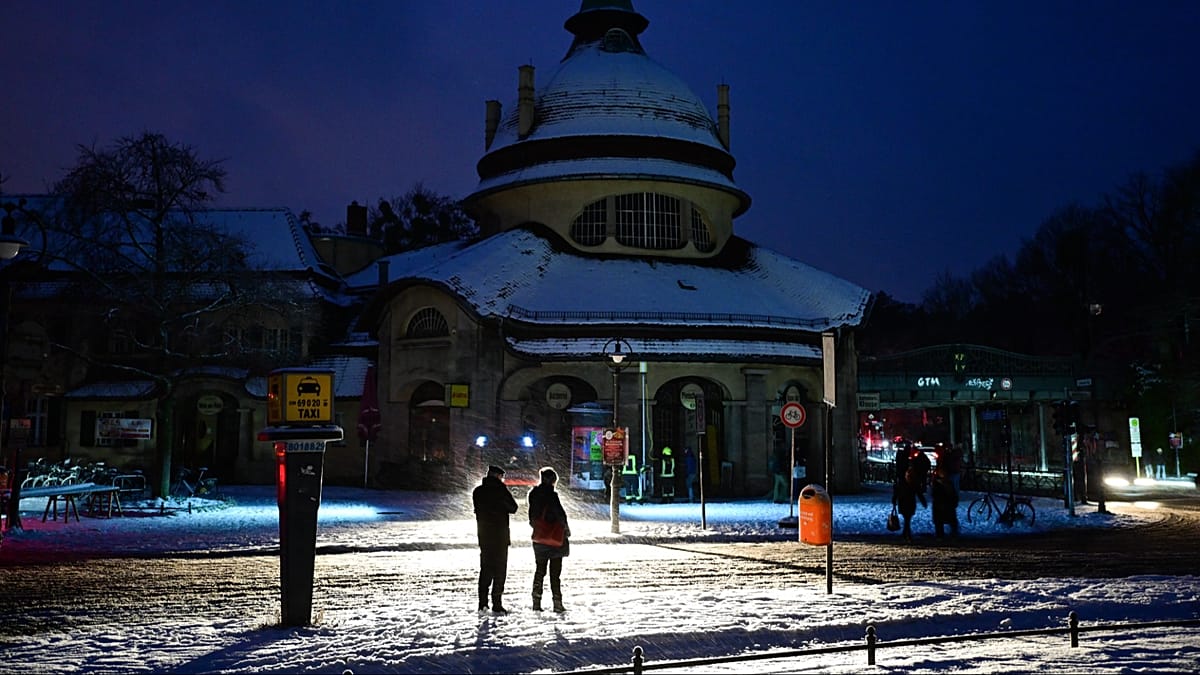
Tens of thousands of households in southwest Berlin were left without electricity, heating and, in some cases, mobile communications after a suspected arson attack on 3 January damaged high-voltage cables on a bridge over the Teltow Canal.
It took four days to authorities to start reconnecting houses to electricity, making it the longest blackout in the German capital since World War II.
A far-left group calling itself the “Vulkangruppe” claimed responsibility for the attack in a letter published online, a claim German prosecutors are now investigating as suspected arson and sabotage.
As repairs dragged on in freezing winter conditions, frustration grew among residents. At the same time, social media posts and AI-generated videos circulated claims that the blackout had worsened because Germany no longer had emergency generators available — as they’d all been sent to Ukraine.
The Cube, Euronews’ fact-checking team, traced some of these claims back to an article published by German daily the Berliner Zeitung, which reported that 1,700 emergency generators were sent to Ukraine via the German federal agency for civil protection and disaster relief (THW), a claim later cited in social media posts.
One post circulating on X falsely claims Berlin’s Mayor Kai Wegner said that “All generators are in Ukraine now”. Another post on Facebook says that, “Unfortunately, all of the German THW’s power generators are located in Ukraine!”.
AI-generated videos also circulated on TikTok, with one showing a fake newscast, with a fake emergency responder answering a question on whether generators are available with, “Unfortunately, not a single one, because all our units are in Ukraine”.
The Berliner Zeitung did not immediately respond to The Cube’s request for comment.
Did Berlin have enough generators?
Statements from authorities show that claims suggesting Berlin lacked enough emergency power generators during the blackout are misleading.
At a press conference on 5 January, Germany’s Interior Ministry said that emergency generators were available during the incident and deployed to support critical facilities, such as hospitals, care homes and emergency shelters.
Germany has indeed delivered approximately 1,700 emergency power generators to Ukraine via THW since the start of Russia’s full-scale invasion, as Ukraine’s energy infrastructure has come under repeated attack.
However, the Interior Ministry said those generators were procured specifically for Ukraine, and not taken from the disaster management agency’s own stock, which remained available for domestic emergencies.
Why did the blackout take so long to fix?
Experts told The Cube that, in this context, more emergency generators could not replace damaged grid infrastructure.
Herbert Saurugg, an expert on blackouts and crisis preparedness, told The Cube that emergency generators have only a limited role during major grid failure. Emergency generators are only able to support essential processes, he said.
Saurugg explained that the length of the outage was linked to the scale and complexity of the damage, as multiple components were attacked at the same time.
“This was because several important cables and different systems were affected,” he said. “In addition, two different designs had to be connected to each other, which normally takes weeks.”
Taking this into consideration, the four-day repair was carried out unusually quickly. “A special feat of engineering was required to carry out this repair in the shortest possible time and under these conditions,” he said.
According to Kai Strunz, a professor of electric energy systems at the Technische Universität Berlin, the attack caused extensive physical damage to the grid, destroying five high-voltage cables and needing comprehensive excavation works.
An unusually cold winter and sub-zero conditions exacerbated the difficulty in repairing the damage. “The heavy damage and very low subzero temperatures made the works on the cables themselves and the cable joints quite challenging,” Strunz said.
Manuel Atug, founder of AG Kritis, an independent group of security experts working to improve the resilience of Germany’s critical infrastructure, emergency generators cannot simply be connected to residential areas unless the infrastructure is already in place.
“You can connect companies or houses to emergency generators if you have a connection possibility,” he said. “And if the connection possibility is not there, you will have a struggle.”
He added that the presence of generators does not shorten repair times when the grid itself is damaged.
“The repairs in this scenario can’t be quicker,” Atug said. “So there is no help if you have some generators in some areas.”
Nevertheless, many residents questioned how it could be possible that such a critical part of Berlin’s energy infrastructure could be damaged by an attack, with most anger expressed towards the city’s mayor, who was reported to be playing tennis during the blackout.
Read the full article here