










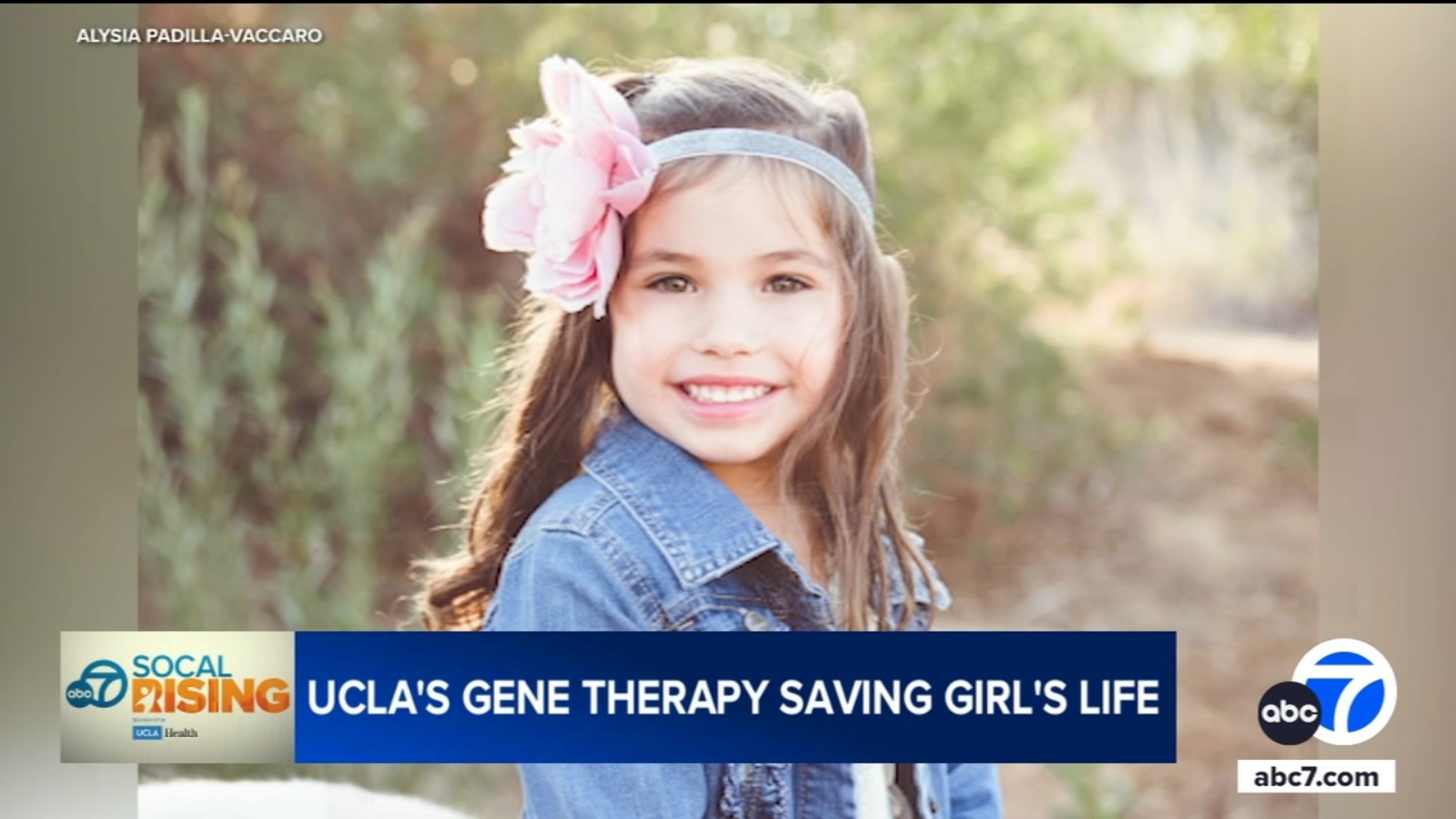
CORONA, Calif. () — A teenage girl is alive thanks to an experimental gene therapy treatment created at UCLA.
She was born with a rare genetic disorder, so any common infection could’ve killed her.
But instead of living her life in a bubble, she’s now thriving.
At birth, 13-year-old Evangelina Vaccaro was dealt a pretty rough hand.
“It kind of felt like a death sentence that day,” said her mom, Alysia Padilla-Vaccaro.
She recalls how a newborn screening test confirmed her daughter was born with a rare genetic disorder, making any common infection life-threatening.
“She had no fighting defenses. No immune system whatsoever,” Padilla-Vaccaro said.
The 1976 movie “The Boy in the Plastic Bubble” was the first time many Americans were introduced to ADA-severe combined immunodeficiency, or ADA-SCID.
Most kids born with this disease don’t live past two years old.
“For patients with SCID, they will almost certainly get an infection that will be fatal,” said Dr. Donald Kohn with the Broad Stem Cell Research Center at UCLA.
Conventional treatment involves replacing the faulty immune system through a bone marrow transplant from a matched donor.
Evangelina, nicknamed Evie, has a twin sister.
“Annabelle was not able to be that perfect match we were looking for,” said Padilla-Vaccaro.
The only other option? An experimental gene therapy.
We first met Evie when she was two years after she underwent an autologous stem cell transplant at UCLA. Dr. Kohn, along with British researchers, pioneered a procedure to correct the faulty gene.
“So, we take some stem cells from the patient, and then in the laboratory we introduce with a virus a normal copy of the gene that they’re missing, and then we transplant those cells back to the patient,” Dr. Kohn said.
It sounds so simple, but the process took three decades of research to refine.
At 3 months old, Evie became Dr. Kohn’s youngest patient.
Today, more than 60 children have been successfully treated.
After a year, Evie was able to shed her protective bubble and has since lived like any other girl her age.
“I’m fine with sharing food with others. I have. I can drink out of other people’s water bottles if I know them. I’m fine with that. I don’t really care,” Evie said.
She’s been playing competitive tennis for the last four years.
Evie’s immune system works beautifully. The hope is that the gene therapy will get FDA approval so that many more children can live long and healthy lives just like Evie.
“We have a waiting list right now of 20 patients or so who are waiting to get this therapy that is not available because we don’t have the funding to make the cell products and treat the patients,” Dr. Kohn said.
“Science gave it to her. They gave her a life that we couldn’t give her,” said Padilla-Vaccaro.
A life many of us take for granted.
© 2025 Television,