









Published on •Updated
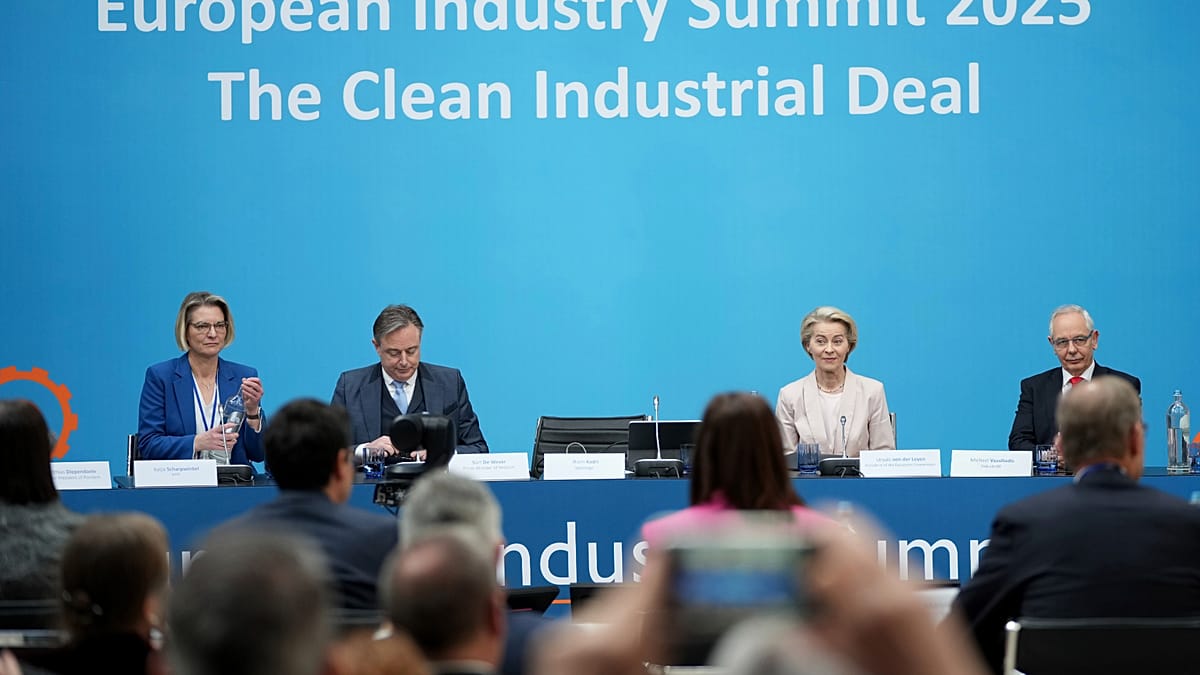
Europe’s top leaders will meet some of the most influential industrial chiefs at a gathering in Antwerp ahead of a crunch summit later this week focused on competitiveness.
The meeting comes as the power dynamic between the industry and the political leadership shifts with a focus on reducing bureaucracy and cutting costs for European companies faced with higher energy costs, tariffs and increasing competition from China.
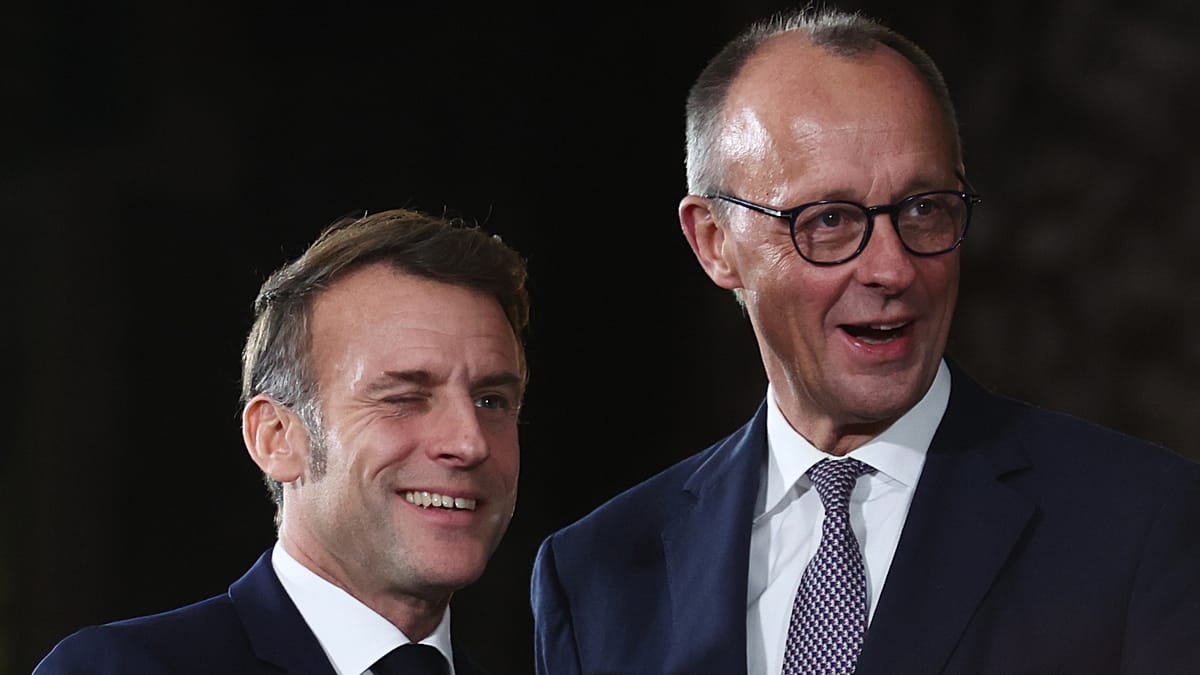
Belgian Prime Minister Bart De Wever, French President Emmanuel Macron and German Chancellor Friedrich Merz are expected to participate at the gathering held in the Belgian port city. They will be joined by the President of the Commission Ursula von der Leyen.
Ahead of the meeting, von der Leyen vowed to continue reducing excessive red tape for companies, extending the pro-business agenda of her second Commission.
The German politician has made bolstering the European economy’s competitiveness the core of her executive’s action, focused on slashing overall regulations under the umbrella of simplification, a Brussels term centered on cutting business barriers.
In a letter published Monday, von der Leyen called to deepen the European single market, which connects 450 million consumers across the EU and is often described as the money maker for the bloc, by removing internal barriers between countries.
The International Monetary Fund estimates market barriers amount to 45% tariff on goods and 110% for services, a drag on the world’s biggest integrated market.
She also promised to roll back gold plating, which sees member states adding more regulation to existing directives, pushing up regulatory costs for smaller businesses.
Her pledges go in line with demands from Rome and Berlin.
At a bilateral summit held last month, Italian premier Giorgia Meloni and German Chancellor Friedrich Merz agreed to put the automotive sector at center of the European industry, called for fewer rules and a more pragmatic approach to climate regulation.
Taking a different stance, France is proposing a European preference that aims to prioritise EU-made products and services in public procurement while promoting domestic production within EU supply chains.
European industry sees influence grow over policymaking
Industry bosses from the chemical sector to construction and manufacturing say they want to use the Antwerp gathering to build on the 2024 Antwerp Declaration, which brought together 73 industry leaders and has the backing of more than 1,000 companies.
Led by trade lobby European Chemical Industry Council, the declaration endorsed last year called on leaders and the Commission to address the “urgent needs of the European industry” and provide “clarity and predictability” in the bloc’s industrial policy.
“The action plan needs to include actions to eliminate regulatory incoherence, conflicting objectives, unnecessary complexity in legislation and over reporting,” it said.
The declaration touted the need for a future commissioner responsible a ‘European Industrial Deal’, a role handed to French Commissioner Stéphane Séjourné in 2025.
The plan also pledged to address high energy costs and enhance competitiveness by allocating over €100 billion in funding to the green transition, with a focus on energy-intensive sectors, the much-awaited and controversial Industrial Accelerator Act.
‘Deregulation without a real industrial strategy’
Stil, the push for pro-industry policies has raised concerns among watchdogs and environmental groups, stressing the growing influence of executives and key industry lobbies over policymakers, rather than keeping the core of climate goals intact.
“Deregulation is not an industrial strategy. The claim that climate and environmental policy is the main cause of Europe’s industrial difficulties does not stand up to scrutiny,” according to a statement by NGO Climate Action Network Europe.
“Europe needs evidence-based industrial governance, not policy driven by short-term lobbying pressure.”
Neil Makaroff, director at think tank Strategic Perspective, added “cutting red tape may help at the margins”, but does not represent a long-term industrial strategy capable of competing with China and the United States.
Read the full article here