








The opinions expressed in this article are those of the author and do not represent in any way the editorial position of Euronews.
Nine months ago, I was travelling to Nuuk. After a five-hour journey, the snowy island came into view — only for the plane to suddenly make a sharp U-turn due to fog.
Another five hours later, we completed our round trip. It took me ten hours to get from Copenhagen to Copenhagen. Greenland remained an enigma: easy to talk about, difficult to reach.
It felt like a scene from the 1970s. Yet this reality is far from outdated. In the new world shaped by US President Donald Trump, NATO must monitor not just its eastern flank, but increasingly its western edge as well.
Within days, a Venezuela moment evolved into a Western Hemisphere moment, into a Greenland moment, and finally into a NATO crisis momentum. Ukraine already feels like a distant war.
For the EU, Greenland presents a looming dilemma: overextend or concede. This is a NATO-made crisis, member against member, and existential in nature.
No empty “deep concerns” or agitating statements are in order. Foresight, preparedness and action should be our response. This response must be tailored. We need to prepare for three scenarios and draw difficult long-term conclusions from each of them.
US-Greenland cooperation is the path forward
The preferred path is cooperation. In a normal world, it is possible to meet American concerns regardless of Greenland’s territorial status.
The three defence treaties—starting with the debatable Greenland treaty of 1941, continuing with the still valid and NATO-compatible Agreement of 1951, and its Igaliku modification of 2004, which gave Greenland a say—form a solid and flexible basis for deeper cooperation and broader rights for the American military.
It is possible to expand the US military presence within these agreements. It is possible to strengthen NATO cooperation in the Arctic, as Nordic foreign ministers recently emphasised.
Economic cooperation with the US, especially since Greenland is not in the EU, is another avenue.
But cooperation has prerequisites. The United States must formally recognise Danish sovereignty and Greenland’s right to self-determination.
Given Trump’s lack of reliability, any widening of US presence without formal confirmation of Danish rule and Greenlandic rights could become a trap. More US presence could turn into a prelude to a later takeover.
I doubt that the cooperative scenario is the current administration’s desire. The US administration does not sound like it wants to cooperate. It wants to own.
In that case, the scenarios become messy, but one still looks acceptable from a European point of view, under certain conditions.
Greenlandic independence is possible
The acceptable scenario would test the EU’s and Copenhagen’s credibility in respecting Greenland’s right to self-determination.
Making Greenland an independent state is possible and legitimate under the 2009 Self-Government Act.
A number of American officials and businesspeople are eager to facilitate such independence and later establish a close relationship with Greenland, for example, along the lines of the Marshall Islands.
This path is legitimate. But it comes with caveats and must meet clear preconditions.
First, the process is not fast. Negotiations between Denmark and Greenland would need to lead to an agreement between the two governments, confirmed by Greenland’s parliament and sealed by a referendum among Greenland’s population.
The agreement would then require confirmation by the Danish parliament. The process exists, and it matters.
For this option to be acceptable, two prerequisites must be met. If the free will of Greenlanders and the Danish leadership is to be respected, that will must be free and informed.
First, the US administration must stop its threats of military action. Under international law, threats of force are as illegal as the use of force. Negotiations under coercion are unacceptable.
Second, there must be no propaganda. The EU should already begin a strategic anti-disinformation effort to prepare for external pressure and manipulation, particularly through social media.
Only if threats are eliminated and disinformation neutralised can independence become a viable path with this American administration.
Given the time required for independence negotiations and the narrow political window before US midterm elections, a third option may appear tempting in Washington, but it would be devastating for all. This is the confrontational scenario: a forceful takeover.
Two points matter. First, the most likely form would be an instantaneous fait accompli.
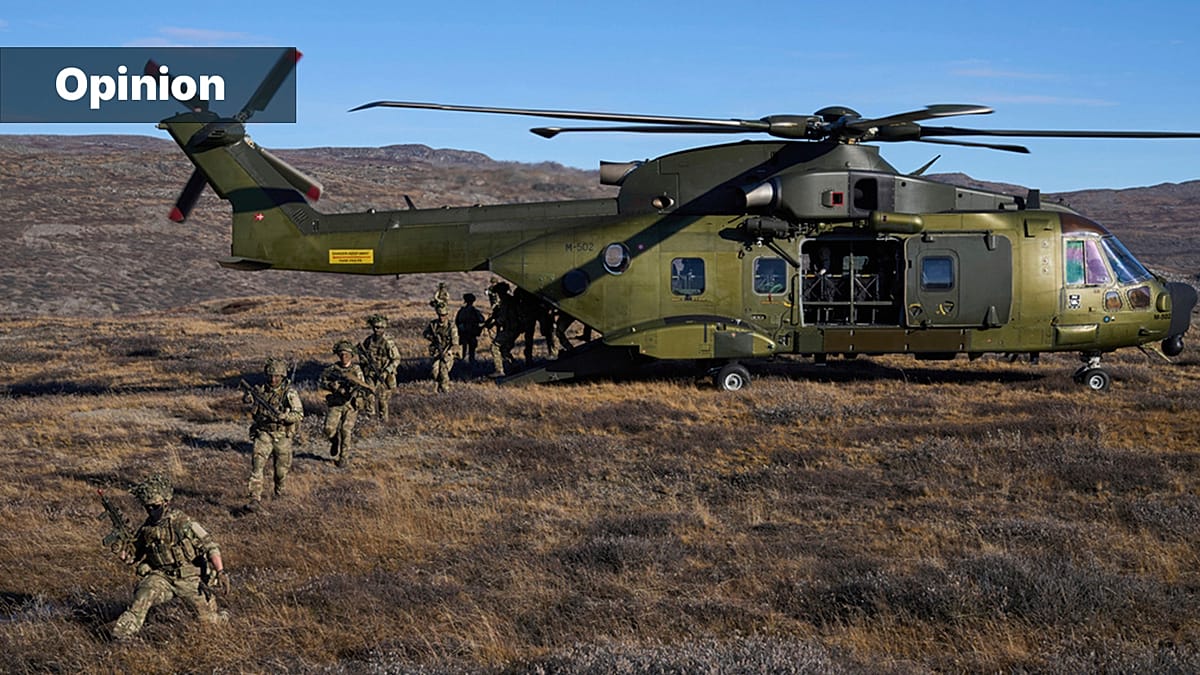
That would mean a sharp increase in American troop numbers from today’s roughly 150 personnel at Pituffik Space Base.
EU boots on the ground
To counter this scenario, European troops, Danish or otherwise, should be positioned in Greenland in advance. This would raise the threshold for presenting Europe with accomplished facts on the ground.
Second, clarity about consequences is essential. No one believes a war between the US and the EU is desirable or winnable.
But a military move against the EU would have devastating consequences for defence cooperation, markets, and global trust in the United States — not just in an administration, but in the country itself. Preparing a list of consequences is grim but necessary.
Then comes the homework. Europe must know what and how it can compensate if military, economic, or financial dependencies are used against it.
Designing alternatives to strategic enablers, technologies, and market structures is difficult. But in this case, the EU has no choice. Preparations must advance quickly.
We also need to rethink our structures. Europe needs a fast and strategic decision centre for defence.
That is why I advocate for a small but strong European Security Council — a circle of the most influential countries together with the President of the European Parliament, able to decide for a coalition of the willing.
Finally, Europe should not abandon cooperation with Washington. But it cannot permanently live on alert, dependent on moods in Mar-a-Lago.
Keeping the US within NATO is crucial — but only stronger European capabilities and autonomous decision-making will allow Europe to sleep safely at night.
Sergey Lagodinsky (Greens/EFA) is a Member of the European Parliament (MEP) from Germany.
Read the full article here