









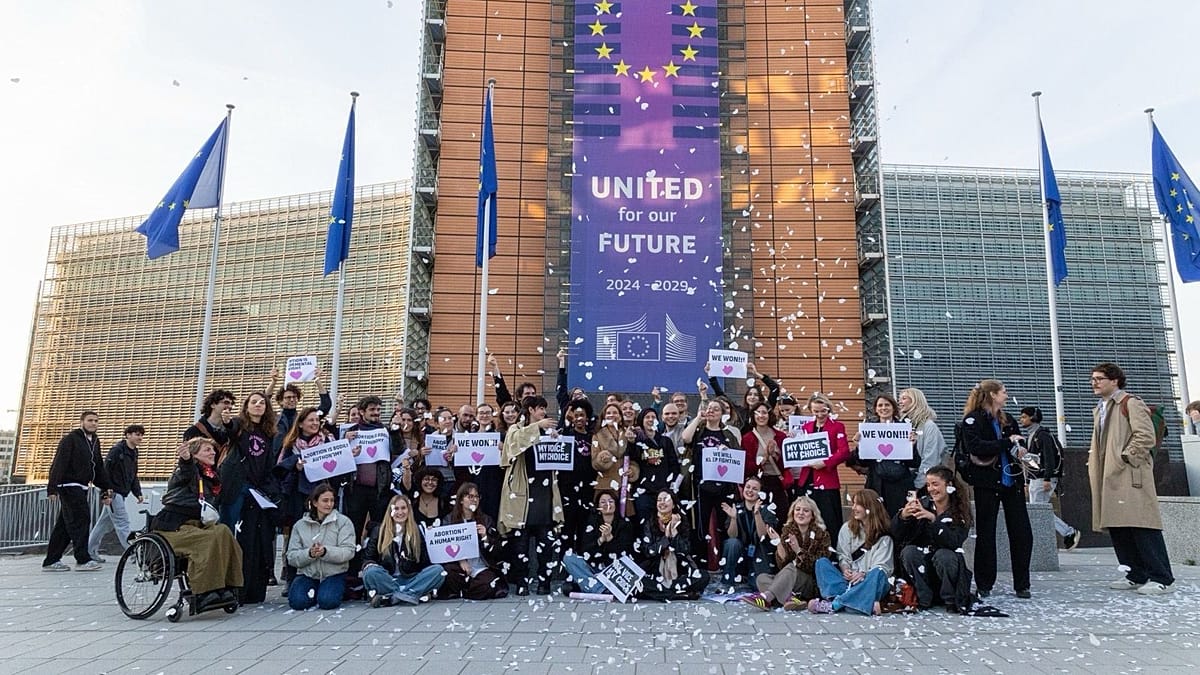
The European Commission said on Thursday that member states can use an EU social fund to provide access to safe and legal abortion for women who are barred from doing so in their home country.
ADVERTISEMENT


ADVERTISEMENT
The decision came in response to calls by the citizens’ initiative “My Voice, My Choice” for the creation of an EU solidarity mechanism to guarantee safe and affordable access to abortion for all women.
Member states can make use of the bloc’s existing European Social Fund Plus (ESF+), which contributes to social, education, employment and healthcare policies, voluntarily and in accordance with their domestic laws to provide such support.
The existing fund will “support women who need to travel, support women in their own country, support women in remote areas, and support women without financial means,” EU Commissioner for Equality Hadja Lahbib said on Thursday.
The ESF+ has a €142.7 billion budget for the period 2021–2027, with funding allocated to countries determined by their population size.
However, the Commission stopped short of establishing a new funding mechanism, which was requested by the European Parliament in a non-binding resolution adopted in December.
“While no new legal instrument is being created, the Commission has formally acknowledged that the core objectives of our initiative can be achieved and outlined a concrete pathway to implement it in practice,” coordinator of the “My Voice, My Choice” initiative Nika Kovač said in a statement.
The role of citizens’ participation
“My Voice, My Choice” is a European Citizens’ Initiative (ECI), a mechanism that allows citizens to call on the European Commission to propose new legislation.
If an initiative gets the support of at least one million people across at least seven EU countries, it must be discussed by the European Parliament, while the European Commission has a timeframe to either set out legislative measures or provide justification for not doing so.
“My Voice, My Choice” raised 1,124,513 signatures across all 27 countries. As a result, the European Parliament approved a non-binding resolution asking to establish a financing mechanism to help women with no acess to safe abortions in their home country.
The proposal was backed by over 100 European Members of Parliament, who sent a letter to the Commission’s President Ursula von der Leyen, increasing pressure on the institution ahead of its decision.
“When 1.2 million citizens raise their voices, when the European Parliament sends a clear democratic signal, and when civil society mobilises across the borders, the European Commission cannot look away,” Kovač said at a press conference following the decision on Thursday.
In addition to attracting a large number of signatures, the initiative also sparked significant attention online.
“A strong online presence was really one of the crucial tools to this campaign, from collecting the signatures to applying pressure,” communications director for the campaign Nika Povz said. “Our online community was our strongest ally and our biggest weapon.”
Some EU countries have highly restrictive laws on abortion rights. A total ban is in force in Malta, where abortion is not allowed under any circumstances, while in Poland it is permitted only when conception follows sexual violence or when there is a risk to the woman’s health.
In January 2021, the Polish Constitutional Tribunal banned abortions in cases of fetal malformation, which until then had been the most frequent reason for terminating pregnancies in the country.
Other countries have more relaxed laws, but they lack legal protections that fully decriminalise abortion, wide service availability, national health coverage, or government-led information on the matter.
According to the European Abortion Policies Atlas 2025, several EU countries have taken steps to guarantee the right to safe abortions. France, for instance, made it a constitutional right, while Luxembourg and the Netherlands have removed mandatory waiting periods.
But other member states have recorded new restrictions, increased harassment of abortion providers, and the spread of disinformation on the topic.
Read the full article here