









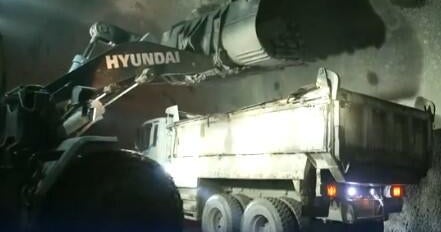
Sangdong mine, South Korea — Over the course of decades, China has come to dominate the rare earths and critical minerals industries, virtually cornering the market on raw materials that are essential to every aspect of modern life, from cellphones to armor piercing ammunition and AI missile guidance systems.
Beijing’s stranglehold on the production of these valuable metals and minerals has driven a hasty search by U.S. authorities to secure alternative supply options.
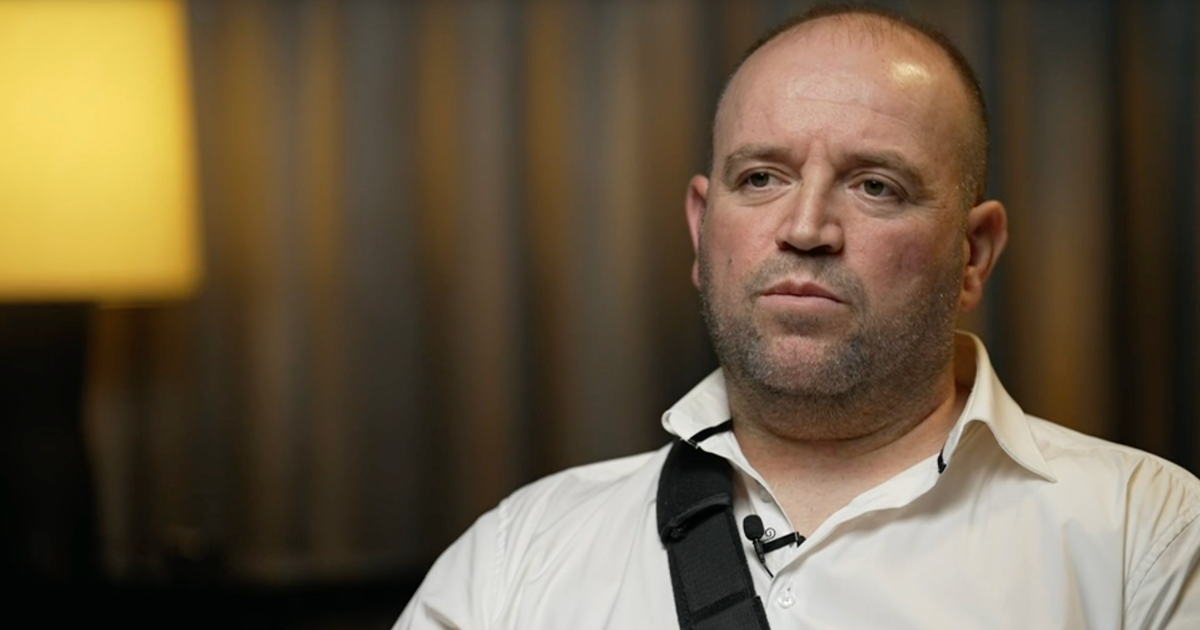
Lewis Black says his company is ready to help fill the void, at least when it comes to the supply of tungsten, a mineral he calls “vital” to U.S. defense needs.
Black, CEO of the Canadian mining company Almonty Industries, flew from New York to South Korea last week to give CBS News a tour of the mine he hopes will soon be producing enough tungsten to meet at least the most urgent of America’s needs.
CBS News
In the days before his flight to the Sangdong mine, Black met with U.S. officials, including at the White House, and he signed a deal guaranteeing that Almonty will, in the future, supply enough tungsten for U.S. security needs.
Black said he couldn’t discuss the details of the agreement with the U.S. government.
Tungsten’s superpower
The power of tungsten is rooted in the fact that it has the highest melting point of any element. While used in everyday items from electrical wiring to semiconductors and batteries, its applications in the defense industry make it truly indispensable.
“It’s vital. It’s further than critical, it’s vital,” Black told CBS News, standing in an enormous red building covered in corrugated steel sheeting that houses his processing plant in Sangdong.
As he spoke, machinery that breaks down the ore — the rocks embedded with tungsten — ground in a slow circular motion, undergoing tests in preparation for being fully commissioned later this year.
CBS News 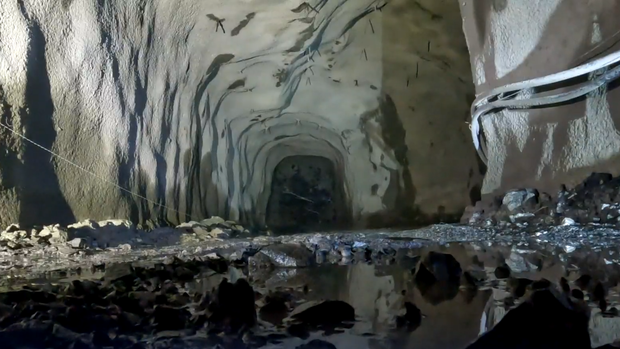

“It’s not just in the things you can see like munitions and armor,” Black said. “You want to build armored vehicles? All the engineering, all the AI chips, AI chips you can’t build without tungsten gas. You want to build a plane? The rockets, it’s in everything. It’s a vital component, a small one, but without it, you can’t do it.”
The Sangdong tungsten mine’s rise, fall and renaissance
Tungsten was first discovered in a rocky outcrop at the Sangdong site, about 115 miles southeast of Seoul, in 1906. A Japanese company started mining there about a decade later, and the tungsten extracted was later used for Japan’s war machine during the Second World War.
The end of that war brought an end to Japan’s occupation of the Korean Peninsula, and the Sangdong mine returned to Korean control. It would go on to have a profound effect on South Korea’s economy, at one point accounting for 30% of the nation’s GDP.
CBS News 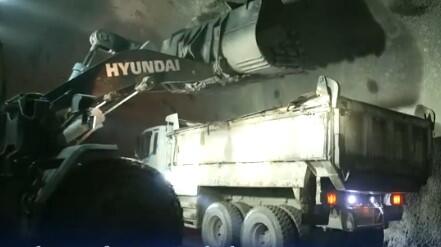

South Korean presidents visited the mine at least six times — it was a source of national pride. But in the 1990s, it fell victim to China’s price dumping policies and was mothballed.
For the ensuing three decades, the U.S., along with many other Western nations, benefited from the cheap, government subsidized materials being produced by China.
But that benefit became a reliance, and it left Washington exposed and vulnerable amid a tense trade war with China that’s seen Beijing impose export restrictions on some rare earths and other critical materials.
In response, there’s been a rush to establish alternative supply chains.
China controls at least 80% of the world’s current tungsten supplies, according to Almonty, with Russia and North Korea both holding a smaller but significant share of the assets.
Almonty Industries is in the process of relocating its headquarters to New York. It’s a clear indication that the U.S. government has become a very important part of Black’s business — his biggest customer, in fact.
Almonty took ownership of the Sandong mine in 2015.
Catching up with China is “going to be disruptive”
Almonty also has tungsten mines in Spain and Portugal, and it recently purchased one in Montana, specifically in the interest, Black said, of U.S. national security.
“With the U.S. government, that’s one of the reasons why we’ve taken a mine in the U.S. — bringing our technology to the country so that we can start to generate more human capital for the long term,” he said. “To me it feels good for the legacy of the company to fill a gap that has been left hugely exposed.”
Black said the mine in Montana won’t be operational for years, however, as Almonty still needs to secure permits and train personnel. It’s all analogous, he notes, to the overarching problem the U.S. and its Western partners have as they seek to untangle themselves from supply chain reliance on China; it’s going to take a long time.
“China dominates so many different sectors, whether it be rare earths, lithium, graphite, tin, lead, aluminum,” Black said, adding that over the last eight decades many such industries simply “fell out of favor in the West, and we abandoned raw materials.”
There are more recently discovered sources of some key materials, particularly in Africa, and the U.S. has sought to build business ties there — but Black says China has “covered most bases,” already securing investment in many African nations through its “Belt and Road” initiative.
He believes it will take at least a decade for the U.S. to completely diversify its supply chains, not least because of the need to train a workforce.
“We don’t have the people to run these mines,” Black told CBS News. “The U.S. and the West have some catching up to do.”
In the interim, he expects American industry to face some disruption.
“I bought this 10 years ago,” he said of the Sangdong facility. “Mines in democracies are a journey, and not for the faint hearted.”
Black expects “it’s going to be a really tough, miserable journey” as industries such as the American automotive sector work to wean themselves off cheap Chinese raw materials.
“You want to onshore all this production but you have no way of producing the components to supply this production. This has got to be done … It’s going to be disruptive, there are going to be times when some sectors are going to run out of components — that’s inevitable. In this particular instance, everyone is going to just suck it up and just power forward, because it’s the only way it can be done.”
A few months ago the U.S. Defense Logistics Agency put out a Request for Information (RFI) for tungsten — effectively an SOS call for the critical mineral, which surprised some in the industry as it effectively exposed the U.S. shortage.
“I think the U.S. government is saying, ‘all right, whatever we can find, we’d better stash it while we build this supply chain,'” said Black.
He expects the Sangdong to be operational by the first quarter of 2026, and once it is, it should be running 16 hours a day, with the associated processing plant operational 24 hours per day, producing an estimated 1.2 million tons of tungsten ore per year.