









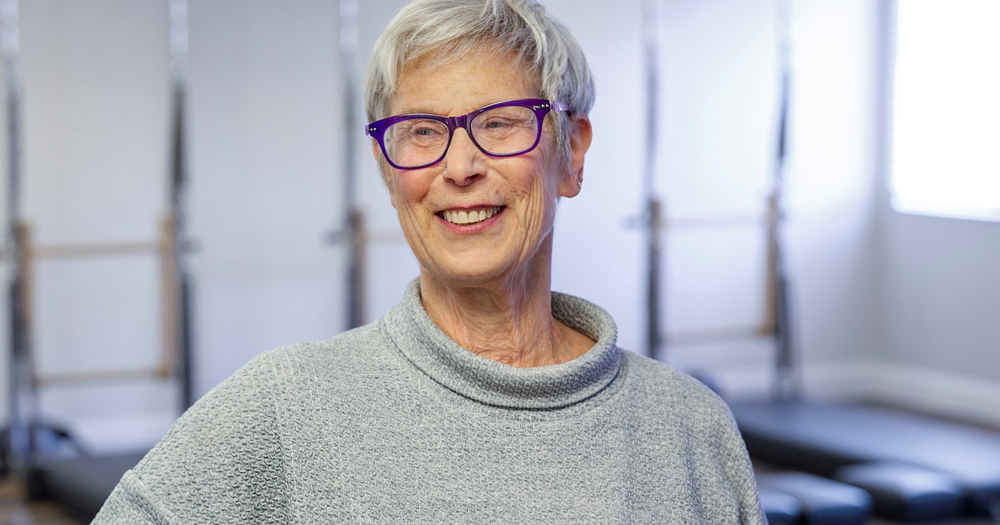
Debi Weiss was annoyed but not concerned when she started feeling weak and out of breath in January 2024. She thought it was a case of the flu.
As the weeks passed, the Pilates instructor’s symptoms worsened. Weiss could no longer walk her dog. She was exhausted all the time. Worst of all, she could barely breathe.
Finally, she saw her primary care provider in March 2024. A test suggested she might have an aggressive form of cancer called diffuse large B-cell lymphoma. Blood tests and a biopsy confirmed the diagnosis.
“It was a bit of a shock,” Weiss said. “It was very much an out-of-body experience.”
Weiss was familiar with the disease from coaching work she had done with the Leukemia and Lymphoma Society earlier in her career. She knew the road ahead would be arduous.
When Weiss started chemotherapy, things seemed to be going well. Her only side effect was fatigue. But one month after she finished chemotherapy, she began to have some neurologic issues, said Dr. Charles Farber, a hematologist-oncologist at Atlantic Health Morristown Medical Center. Imaging showed the lymphoma had recurred — and it was in her brain.
Weiss’ prognosis was “dismal,” Farber said — but there was a chance a personalized immunotherapy treatment could save her. Weiss said the news was “hard to handle,” but she again put her faith in her care team.
“I’m a bit naive,” Weiss told CBS News. “When I’m told something’s going to work, I believe it.”
Atlantic Health
Trying personalized immunotherapy
Large diffuse B-cell lymphoma is a form of blood cancer, and the most common subgroup of lymphomas, said Dr. Lorenzo Falchi, a lymphoma specialist at Memorial Sloan Kettering Cancer Center. There are about 25,000 cases each year in the United States. The disease tends to grow quickly and be difficult to diagnose, Felchi said.
When a patient is treated with chemotherapy, it’s like using “mostly indiscriminate poison” that doctors “hope kills more of the tumor cells” than healthy cells, Farber said. When cancer recurs shortly after chemotherapy, “giving more poisons” isn’t usually the answer, he said.
That’s where biological therapies like CAR-T come in. CAR-T is a form of immunotherapy that has been around for about a decade, according to Dr. Mohamad Cherry, the medical director of hematology at Atlantic Health. A person’s T-cells, a part of the immune system, are removed and genetically engineered to recognize and attack certain cancer cells, Cherry explained. The cells are then infused back into the body, “like a blood transfusion,” Cherry said.
Felchi said the infusion takes just 20 to 30 minutes. CAR-T can have some side effects, including neurotoxicity, Farber said, so patients are typically hospitalized for a week or two after the infusion.
In addition to lymphoma, CAR-T is most often used for leukemia and myeloma. Farber and Cherry said they are beginning to use it to treat autoimmune diseases, while other research is looking at its use for different types of cancer. Cherry said the potential applications are “endless.”
Weiss underwent the process in January 2025. Watching the engineered cells re-enter her body, she thought of a classic video game.
“One of the nurses on the floor drew pictures of Pac-Man on the white board across from my bed, because that’s what I felt like my cells were going to do,” Weiss said. “They were going to come into my body and Pac-Man themselves all the way around, and eat up all my cancer cells, and I’d be fine.”
Atlantic Health 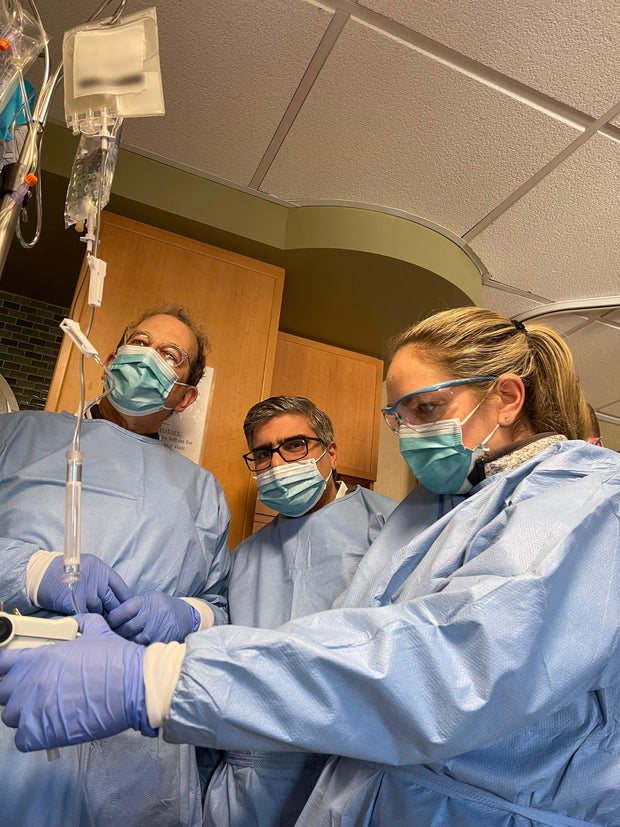

“Life is better than it was before”
Weiss responded well to the CAR-T. She had no side effects. When nurses asked her questions to confirm her neurological status, she always had the correct answers. She took walks around the hospital floor to keep her energy up. When she was released from the hospital, she easily transitioned back to daily life, taking her dog for walks in a park near her New Jersey home.
“I was very lucky, in a lot of ways,” Weiss said.
Weiss was closely monitored by Farber and Cherry for a year after completing CAR-T. Now, Weiss is “in complete remission” and has no evidence of disease, Cherry said. She will continue to undergo scans every four to six months to make sure her cancer has not returned, Farber said. If the lymphoma does not come back within three years, it likely never will, Farber said.
Debi Weiss 

Weiss said her life has returned to normal over the past few months. She is happy to be active again and working two part-time jobs she loves. At an art therapy group, she and other cancer survivors talk about their journeys. She and her husband are hoping to travel to Ireland soon for a trip they delayed due to her diagnosis.
Most importantly, Weiss said, the experience has given her a new perspective on life.
“Life is better than it was before in a lot of ways,” Weiss said. “Your priorities change. Before, I would work and I would not do things because I needed to work, I was scheduled, I needed to do (something else). Now, if my family needs me, I don’t work. I will be where my family is at any given moment. I don’t have time to spend with people that I really don’t want to spend time with. I’m honest enough with myself to say ‘No.’ It’s been good. It’s been a great year.”